 |
Jing-Well and Wood point
Child point of the Kidney channel
Entry point from Zhiyin Bl-67
Nine Points for Returning Yang (Second Trinity: Transition)
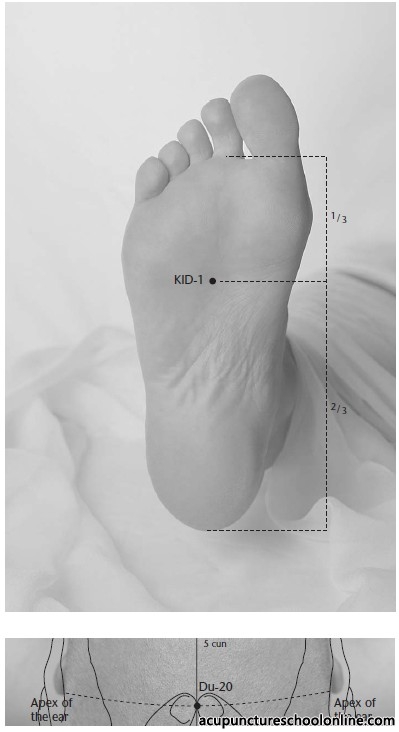
On the sole of the foot, between the second and third metatarsal bones, approximately one third of the distance between the base of the second toe and the heel, in a depression formed when the foot is plantar flexed.
Perpendicular insertion 0.5 - 1 cun
"The Shaoyin usually has little Blood and much Qi" (Su Wen 素問 ch. 24) implying this channel should normally be needled.
"The foot Shaoyin is to be pierced 2 fen deep and remain inserted for three exhalations" (Ling Shu 靈樞 ch. 12).
"It is needled to a depth of three fen, (the needle) is retained for a duration of three exhalations, and it is moxaed with three cones" (Huangfu Mi 皇甫謐, 3rd Century, Zhenjiu Jiayi Jing 針灸甲乙經).
Descends excess from the head
Calms the Shen
Revives consciousness and rescues Yang
Superficial Innervation: Medial plantar nerve from L4 - L5
Dermatome Segment: L5
Only used as a resuscitation point (Montaigue, Dim Mak Locations, Taijiworld.com).
Trigrams: Zhen (Thunder) below, Kan (Water) above.
Movement within, danger without — the impulse to act meets a perilous environment. This is the difficulty of birth, of any new beginning.
Nuclear Trigrams: Lines 2-3-4 form Kun (Earth). Lines 3-4-5 form Gen (Mountain). Beneath the difficulty, there is receptivity (Kun) and a need to stop and wait (Gen). The hidden message: do not force your way through. The ground will receive you if you are still.
Judgement:
元亨利貞。勿用有攸往。利建侯。
Supreme Opening. Burning is beneficial.
This point can reach the Yuan level, open the channel to remove obstructions, and tonify through moxa.
利建侯。
It is beneficial to appoint feudal lords.
Support this point with assistance from other points.
Overall: Something new is being born. The energy is real, but the environment is dangerous. Do not push to hard at the point but investigate others to gather support.
Lines:
| Line | Yin/Yang | Image | Literal Translation | Clinical Reading |
|---|---|---|---|---|
| 1 | Yang | 磐桓,利居貞,利建侯 | Firm foundations. Burning is beneficial for a dwelling. Favourable to establish feudal lords. | The yang at the bottom should provide a firm foundation, but it is obstructed. Moxa will be beneficial to help the yang grow and provide a solid foundation. Recruit other points to assist this. |
| 2 | Yin | 屯如郍如,乘馬班如。匪寇婚嫁,女子貸不字,十年乃字 | Difficult and halting; horses shy and stop. Not a robber, but a suitor. The girl is correct and does not consent; after ten years, she consents. | The point is reactive and acutely painful, causing one to stop direct treatment. However, this pain is not the enemy, but other points which can be partnered with this and treated until it softens. This is a common presentation in plantar fasciitis where the acute pain felt here can be better resolved with points around the calf or Achilles. |
| 3 | Yin | 即鹿無虞,維入于林中,君子幾不如舍,往吝 | Hunting deer without a forester; one enters the forest. The gentleman sees the danger and stops; going on brings regret. | The point reaches exhaustion and pursuing treatment at the point risks losing sight of the bigger problem, that the channel will soon be affected. The noble thing to do is recognise danger and stop. Forcing treatment here will bring regret. |
| 4 | Yin | 乘馬班如,求婚嫁,往吉,無不利 | Horses shy and stop. Seeking a marriage; proceeding is auspicious. Nothing is unfavourable. | Inaction has caused the channel to be affected. The point should be treated, but partnered with other points to ensure success. There is no disadvantage. |
| 5 | Yang | 屯其膏,小貞吉,大貞凶 | Difficulty in bestowing favours. A small burning is auspicious; a great burning is inauspicious. | The whole channel is affected, causing systemic blockage. Gentle moxa will be successful; aggressive moxa will be harmful. Do not overreach. Small, steady treatment is the way. |
| 6 | Yin | 乘馬班如,泣血漊如 | Horses shy and stop. Tears of blood flow. | Inaction has caused harm causing disruption of yin which can no longer hold fluids that begin to flow out. |
Image:
雲雷屯,君子以經絲。
Clouds and thunder: Zhun. Thus the gentleman brings order out of confusion.
The image is of a thunderstorm gathering — clouds above, thunder below. Chaos before rain. The gentleman does not panic. He weaves — he takes the tangled threads of the beginning and begins to organize them.
Acupuncture Point Connections:
Shared with Shugu Bl-65.
Inverted into ䷃ (Yinlingquan Sp-9 or Neiting St-44).
Opposed by ䷱ (Yinxi He-6 or Yanglao SI-6).
Hexagram attributions are my own with an explanation given in the glossary.
Translations are my own, assisted by DSeek and compared to Richard Rutt's interpretion (2002).
Important point in Taiji and Qigong for feeling the balance through the feet and where Yin is drawn upwards from the Earth, or Yang is drawn down towards. Zhuangzi, Book 6, The Great and Venerable Teacher, says: "The True Man breathes with his heels; the mass of men breathe with their throats (其息深深,真人之息以踵,眾人之息以喉)" (trans. Burton Watson).
In five element acupuncture this point is reduced to drain excess in the Kidney.
Ling Shu Ch. 19, on the Four Seasonal Qi, advises selecting the Jing-Well and Ying-Spring openings in winter, piercing deeply and retaining for a while. However, the character for "retain" 留 is a combination of 田 "a field," possibly referring to the idea of waiting for things to grow, and 卯 which is the 4th Earthly Branch (Mao, Rabbit, ䷡, 5-7 am, Large Intestine) and said to derive from a Shang Dynasty glyph, originally referring to a blood sacrifice (a person or animal cut in half) before coming to mean bloodletting and "pouring out" (Smith, 2011). This might suggest it was actually referring to bleeding these points, and maybe even letting the points bleed for a time rather than retaining the needle.
Ling Shu Ch. 20, On the Five Evils, advises piercing this point and Kunlun Bl-60, removing any stagnant blood from visible vessels for pathogens in the Kidneys causing aching bones and Yin-type Bi syndrome with numbness, swollen abdomen, difficult defecation, dizziness and aching of the lower back, neck, nape and shoulders. A near identical passage in the Su Wen Ch. 74, gives the same advice but only refers to the Kunlun Bl-60 point which might save a lot of unnecessary pain.
Ling Shu Ch. 22, On Mania and Madness, advises that when Wind invasion and counterflow causes the limbs to become swollen, profuse sweating, a feeling of cold and to be irritated when hungry, then blood is removed from the outer and inner sections of the hand Taiyin and foot Shaoyin and Yangming. If the flesh is cool then it is be done through the Ying-Spring points and if the bones are cold it is to be done through the Jing-Well and Jing-River points.
Ling Shu Ch. 23, On Heat Diseases, recommends this point with Yinlingquan Sp-9 and Lianquan Ren-23 to remove a Heat disease with tension and pain on both sides of the navel, and a feeling of fullness in the chest and flanks.
At the end of the chapter it suggests bleeding this point and then any full vessels around the instep if a man has a retraction of the genitals or a woman has her menses blocked, or if the lower back and spine feel as if detached with no desire to eat or drink.
Ling Shu Ch. 44, On the Qi Moving in Accordance with the Norms, indicates that the Jing-Well points should be pierced in winter or when the disease is in the Zang organs. The seasonal aspect should not be interpreted literally as it describes the nature of winter as the the time of storage and the Zang as "controlled by winter" (i.e. to be storage depots by nature). It also describes the morning, afternoon, evening and night cycle of the day to be like the four seasons of the year with night corresponding to winter.
Shang Han Lun, line 292, advises using seven cones of moxa on Shaoyin if the pulse fails to arrive normally in a Shaoyin pattern with symptoms of vomiting and diarrhoea, absence of counterflow but presence of heat effusion. No points are given but Ke Qin suggests this point and Fuliu Kid-7 while Zhang Nan suggests Taixi Kid-3 (Mitchell, Ye and Wiseman, 1999, Shang Han Lun).
----------------------------------------
Located 1 cun behind this point, at the centre of the sole is the extra point known as Zuxin 足心, "the heart of the foot." The Records of the Grand Historian: Biographies of Bian Que and Cang Gong states: "The mother of the King of Jibei said that her feet were hot and she was upset. I thought to myself: 'It's because of the heat.' So I pierced the sole of each foot three times. There was no bleeding, and the illness was cured soon." This indicates that this point is used for clearing Shaoyin Empty Heat, rising from the Kidneys and agitating the Heart.
The Zuxin 足心 point described above, located slightly proximal, in the middle of the sole, is also the end of the 4th trajectory of the Chong mai relating to structural aspects of the body via the Qiao (Yuen, 2005, The Extraordinary Vessels).
This point is also indicated in issues with the Second Level of Manifestation of the Soul, or Svadhishthana chakra manifesting in deficiency in ability to make subconscious associations, along with Jingming Bl-1 and Mingmen Du-4. They represent individuality, ability to see polarity, make separations and move into the world (Yuen, 2005, 3 Spirits & 7 Souls).
In Sufism this level would relate to the Valley of Love described by Attar in the Conference of the Birds as:
"Next the tempting valley of love displays itself
Whoever enters that field burns in the furnace;
A true lover stakes his cash and his head
For union with his beloved and his mate;
Others are content with another day's promise to wait
But the lover finds his beloved here ..."
Here the mystic is consumed with desire to be absorbed into the divine.
Like the other even (Yin) sets, the unifying theme is the mingling of Kidney Yang (Jingming Bl-1) with Kidney Yin (Yongquan Kid-1) in the Life Gate Fire (Mingmen Du-4), with the connection to the eyes and the Fire in the lower Dan Tian indicating desire. Alchemically it therefore represents the mingling of Water and Fire, Kan and Li. Desire to be united with the beloved also indicates a separation of lover and beloved and hence duality, but with the desire to have those opposites unite into one.
This is also one of the points in the 3 Treasures treatment along with Shanzhong Ren-17 and Baihui Du-20. The alchemist Ge Hong used moxa on these points for exorcism of ghosts ("Gui") with Yongquan Kid-1 especially indicated for nightmares of being subdued (ibid.).
The Nine Points for Returning Yang are used for assisting those close to death. They may be used to resuscitate collapse from deserted Yang, or if it is their time, to assist them in their passage. They are divided into three trinities, related to separation, transition and reunion.
This point belongs to the second trinity, related to transition, visionary experiences, the Hun dimension and loved ones. They open the orifices, astringe leakages, restrain Yin and anchor the Shen. Symptoms include:
- Connecting to another dimension, usually manifesting as visions of loved ones, ancestors or parental figures.
- May become relatively alert, energetic and strong in spirit, keen to talk about what they are seeing but less present in memory and talking about the past.
This point calms the Shen, stabilises the disposition, counters fear and assists with loss of memory. It also assists with the transition to the new world by being the spring of water and in shamanism water is required to travel to a new world. Just a baby is born in a sac of fluid, so water is required to propel us into the new heavenly dimension.
J. Yuen lectures on death/dying and the spirit of points, posted as Facebook comments, 19 Dec 2020.
Wang Liping (2019, Daoist Internal Mastery) describes an exercise of "sleep practice" (carried out in a lying position) to lower blood pressure utilising this point. After drawing in the spirit light through Yintang and allowing it to descend to the lower Dantian, visualise the breath drawing energy in through this point and rising to the lower Dantian and as you breathe out visualise it descending and exiting through this point.
In ancient times this point was connected via a direct meridian to Huiyin Ren-1, which was seen as the meeting point for all the Yin channels and "the Gate of Life and Death" (ibid: 214). This would suggest Kid-1 to be a potential alternative to Ren-1 when called for.
In Tung acupuncture the San Shen (55.07), Three Saints, points are located 1, 2 and 3 cun posterior to this point. It is indicated for hypertension, especially diastolic and cerebral haemorrhage or thrombosis (eLotus, 2022).
In Maoshan Daoism the character for Jing 井 is used to trap disease, ghosts and demons. It is drawn in the air invoking the "three mountains" mudra (index, middle and ring finger extended) with the bent line continuing in a circle (usually clockwise), or with ash and sprayed on with water held in the mouth, and sometimes on talismans (Read, 2020, FB Post, 1 Sep 2020). This may explain why the Jing-Well points are so often used to expel pathogens.
In Tibetan medicine this is one of the "Six Wind Points" which can be stimulated with warmth from oils, hands, compresses or hot stones to treat disorders of Wind, seen in Tibetan medicine as problems of anxiety, insomnia, nervousness, mood swings, irritability, stiffness, memory loss, and trembling as well as discomfort and pain in the lower back, hips and joints. The other Wind Points are Baihui Du-20, Dazhui Du-14, Tiantu Ren-22, Shanzhong Ren-17, Laogong Pc-8 and Yongquan Kid-1 (Tibet House US, https://tibethouse.us/stress-tibetan-medicine/, Accessed 18th May 2019).
In ayurvedic medicine:
Talahridya marma point
Size: 1/2 angula (cun)
Structure: Muscular
Effect of Injury: Early death (sadhyapranahar marma)
(Harish Johari, 1996, Ayurvedic Massage, Sanatan Society; Anupama Bhattacharya, n.d. Marma Shastra)
Lad and Durve (2008) in Marma Points of Ayurveda call this point Pada Madhya and associate it with the doshas: Prana Vayu, Vyana Vayu and Pachaka Pitta.
They give the following functions:
- Benefits the feet and lower extremities
- Relieves pain locally
- Relieves headaches
- Maintains equilibrium
- Calms the mind and relieves stress
In Thai massage:
Acupressure point indicated for headache, heart conditions, hypertension respiratory ailments and stress (Salguero & Roylance, 2011, Encyclopedia of Thai Massage).
Basic information on location, needle depth, TCM actions, indications and combinations is taken from Deadman et al (2001): A Manual of Acupuncture with additional anatomical information researched by reference to Gray's Anatomy (38th Ed., 1995) unless otherwise referenced. Images were found on acupunctureschoolonline.com and can be traced back to Claudia Focks (2008) Atlas of Acupuncture originally. I cannot claim any credit or rights over them. Other sources should be quoted in the text.
For some of the more unusual terms I have created a glossary here
Woodley Bioenergetics
90 Deane Croft Road,
Eascote, Pinner, Greater London. HA5 1SP
Tel/WhatsApp: +44 (0) 7946 174 829
Email: steve@steve-woodley.co.uk