 |
Location Guides: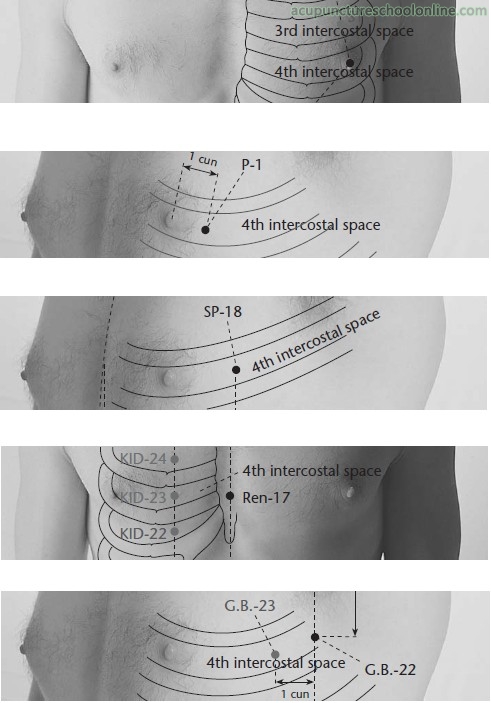 |
Front Mu of the Pericardium
Hui-Meeting point of the Qi
Point of the Sea of Qi
Binding point of the hand Jueyin Sinews
Trigger point (Travell & Simons, 1998, Trigger Point Manual; Melzack, Stillwell & Fox, 1977)
Meeting of Conception Vessel with Spleen, Kidney, Small Intestine, San Jiao, Bladder Divergent, Stomach Divergent, Spleen Divergent, Small Intestine Divergent, Heart Divergent, San Jiao Divergent and Pericardium Divergent
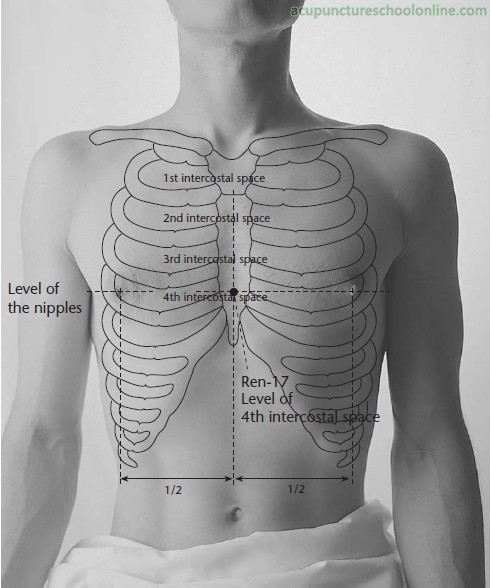
On the midline of the sternum, in a depression level with the junction of the fourth intercostal space and the sternum.
Transverse insertion directed superiorly or inferiorly along the channel 0.5 - 1 cun, or transverse insertion directed laterally towards the breasts 1 - 1.5 cun for breast disorders.
According to several classical texts this point is contraindicated to needling.
"Locate it with the" (patient) lying supine. It is needled to a depth of three fen and is moxaed with five cones" (Huangfu Mi 皇甫謐, 3rd Century, Zhenjiu Jiayi Jing 針灸甲乙經).
Regulates Qi and unbinds the chest
Descends rebellion of the Lung and Stomach
Benefits gathering Qi
Benefits the breasts and promotes lactation
Regulates the Upper Jiao (Nan Jing 31)
Superficial Innervation: Anterior cutaneous thoracic nerve from T6
Dermatome Segment: T5
Muscle:
Sternalis
Location Notes:
Travell & Simons (1998) actually locate this either side of Renzhong ren-17
Pain Referral Pattern:
Over the sternum and across the top of the chest inferior to the clavicle, to the shoulders and radiating down the medial aspect of the upper arms
Indications:
Chest pain
; Shoulder and arm pain
Striking this point traditionally drains Qi from the "seat of power", or the diaphragm. Striking downwards causes knock out or death from loss of power. As the Front Mu of the Pericardium, attacking it also attacks the Heart, and as meeting point of Shaoyin it destroys the relationship between Fire and Water. As a "Sea of Qi" and Hui Meeting point of Qi, it disrupts the Qi of the entire system.
It is especially dangerous in those under the age of 25 as the sternum cartilage has not yet hardened and can be broken easily (Montaigue, Dim Mak Locations, Taijiworld.com).
䷭ Sheng 升 Ascending & ䷋ Pi 否 Stalemate
Trigrams: Kun (Earth) below, Qian (Heaven) above.
Earth within, Heaven without — the heavy sinks further down and the light rises further up, so they move apart. This is the separation of yin and yang, the moment of standstill.
Nuclear Trigrams: Lines 2-3-4 form Gen (Mountain). Lines 3-4-5 form Xun (Wind). Beneath the standstill, there is stillness (Gen) and gentle penetration (Xun). The hidden message: the standstill is not permanent. There is a mountain that blocks, but also a wind that can eventually wear it down.
Judgement:
否:否之匪人,不利君子貞,大往小來。
Standstill. The standstill is not the way of man. It is not favourable for the gentleman to persevere. The great departs. The small arrives.
Standstill is the moment when Heaven and Earth separate. The great departs, the small arrives. This is not a time for the gentleman to act. It is a time for withdrawal, for preservation, for waiting for the cycle to turn.
Lines:
| Line | Yin/Yang | Image | Literal Translation | Commentary |
|---|---|---|---|---|
| 1 | Yin | 拔茅茹,以其彙,貞吉亨 | Pulling up the reed grass, connected by its roots. Perseverance brings Gain and Success. | Yin at the bottom. The beginning of standstill. The yin lines are drawn downward together. But perseverance brings Gain and Success — the gentleman withdraws with his group. The withdrawal is not defeat; it is preservation. |
| 2 | Yin | 包承,小人吉,大人否亨 | Embracing and bearing. The small man brings Gain. The great man brings standstill and Success. | Yin at 2, central and correct. The small man flourishes in a time of standstill because he is in his element. The great man withdraws and finds success in his integrity. Gain and Success are different for each. |
| 3 | Yin | 包羞 | Embracing shame. | The threshold. The yin is at the point of transition. It is about to be left behind by the rising yang. It embraces shame — it knows it is in the wrong place. |
| 4 | Yang | 有命無咎,疇離祉 | There is a command. No trouble. The companions share the blessing. | Yang at 4. The first yang line. The standstill is beginning to turn. The yang lines are rising, drawn by the command from above. The companions share in the blessing. No trouble because the turning is natural. |
| 5 | Yang | 休否,大人吉。其亡其亡,繫于苞桑 | Resting in standstill. The great man brings Gain. "It is perishing, it is perishing!" — tied to a bundle of mulberry shoots. | Yang at 5, central and correct. The great man rests in the standstill but does not forget the danger. He cries "It is perishing!" — he is vigilant. He ties himself to a bundle of mulberry shoots — he holds fast to what is firm. Gain because the vigilance preserves. |
| 6 | Yang | 傾否,先否後喜 | Overturning the standstill. First standstill, then joy. | Yang at the top. The standstill is overturned. The cycle is turning. First there was standstill, now there is joy. The joy is the natural response to the turning of the cycle. |
Image:
天地不交,否。君子以儉德辟難,不可榮以祿。
Heaven and Earth do not unite: Pi. Thus the gentleman restrains his virtue and avoids difficulty. He cannot be honoured with salary.
The image is of Heaven and Earth separated — the creative and the receptive out of harmony. The gentleman restrains his virtue (儉德, jian de) and avoids difficulty (辟難, bi nan). He does not seek reward or recognition. He cannot be honoured with salary because the time does not support virtue. He withdraws, preserves his integrity, and waits.
Acupuncture Point Connections:
This point is unusual in that no other point in the standard sequence shares this hexagram. Its complementary opposite is ䷊ which is attributed to the Luo of the Ren Mai, Jiuwei Ren-15. A connection between these two points is referred to as the Bao Mai, Uterus Vessel, described in Su Wen ch. 47 (see note below).
Among the standard sequence, this hexagram is shared with Changqiang Du-1, the Luo point of Du Mai, and opposed by Jiuwei Ren-15.
Hexagram attributions are my own with an explanation given in the glossary.
Translations are my own, assisted by DSeek and compared to Richard Rutt's interpretion (2002).
The character 膻 is only really used in the name of this point but derives from an ancient character that means "a rank odour, or sheepy smell" and most likely referred to the ancient altars upon which incense and sacrifices would be made. Hence in the landscape of the body, this point the central altar where the Shen-Spirit of man resides.
Possible location of the middle dan tian or Yellow Court (huangting) in alchemical practice, at the level of the heart, or where heaven (upper dan tian) and earth (lower dan tian) meet. See also Juque Ren-14.
In Neidan this point can be pressed downwards when if emotions come to the fore during meditation practice. This is especially useful for women and is called the "mother of metal" technique. The effect is to send them down to the Big Cauldron (the uterus) in the lower Dan Tian where they become more powerful (Wang, 2018, Daoist Internal Mastery, p.46).
The Illustration of Time in the Principles of the Innate Disposition and the Lifespan (Xingming Guizhi, 性命圭旨) describes the movement of prenantal Qi through the microcosmic orbit in terms of the I Ching Hexagrams and the twelve Earthly Branches. It says that:
The prenatal Qi of human beings follows the course of the day:
during the Zi (11 pm - 1 am), the Fu (Turning Back, ䷗) Qi arrives at Caudal Defile (GV 1);
during the Chou (1-3 am), the Lin (Approaching, ䷒) Qi arrives at Kidney Hall [maybe GV 4];
during the Yin (3-5 am), the Tai (Advance, ䷊) Qi arrives at the Mystic Pivot [maybe GV 5 based on name, or GV 7 based on location];
during the Mao (5-7 am), the Dazhuang (Great Strength, ䷡) Qi arrives at the Spinal Handle [possibly GV 10 or GV 11];
during the Chen (7-9 am), the Guai (Eliminating, ䷪) Qi arrives at the Kiln Path (GV 13);
during the Si (9-11 am), the Qian (Initiating, ䷀) Qi arrives at the Jade Pillow (Bl 9 [or GV 17]);
during the Wu (11 am -1 pm), the Gou (Encountering, ䷫) Qi arrives at the Mud Pill (GV 20);
during the Wei (1-3 pm), the Dun (Retreating, ䷠) Qi arrives at Hall of Brilliance (GV 23);
during the Shen (3-5 pm), the Pi (Hindrance, ䷋) Qi arrives at the Centre of the Chest (CV 17);
during the You (5-7 pm), the Guan (Watching, ䷓) Qi arrives at the Central Venter (CV 12);
during the Xu (7-9 pm), the Bo (Falling Away, ䷖) Qi arrives at Spirit Gate (CV 8);
during the Hai (9-11 pm), the Kun (Responding, ䷁) Qi returns to the Sea of Qi (CV 6).
(translated in Liu Lihong, 2019, Classical Chinese Medicine).
Based on some considerations of the hexagram associations given here, the attributions of ䷁ and ䷀ to Huiyin Ren-1 and Baihui Du-20, and a desire to make ䷊ and ䷋ oppose one another at the centre of the body, it would seem that these attributions are where the Qi of a particular hexagram start, and finish at the start of the next, similar to how an hour continues until the next begins. Hence ䷋ governs the region between Shanzhong Ren-17 and Zhongwan Ren-12.
Therapeutically, it would make sense that these points are associated with certain aspects of pre-natal Qi and its relation to the associated Zangfu of its Earthly Branch.
The hexagram associated with this point represents the obstruction of Yang as Yin takes equal control and is associated with the Earthly Branch of Shen, 3 - 5 pm, and the Bladder.
Based on the Hexagram attributions of the Antique Points, this would correspond to Changqiang Du-1 which shares the Hexagram Pi (Hindrance, ䷋). This connection with the Luo of the Du Mai connects it to the Uterus Vessel, the Bao Mai, which is of utmost importance in Neidan practice for the formation of the Spiritual Embryo. It also connects it to the hour of the Bladder which follows a similar trajectory to the Du Luo, along the sides of the spine and is the lowest of the Fu, located near Huiyin Ren-1 and Qugu Ren-2. This hexagram specifically implies the separation of Yin and Yang due to the Yang rising and the Yin sinking, whereas ䷋, associated with Lingtai Du-10 or Shendao Du-11 and Jiuwei Ren-15 is associated with their active recombination.
This places Water in the west and may have some bearing on the alchemical practice of extracting Mercury (True Yin) from Cinnabar (Fire), as a reference to returning to the prenatal cycle. This is further suggested by the fact that this hexagram is exactly equivalent in its composition to Lesser Yang (⚎.
This point treats disorders of the Upper Burner in a San Jiao treatment (Wang & Robertson, 2008, Applied Channel Theory).
This point is also indicated for issues relating to the Third Level of Manifestation of the Soul, or the Manipura chakra, manifesting in difficulties switching the mind off, becoming unconscious and sleeping. The problem is that the Lung qi is unable to descend into the formless darkness of the Kidneys or the Kidneys are unable to hold it here.
The specific purpose of this point is clear obstruction in the chest preventing the mind's descent. The others in the set are Shuaigu GB-8, Daling Pc-7 and Jimai Liv-12 or Ququan Liv-8 (Yuen, 2005, 3 Spirits & 7 Souls).
All the points in this set have an association with Jueyin with a focus on the Pericardium and therefore the descent of Fire.
In Sufism this level would relate to the Valley of Knowledge described by Attar in the Conference of the Birds as:
"No one can find a fixed road in this place
Because there are many roads and different destinations;
And since many paths the wanderer sees
Each rise as his wisdom guides or foresees;
Each person marches till he attain his own perfection
Yet moods dictate friendship and one's action ..."
Here there are many paths all leading to knowledge of the Divine, which comes from the Heart and its willingness to sink into formlessness, rather than intellectual knowledge of worldly forms, which are revealed to be utterly useless.
This is also one of the points in the 3 Treasures treatment along with Baihui Du-20 and Yongquan Kid-1.
The alchemist Ge Hong used moxa on these points for exorcism of ghosts ("Gui") (ibid.).
When using the Bladder or Small Intestine Divergent meridians to expel a pathogen a band around the chest at this point, including Shendao Du-11, Xinshu Bl-15 and Shentang Bl-44, should be treated with Gua Sha before commencing needling (Cecil-Sterman, 2012, Advanced Acupuncture).
The alchemical text Zhouyi Cantong Qi (周易參同契 attributed to Wei Boyang, 2nd century CE) represents the lunar cycle in sequence of 6 groups of 5 days governed by the waxing and waning trigrams. These correspond to a rotating cycle of the Early Heaven sequence, with Kan in the west and Li in the east governing the whole Yin and Yang parts of the cycle respectively.
These attributions can be mapped onto the body with the inner trigram representing the Early Heaven trigram that rules the period of 5 days and the outer trigram being its Late Heaven pair, corresponding to the Channel that governs that period. This results in a sequence that has relevance to the menstrual cycle which also corresponds to the moon.
䷭ Xun within Kun : Days 1-5 : Shimen Ren-5 or Danzhong Ren-17
Front Mu of the San Jiao and Pericaridum. Shimen Ren-5 lies between Qihai Ren-6 and Guanyuan Ren-4 which nourish the Qi and Blood of the uterus respectively, so the point between them communicates between both of these, while the San Jiao has strong connections to Yin. Danzhong Ren-17 is the Hui of Qi and Sea of Qi point, also assisting to gathers Chest Qi that is used to make Blood.
䷠ Gen within Qian : Days 6-10 : Pishu Bl-20
Back Shu of the Spleen. Raises and holds the Blood by strengthening the Spleen, completing the endometrial lining and holding it in place.
䷇ Kun within Kan: Days 11-15 : Taixi Kid-3
Yuan-Source of Kidney, Kidneys govern fertility and this point in particular tonifies Kidney Yang as well as Yin, initiating the return of Yang from within Yin, representing ovulation and the start of the Yang part of the cycle.
䷚ Zhen within Gen: Days 16-20 : Yinbai Sp-1
Return of Yang. This point has many indications for stopping bleeding, especially uterine bleeding which would indicate a disorder of Yang failing to uphold the Blood. It is also a Ghost Point so has an influence on the Shen.
䷼ Dui within Xun: Days 21-25 : Jianshi Pc-5
Strong regulator of the Shen and menstruation for the pre-menstrual phase.
䷍ Qian within Li: Days 26-30 : Tongli He-5
Luo of the Heart, a strong invigorating Blood point to govern the days of the period.
One notable pattern that emerges is that the points which govern the 5 day periods corresponding to the ordinal directions only involve the Spleen and Pericardium, which are the channels that were chosen to open the Chong Mai and Yin Wei Mai. The cardinal directions of north and south are governed by the Heart and Kidneys that make up the Shaoyin Axis.
Another pattern is that the Yin part of the cycle draws upon the Ren, Du and Kidneys that connect to the Jing, while the Yang half of the cycle comprises of points that affect the Shen. This connects them to the principle of the Curious Organs, where Jing and Shen combine, and includes the uterus.
The two directions that are not part of the waxing and waning trigrams are Kan and Li. These govern the 15 day Yin and Yang halves of the cycle as a whole and correspond to:
䷮ Kan within Dui: Days 1-15 : Chize Lu-5
Water point of Taiyin, which is a term for the moon, thus representing the moon's influence on the tides and its corresponding influence on Yin aspects of the body.
䷶ Li within Zhen: Days 16-30 : Xingjian Liv-2
Fire point of Jueyin, reverting Yin, representing the return of Yang. Clinically this point clears Liver Fire, spread Liver Qi and stops bleeding due to Heat and so is appropriate for any number of issues stemming from overactive Yang in this half of the cycle.
Medieval phlebotomy point (John de Foxton, 1408: Liber Cosmographiae, maa.cam.ac.uk)
In Tibetan medicine:
May be treated with burnt cones of edelweiss flowers (Trah-wah) on crushed garlic for mental conditions (Bradley, 2000: Principles of Tibetan Medicine).
This point is also one of the "Six Wind Points" which can be stimulated with warmth from oils, hands, compresses or hot stones to treat disorders of Wind, seen in Tibetan medicine as problems of anxiety, insomnia, nervousness, mood swings, irritability, stiffness, memory loss, and trembling as well as discomfort and pain in the lower back, hips and joints. The other Wind Points are Baihui Du-20, Dazhui Du-14, Tiantu Ren-22, Laogong Pc-8 and Yongquan Kid-1 (Tibet House US, https://tibethouse.us/stress-tibetan-medicine/, Accessed 18th May 2019).
The Front Mu points make likely locations for application of leeches to reduce fevers according to François Broussais' (1772–1838) philosophy who believed in placing them over the diseased organs to reduce inflammation (Greenstone, 2010, The history of bloodletting, BCMJ, Vol. 52, No. 1, Pp 12-14).
In the Vedic tradition the Anahata Chakra would be located between this point and Shendao Du-11.
In Ayurvedic and Siddha medicine:
This is a marmmam vital spot in Indian martial arts and medicine (Ayurvedic and Siddha) known as Trisangupuspam, "three conch flower" and is popular in Malayalam cinema. Striking it causes "the eyes to pop out, while the victim, screaming unknowingly, spits blood (in Sieler, R. 2012, Lethal Spots, Vital Secrets, p.41).
In the Qabalah this point would be the location of Tiphareth, Harmony (Farrow, 2007, The Psychology of the Body).
Basic information on location, needle depth, TCM actions, indications and combinations is taken from Deadman et al (2001): A Manual of Acupuncture with additional anatomical information researched by reference to Gray's Anatomy (38th Ed., 1995) unless otherwise referenced. Images were found on acupunctureschoolonline.com and can be traced back to Claudia Focks (2008) Atlas of Acupuncture originally. I cannot claim any credit or rights over them. Other sources should be quoted in the text.
For some of the more unusual terms I have created a glossary here
Woodley Bioenergetics
90 Deane Croft Road,
Eascote, Pinner, Greater London. HA5 1SP
Tel/WhatsApp: +44 (0) 7946 174 829
Email: steve@steve-woodley.co.uk