 |
Ying-Spring and Fire point
Father point of the Lung channel
Binding point of the hand Taiyin Sinews
Trigger point (Travell & Simons, 1998, Trigger Point Manual)
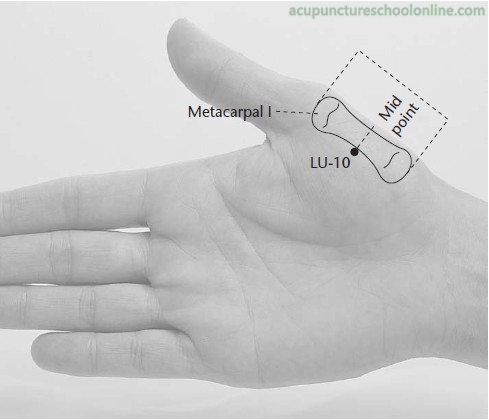
On the thenar eminence of the hand, in a depression between the midpoint of the shaft of the first metacarpal bone and the thenar muscles
Perpendicular insertion 0.5 - 1 cun
"The Taiyin usually has much Qi and little Blood" (Su Wen 素問 ch. 24) implying this channel should normally be needled.
"The hand Yin and Yang receive their Qi via nearby paths so their Qi arrive swiftly. The depth of piercing must not exceed 2 fen and must not remain inserted for longer than one exhalation" (Ling Shu 靈樞 ch. 12).
"It is needled to a depth of twofen, and (the needle) is retained for a duration of three exhalations. It is moxaed with three cones" (Huangfu Mi 皇甫謐, 3rd Century, Zhenjiu Jiayi Jing 針灸甲乙經).
Benefits the throat
Clears Lung Heat
Descends rebellious Qi
Harmonises the Stomach and Heart
Superficial Innervation: Superficial branch of radial nerve from C7, C8
Dermatome Segment: C6
Muscle:
Opponens pollicis
Pain Referral Pattern:
Palmar surface of radial wrist and thumb
Indications:
Pain and trouble with fine manipulations (writing, buttoning clothing, sewing, painting, etc)
As a Fire and Ying-Spring point, if struck very hard, it will cause heat to rise in the lungs causing coughing but is not a realistic point to use (Montaigue, Dim Mak Locations, Taijiworld.com).
䷰ Ge 革 Revolution, reform, skinning
Shared with Yangxi LI-5. Balanced by ䷱ (Neiting St-44 or Yanglingquan Sp-9).
Hexagram attributions are my own with an explanation given in the glossary.
Translations are my own, assisted by DSeek and compared to Richard Rutt's interpretion (2002).
Along with Shaoshang Lu-11 this is the main point for sore throats.
In five element acupuncture, as father point of the Lung channel this can control excesses in the Lung.
Ling Shu Ch. 6 suggests piercing the Ying points (and Shu points according to Unschuld, 2016, but not according to Wu & Wu, 201) of the Yin channels if a disease is in the Yin of the Yin realm (e.g. the Zang organs) suggesting this point (and Taiyuan Lu-9) in diseases of the Lung.
Ling Shu Ch. 9, On Ends and Beginnings, advises that in the case of Heat associated with receding Yin Qi the Yang conduit should be pierced once and the Yin conduits twice. Based on other recommendation to use the He-Sea of the Yang conduits (Ch. 19) and the Yuan-Source with the Ying-Spring points (Chs. 6, 19 and 24) to clear Heat from the Zangfu, that would suggest this point, Quchi LI-11 and Taiyuan Lu-9 as a protocol to clear Heat in the Lung/Large Intestine. Next it advises that in Cold associated with receding Yang Qi the Yang should be pierced twice and the Yin once but no such obvious protocol is evident for this situation. Another interpretation that would match with common practice today, based on the idea of odd numbers being Yang/moving/clearing while even numbers are Yin/tonifying/reinforcing, is that the points on the channel to be cleared are pierced on one side only while those on the channel to be tonified are pierced bilaterally.
Ling Shu Ch. 10, On Channels, describes how the veins on the thenar eminence around this point can be used to diagnose the Stomach. If Cold they turn green-blue, if Hot they turn red. If they suddenly turn black, it indicates a chronic obstruction.
Ling Shu Ch. 19, on the Four Seasonal Qi, advises selecting the Jing-Well and Ying-Spring openings in winter, piercing deeply and retaining for a while. However, the character for "retain" 留 is a combination of 田 "a field," possibly referring to the idea of waiting for things to grow, and 卯 which is the 4th Earthly Branch (Mao, Rabbit, ䷡, 5-7 am, Large Intestine) and said to derive from a Shang Dynasty glyph, originally referring to a blood sacrifice (a person or animal cut in half) before coming to mean bloodletting and "pouring out" (Smith, 2011). This might suggest it was actually referring to bleeding these points, and maybe even letting the points bleed for a time rather than retaining the needle.
Ling Shu Ch. 22, On Mania and Madness, advises that when Wind invasion and counterflow causes the limbs to become swollen, profuse sweating, a feeling of cold and to be irritated when hungry, then blood is removed from the outer and inner sections of the hand Taiyin and foot Shaoyin and Yangming. If the flesh is cool then it is be done through the Ying-Spring points and if the bones are cold it is to be done through the Jing-Well and Jing-River points.
Ling Shu Ch. 34, On the Five Disturbances, advises this point and Taixi Kid-3 to remove disturbing Qi in the Lung causing a raising and lowering of the head, panting, shouting and pressing their chest with their hands to breathe.
Ling Shu Ch. 44, On the Qi Moving in Accordance with the Norms, indicates that the Ying-Spring points should be pierced in spring or when the disease is associated with a change in complexion. The seasonal aspect should not be interpreted literally as it describes the colours as "controlled by spring". It also describes the morning, afternoon, evening and night cycle of the day to be like the four seasons of the year with morning corresponding to spring.
In Tung acupuncture two points are located close to this on the palm below the thumb. The first Chong Zi, Double Son, is located 1 cun lateral and distal below the web of the first and second metacarpals, opposite Hegu LI-4. The second is located on the palmar aspect of the hand, at the junction of the first and second metacarpals. They are usually combined as a pair for the treatment of upper back, chest and respiratory problems (Chu, 2015).
According to Jeffrey Yuen (2005, 3 Spirits & 7 Souls) this point, as the fire (Heart) point of the Lung channel was bled, along with Xuehai Sp-10, by daoist adepts to explore the "Ring of Death" between the Third and Fourth Levels of Manifestation of the Soul where near death experiences happen. The most common reaction would be to induce hyperventilation and a sense of dying.
If used in comatose patients it is believed to give them a choice to wake up or move on.
A more applicable use in general practice may be to gently stimulate these points with essential oils to assist someone explore their relationship with life after death.
Yuen says little more on the subject but my own contemplation on these points has found several ways they may be used in meditation or therapy on issues relating to death:
- Both Lung and Spleen are the Yin meridians relating to our survival needs: air and food. Bleeding is considered a strong reduction technique implying they are aiming to quieten their survival instincts.
- The Lung meridian relates to our connection with life, affected by grief, the loss of things we are connected to. The use of the Fire point, being its reducing five phase point (Fire controls Metal), may suggest a reduction of our attachments to life. Meanwhile Xuehai Sp-10 is the main point for moving Blood Stagnation, thus suggesting freeing emotions that have become stuck and helping us to move forward.
- There is also considerable imagery in the names for visualisation: 魚際 Yuji (Fish Border) and 血海 Xuehai (Sea of Blood). The sea is the deep unknown and blood the stuff of life while the fish can swim below the surface. With this imagery we can cross the border and travel into the deeper issues of life.
- In another image the character 際 Ji for "Border" contains the character 祭, making offering at a ceremonial altar, while 血 Xue for "Blood" is derived from a container so a suggestion of blood sacrifice might also be implied.
Thus this two point combination is relevant on several levels for meditating on one's relationship to death and the impermanence of life.
Lad and Durve (2008) in Marma Points of Ayurveda call this point Kurcha and associate it with the doshas: Apana Vayu, Prana Vayu, Sadhaka Pitta and Avalambaka Kapha.
They give the following functions:
- Benefits the hand and fingers
- Reduces stress
- Enhances the flow of prana and benefits the lungs
- Enhances the immune response
- Influences the reproductive organs
In Tibetan medicine:
Bleeding point (AMNH, Tibetan Medical Paintings)
In Thai massage:
Acupressure point indicated for asthma, breathing difficulties, cough and lung conditions (Salguero & Roylance, 2011, Encyclopedia of Thai Massage)
Basic information on location, needle depth, TCM actions, indications and combinations is taken from Deadman et al (2001): A Manual of Acupuncture with additional anatomical information researched by reference to Gray's Anatomy (38th Ed., 1995) unless otherwise referenced. Images were found on acupunctureschoolonline.com and can be traced back to Claudia Focks (2008) Atlas of Acupuncture originally. I cannot claim any credit or rights over them. Other sources should be quoted in the text.
For some of the more unusual terms I have created a glossary here
Woodley Bioenergetics
90 Deane Croft Road,
Eascote, Pinner, Greater London. HA5 1SP
Tel/WhatsApp: +44 (0) 7946 174 829
Email: steve@steve-woodley.co.uk