 |
Location Guides: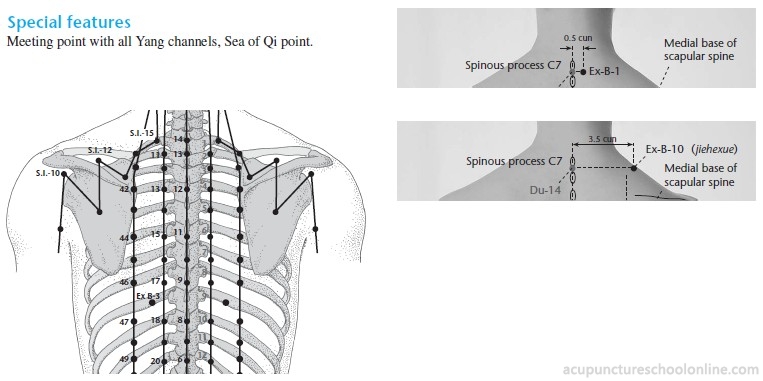 |
Meeting of Governing Vessel with Bladder, Gall Bladder, Large Intestine, Small Intestine, Stomach, San Jiao, Bladder Divergent, Kidney Divergent and Large Intestine Divergent
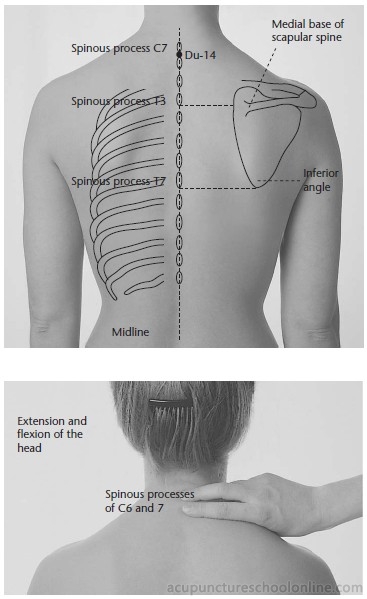
On the midline at the base of the neck, in the depression below the spinous process of the seventh cervical vertebra (C7).
Perpendicular-oblique superior insertion 0.5 - 1 cun, or transverse inferior insertion up to 6 cun in "xiangwei needling" to connect with Taodao Du-13, Shenzhu Du-12, Shendao Du-11, Lingtai Du-10 and Zhiyang Du-9.
The spinal canal lies between 1.25 and 1.75 cun deep to the skin surface, varying according to body build.
" It is needled to a depth of five fen and is moxaed with nine cones" (Huangfu Mi 皇甫謐, 3rd Century, Zhenjiu Jiayi Jing 針灸甲乙經).
Expels Wind and firms the Exterior
Clears Heat
Treats malaria
Tonifies deficiency
Pacifies Wind
Superficial Innervation: Medial branches of dorsal rami of C8 and T1
Dermatome Segment: C4
One of the 36 vital points of Feng Yiyuan 馮一元 listed in the Wu Bei Zhi 武備志 (Treatise on Armament Technology) by Mao Yuanyi 茅元儀 (1621) (McCarthy, 2016, Bubishi: The Classic Manual of Combat).
See Montaigue, Dim Mak Locations, Taijiworld.com for explanation of effects.
A very common point for clearing heat caused by external pathogens. It may be needled, cupped, treated with Gua Sha or with Jiu Sha where the skin over this point is grasped and pulled repeatedly until reddened to clear an external pathogen.
In the Shang Han Lun, line 171, Zhang Zhong-Jing recommends using this point along with Feishu Bl-13 and Ganshu Bl-18 for the dragover of Taiyang and Shaoyang disease. This is because Feishu Bl-13 can eliminate pathogens from the Taiyang while Ganshu Bl-18 can eliminate pathogens from the Shaoyang (Liu, 2016, Shang Han Lun, p. 500). This explanation uses the different ways of pairing the channels: one using the connection between both Tai stages while the other uses the internal-external relationship of the Liver-Gallbladder. Dazhui Du-14 meanwhile simply releases the exterior from all Yang channels.
This point is also on the 3rd trajectory of the Chong mai connecting the Chong with the Du for Invigorating Yang in cases of Bi Obstruction due to Blood Stagnation (Yuen, 2005, The Extraordinary Vessels).
This point and Yamen Du-15 connects with the lower brain concerned with survival and is associated with the Lung and Spleen channels (Yuen, 1995, The Curious Organs, taken from class notes by Avi Magidoff).
In "xiangwei needling" the Du is needled transversely against the direction of the channel in order to reduce excess conditions, in this case of the brain and upper body (Liu Yan, 2008, Diagrams of Acupuncture Manipulations, p.121).
In Mayan medicine:
Used by some curanderos to lower fever (Garcia, Sierra, Balam, 1999: Wind in the Blood)
In the Vedic tradition the Vishuddha Chakra would be located between this point and Tiantu Ren-22.
In Ayurvedic medicine:
Lad and Durve (2008) in Marma Points of Ayurveda call this point Manymani and associate it with the doshas: Prana Vayu, Vyana Vayu, Apana Vayu and Udana Vayu.
They give the following functions:
- Relieves neck pain
- Helps regulate pituitary, thyroid and parathyroid functions
- Relieves stress
In Tibetan medicine:
mLung point. Edelweiss flowers (Trah-wah) are burnt in cones like moxa over crushed garlic at this point for mental disorders and loss of speech (Bradley, 2000: Principles of Tibetan Medicine).
This point is also the main Wind Point of the "Six Wind Points" which can be stimulated with warmth from oils, hands, compresses or hot stones to treat disorders of Wind, seen in Tibetan medicine as problems of anxiety, insomnia, nervousness, mood swings, irritability, stiffness, memory loss, and trembling as well as discomfort and pain in the lower back, hips and joints. The other Wind Points are Baihui Du-20, Tiantu Ren-22, Shanzhong Ren-17, Laogong Pc-8 and Yongquan Kid-1 (Tibet House US, https://tibethouse.us/stress-tibetan-medicine/, Accessed 18th May 2019).
In Thai massage:
Points either side of C7 form acupressure points of the Itha (left) and Pingala (right) sen lines. Indicated for neck and shoulder pain/injury/arthritis.
(Salguero & Roylance, 2011, Encyclopedia of Thai Massage).
In the Unani Islamic medical practice of Hijama this point is known as Kahil. It is the most frequently recommended point in the Sunnah. The reports which mention it are:
"In gazawah khybre while our beloved prophet Muhammad s.a.w.sallam was poisoned, he took hijama at 3 point on the kahil, we feel that a cup was applied behind the heart ( at the left of kahil), & the third was either a little bit lower to this point or on the right side of the kahil, Allah knows the best.
Abdul Razzaq narrated that, 'A jewish woman brought to prophet Muhammad Sallallahoo Alaihi Wa Sallam a roasted that she had poisoned, while he was in khyber, our beloved prophet Muhammad Sallallahoo Alaihi Wa Sallam asked, what is this, she said, a gift, being careful not to say that it was from charity so that he would not eat it. Prophet Muhammad Sallallahoo Alaihi Wa Sallam and sahaba (his companions) ate from the sheep, then our prophet Muhammad Sallallahoo Alaihi Wa Sallam said, "stop eating". He said to the women, "Did you poison this sheep?", she said, "who told you that"? He said , "this bone", meaning the ewe’s leg that he had in his hand. She said, "Yes". He said, "Why"? She said, "I thought that if you were a liar, the people would be relieved from you. However, if you were a true prophet, it would not harm you." Prophet Muhammad Sallallahoo Alaihi Wa Sallam then used hijama (cupping ) thrice on the kahil (upper part of his back ) and commanded that his companions do the same. Yet, several of them died.'
Narrated by ibn majah, on the authority of Ali razi allaho anh that angel Jibreel advised prophet Muhammad Sallallahoo Alaihi Wa Sallam for hijama at Akhda’ain (posterior jugulars) and KAHIL (upper back ~between the shoulder).
Reported by abu kabsha al anmari raza allaho anh that prophet Muhammad Sallallahoo Alaihi Wa Sallam took hijama on Haamah & between the shoulder (which is KAHIL). Narrated by abu dawood & ibn~majah."
Kahn, 2019, http://hijamacups.com/sunnah-points/. Accessed 12 May 2019.
In the Qabalah this point would be the location of Geburah, Severity (Farrow, 2007, The Psychology of the Body).
Basic information on location, needle depth, TCM actions, indications and combinations is taken from Deadman et al (2001): A Manual of Acupuncture with additional anatomical information researched by reference to Gray's Anatomy (38th Ed., 1995) unless otherwise referenced. Images were found on acupunctureschoolonline.com and can be traced back to Claudia Focks (2008) Atlas of Acupuncture originally. I cannot claim any credit or rights over them. Other sources should be quoted in the text.
For some of the more unusual terms I have created a glossary here
Woodley Bioenergetics
90 Deane Croft Road,
Eascote, Pinner, Greater London. HA5 1SP
Tel/WhatsApp: +44 (0) 7946 174 829
Email: steve@steve-woodley.co.uk