 |
Location Guides: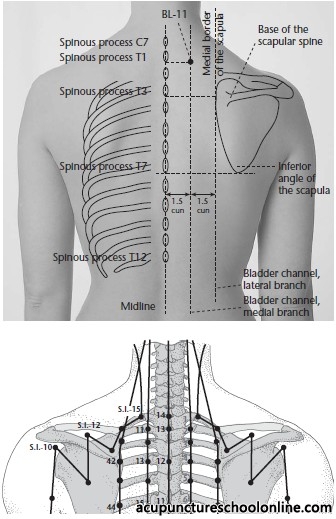 |
Hui-Meeting point of Bones
Point of the Sea of Blood
Alternative to Bl-1 as a Master point for the Kidney and Bladder Divergent Meridians (Chace, The Merging of Ways)
One of the "59 piercings" for clearing Heat in Su Wen Ch. 61
Meeting of Bladder with Small Intestine, San Jiao, Gall Bladder and Du Mai
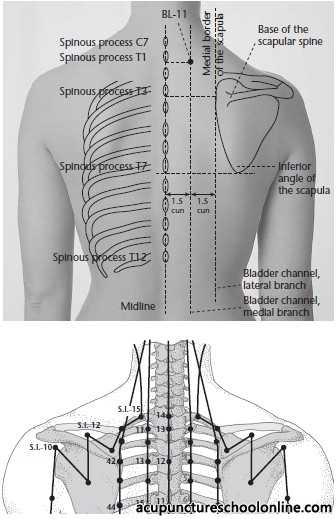
1.5 cun lateral to the lower border of the spinous process of the first thoracic vertebra (T1).
Oblique insertion towards the spine 0.5 - 1 cun, or transverse-oblique insertion 1 - 1.5 cun
Perpendicular needling carries a substantial risk of cuasing a pneumothorax.
"The Taiyang usually has much Blood and little Qi" (Su Wen 素問 ch. 24) implying this channel should normally be bled.
"The foot Taiyang is to be pierced 5 fen deep and remain inserted for seven exhalations" (Ling Shu 靈樞 ch. 12).
"It is needled to a depth of three fen, (the needle) is retained for a duration of seven exhalations, and it is moxaed with seven cones" (Huangfu Mi 皇甫謐, 3rd Century, Zhenjiu Jiayi Jing 針灸甲乙經).
Benefits the bones and joints
Expels pathogenic factors and firms the Exterior
Regulates Lung Qi and alleviates cough
Superficial Innervation: Supraclavicular nerve from C3 - C4
Dermatome Segment: C6
Deeper Structures: Dorsal rami of spinal nerves from T1
As the Hui of Bones, striking this point affects the bones and Kidneys so can be used as a set up point to facilitate a bone break. It can also cause immediate nausea. Due to being a Sea of Blood point, it can cause delayed death due to Blood disorders, especially if combined with Shangjuxu St-37 or Xiajuxu St-39. The close relationship of the Blood to the Shen makes damage to this point also able to cut a person off from their Shen causing psychological and spiritual decline (Montaigue, Dim Mak Locations, Taijiworld.com).
One of the points in the External Dragons protocol in five element acupuncture, along with Baihui Du-20, Shenshu Bl-23 and Pucan Bl-61, for eliminating a blockage between the therapist and patient, or a disconnection from themselves, with the additional presence of external symptoms or trauma.
The "59 piercings" are named in the Su Wen Ch. 61 and mentioned in Su Wen Ch. 32 and Ling Shu Ch. 23 for treating Heat diseases. This point along with Zhongfu Lu-1, Qupen St-12 and Feishu Bl-13 clear Heat from the chest.
Ling Shu Ch. 22, On Mania and Madness, advises piercing this point in case of a madness-illness involving the sinews with tiredness, cramping and enlarged blood vessels. If there if vomiting of foam then cure is impossible.
If the disease is in the vessels causing sudden falling to the ground and the four extremities being swollen and relaxed then the Luo are pierced if full and if empty then this point is cauterised on both sides along with Zhishi Bl-52 and at all Shu points located on partings in the flesh.
Ling Shu Ch. 33, On the Four Seas, says the Chong Mai is the Sea of the 12 Meridians with its upper Shu-transport point at this point and lower Shu transport points at Shangjuxu St-37 and Xiajuxu St-39.
Ling Shu Ch. 34, On the Five Disturbances, advises this point and Tianzhu Bl-10 to remove disturbing Qi in the head causing counterflow leading to headaches, a heavy head and dizziness with falling down. If this does not work then pierce Shugu Bl-65 and Zutonggu Bl-66.
Ling Shu Ch. 75, On Piercing to Regulate True and Evil Qi, recommends this point as part of the "Undressing" treatment. Its indications are when there is a surplus of Yang and insufficiency of Yin Qi causing Heat in the interior and exterior. The two heats combine to become hot like burning coal and they cannot bear to have clothes touch the skin or to lie on a mattress, the pores are closed and there is no sweating, the tongue is scorched, the lips are desiccated, the flesh dries up, the throat is parched and they cannot tell good from bad food. It is treated by removing the Heat from this point, Tianfu Lu-3 and Zhonglushu Bl-29, then supplementing the Taiyin channels of hand and foot, Lung and Spleen, to diminish the sweat. Presumably the initial piercings are supposed to induce the sweat or this contradicts the earlier symptom of the pores being closed and the sweat not leaving.
When used as part of a Divergent Meridian treatment is paired with the He Sea point, or less commonly with the Yuan Source or Luo Connecting point of the channels (Chace, The Merging of Ways).
In Tibetan medicine:
Moxa point (AMNH, Tibetan Medical Paintings)
Basic information on location, needle depth, TCM actions, indications and combinations is taken from Deadman et al (2001): A Manual of Acupuncture with additional anatomical information researched by reference to Gray's Anatomy (38th Ed., 1995) unless otherwise referenced. Images were found on acupunctureschoolonline.com and can be traced back to Claudia Focks (2008) Atlas of Acupuncture originally. I cannot claim any credit or rights over them. Other sources should be quoted in the text.
For some of the more unusual terms I have created a glossary here
Woodley Bioenergetics
90 Deane Croft Road,
Eascote, Pinner, Greater London. HA5 1SP
Tel/WhatsApp: +44 (0) 7946 174 829
Email: steve@steve-woodley.co.uk