 |
Location Guides: |
Doorway to the Earth Point
Master Tung's Three Rivers
Meeting of Governing Vessel with Bladder Divergent, Kidney Divergent and Destiny Protection Line (Baoming Xian 保命線)
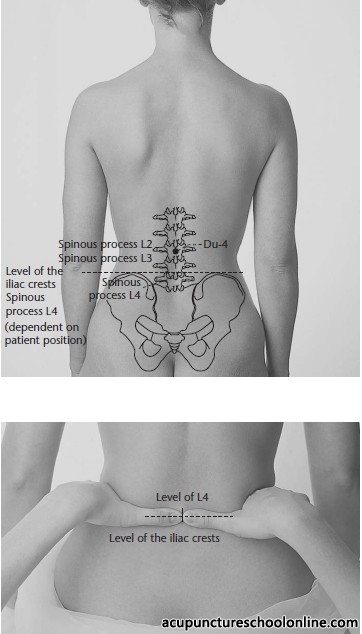
On the midline of the lower back, in the depression below the spinous process of the second lumbar vertebra (L2).
Perpendicular insertion 0.5 - 1 cun, or transverse inferior insertion up to 6 cun in "xiangwei needling" to connect with other Yangguan Du-3.
The spinal canal lies between 1.25 and 1.75 cun deep to the skin surface, varying according to body build. According to a number of classical texts, this point is contraindicated to moxibustion in those who are under 20 years of age.
"Lie (the patient’s body) prostrate to locate it. It is needled to a depth of five fen and moxaed with three cones" (Huangfu Mi 皇甫謐, 3rd Century, Zhenjiu Jiayi Jing 針灸甲乙經).
Clears Heat
Regulates the Du Mai
Tonifies the Kidneys
Benefits the lumbar spine
Superficial Innervation: Medial branches of dorsal rami of L2
Dermatome Segment: L2
Listed in the Wu Bei Zhi 武備志 (Treatise on Armament Technology) by Mao Yuanyi 茅元儀 (1621), Article 24: Bronze Man Statue, which divides the body into zones associated with the Twelve-Hour branches (Shichen 時辰) going from top downwards, the ankle and Achilles tendon are the vital points of Hai 亥 Pig (9 - 11 pm) and considered most vulnerable to an upward trauma during this time (McCarthy, 2016, Bubishi: The Classic Manual of Combat).
See Montaigue, Dim Mak Locations, Taijiworld.com for explanation of effects.
Trigrams: Dui (Lake) below, Kun (Earth) above.
Openness within, receptivity without — the lake rests upon the earth. The joyful and open is supported by the receptive and yielding. This is approach: something new is drawing near, and the ground is ready to receive it.
Nuclear Trigrams: Lines 2-3-4 form Zhen (Thunder). Lines 3-4-5 form Kun (Earth). Beneath the approach, there is movement (Zhen) and receptivity (Kun). The hidden message: the approach is alive with movement, and it is grounded in the receptive earth.
Judgement:
臨:元亨利貞。至于八月有凶。
Approach. Sublime success. Furthering through perseverance. When the eighth month comes, there will be misfortune.
Something new is approaching. The yang is rising. This is a time of growth and opportunity. But the cycle will turn. The eighth month will come. Do not become attached to the approach as if it will last forever.
Lines:
| Line | Yin/Yang | Image | Literal Translation | Commentary |
|---|---|---|---|---|
| 1 | Yang | 咸臨,貞吉 | Approaching with influence. Perseverance brings Gain. | Yang at the bottom. The beginning of the approach. The yang is moving upward, influencing the yin. Gain because the movement is correct and the time is right. |
| 2 | Yang | 咸臨,吉無不利 | Approaching with influence. Gain. Nothing is unfavourable. | The ruler line. Yang at 2, central and correct. The approach is now strong and correct. Nothing is unfavourable because the yang is in its proper place and the timing is perfect. |
| 3 | Yin | 甘臨,無悠利。既憂之,無咎 | Sweet approach. Nothing is favourable. If one is anxious about it, no trouble. | The threshold. The approach has become sweet — too comfortable, too easy. Nothing is favourable because the yang is no longer rising. But if one recognises the danger and becomes anxious, there is no trouble. The anxiety itself is the correction. |
| 4 | Yin | 至臨,無咎 | Arriving approach. No trouble. | Yin at 4. The first yin line above the threshold. The approach has arrived. The yang is now at the threshold of the upper trigram. No trouble because the approach is complete and correct. |
| 5 | Yin | 知臨,大君之宜,吉 | Knowing approach. The appropriateness of the great prince. Gain. | Yin at 5, the place of honour. The great prince knows how to approach. He does not force; he understands. Gain because the leadership is wise and appropriate. |
| 6 | Yin | 敦臨,吉無咎 | Generous approach. Gain. No trouble. | Yin at the top. The approach is now generous and complete. The yang has fully arrived, and the yin receives it with generosity. Gain and no trouble because the reception is wholehearted. |
Image:
澤上有地,臨。君子以教思無窮,容保民無疆。
The earth above the lake: Lin. Thus the gentleman teaches with inexhaustible thought and protects the people without boundary.
The earth is above the lake — the receptive is above the open. The gentleman teaches with inexhaustible thought (教思無窮) and protects the people without boundary (容保民無疆). Approach is not just receiving what comes. It is actively preparing the ground — teaching, protecting, making ready. The yang is approaching, but the yin must be ready to receive it.
Acupuncture Point Connections:
Its rising and falling hexagram attribution is shared by the points Zhongfu Lu-1 and Tianshu St-25, the front Mu points of Metal.
Hexagram attributions are my own with an explanation given in the glossary.
Translations are my own, assisted by DSeek and compared to Richard Rutt's interpretion (2002).
Mainly used for treatment of heat whether excess or deficient and tonification of Kidneys.
Possible location for the middle barrier of internal alchemy (Deadman, 2001). See also Xuanshu Du-5, Lingtai Du-10 and Shendao Du-11.
The Destiny Protection line (Baoming Xian 保命線) is an internal line used in inner cultivation arts (Neigong Shu 內功術) that connects this point with Shenque Ren-8 (Wang, 2019, Daoist Internal Mastery ).
The Illustration of Time in the Principles of the Innate Disposition and the Lifespan (Xingming Guizhi, 性命圭旨) describes the movement of prenantal Qi through the microcosmic orbit in terms of the I Ching Hexagrams and the twelve Earthly Branches. It says that:
The prenatal Qi of human beings follows the course of the day:
during the Zi (11 pm - 1 am), the Fu (Turning Back, ䷗) Qi arrives at Caudal Defile (GV 1);
during the Chou (1-3 am), the Lin (Approaching, ䷒) Qi arrives at Kidney Hall [maybe GV 4];
during the Yin (3-5 am), the Tai (Advance, ䷊) Qi arrives at the Mystic Pivot [maybe GV 5 based on name, or GV 7 based on location];
during the Mao (5-7 am), the Dazhuang (Great Strength, ䷡) Qi arrives at the Spinal Handle [possibly GV 10 or GV 11];
during the Chen (7-9 am), the Guai (Eliminating, ䷪) Qi arrives at the Kiln Path (GV 13);
during the Si (9-11 am), the Qian (Initiating, ䷀) Qi arrives at the Jade Pillow (Bl 9 [or GV 17]);
during the Wu (11 am -1 pm), the Gou (Encountering, ䷫) Qi arrives at the Mud Pill (GV 20);
during the Wei (1-3 pm), the Dun (Retreating, ䷠) Qi arrives at Hall of Brilliance (GV 23);
during the Shen (3-5 pm), the Pi (Hindrance, ䷋) Qi arrives at the Centre of the Chest (CV 17);
during the You (5-7 pm), the Guan (Watching, ䷓) Qi arrives at the Central Venter (CV 12);
during the Xu (7-9 pm), the Bo (Falling Away, ䷖) Qi arrives at Spirit Gate (CV 8);
during the Hai (9-11 pm), the Kun (Responding, ䷁) Qi returns to the Sea of Qi (CV 6).
(translated in Liu Lihong, 2019, Classical Chinese Medicine).
The "Kidney Gate" most likely refers to this point.
Based on some considerations of the hexagram associations given here, the attributions of ䷁ and ䷀ to Huiyin Ren-1 and Baihui Du-20, and a desire to make ䷊ and ䷋ oppose one another at the centre of the body, it would seem that these attributions are where the Qi of a particular hexagram start, and finish at the start of the next, similar to how an hour continues until the next begins. Hence ䷒ governs the region between Mingmen Du-4 and Xuanshu Du-5 or Zhongshu Du-7.
Therapeutically, it would make sense that these points are associated with certain aspects of pre-natal Qi and its relation to the associated Zangfu of its Earthly Branch. The hexagram associated with this point represents the progression of Yang and is associated with the Earthly Branch of Chou, 1 - 3 am, and the Liver. Its structure is also the same as the trigram ☳ which corresponds to Thunder and Wood. Wood, as the mother of Fire and the location of this point at the Ming Men Fire suggest that this point is associated with Kidney Yang and the Life Gate Fire.
Based on the Hexagram attributions of the Antique Points, this would correspond to Zhongfu Lu-1 or Tianshu St-25 which share the Hexagram Lin (Approaching, ䷒). Its association with the Front Mu of the Lung and Large Intestine (LI is opposite Kidney in the Chinese clock) and its association with the Earthly Branch of the Liver (Wood) refers to the Kidney Yang's role in grasping the breath and fanning the Ming Men Fire, as seen in various breathing techniques, like those of the Martial and Civil Fire Times in Neidan.
This point is also on the 3rd trajectory of the Chong mai connecting the Chong with the Du for Invigorating Yang in cases of Bi Obstruction due to Blood Stagnation (Yuen, 2005, The Extraordinary Vessels).
This point is also indicated in issues with the Second Level of Manifestation of the Soul, or Svadhishthana chakra manifesting in deficiency in ability to make subconscious associations, along with Jingming Bl-1 and Yongquan Kid-1. They represent individuality, ability to see polarity, make separations and move into the world (Yuen, 2005, 3 Spirits & 7 Souls).
In Sufism this level would relate to the Valley of Love described by Attar in the Conference of the Birds as:
"Next the tempting valley of love displays itself
Whoever enters that field burns in the furnace;
A true lover stakes his cash and his head
For union with his beloved and his mate;
Others are content with another day's promise to wait
But the lover finds his beloved here ..."
Here the mystic is consumed with desire to be absorbed into the divine.
Like the other even (Yin) sets, the unifying theme is the mingling of Kidney Yang (Jingming Bl-1) with Kidney Yin (Yongquan Kid-1) in the Life Gate Fire (Mingmen Du-1), with the connection to the eyes and the Fire in the lower Dan Tian indicating desire. Alchemically it therefore represents the mingling of Water and Fire, Kan and Li. Desire to be united with the beloved also indicates a separation of beloved and beloved and hence duality, but with the desire to have those opposites unite into one.
In "xiangwei needling" the Du is needled transversely against the direction of the channel in order to reduce excess conditions, in this case of the urinary and reproductive systems, sciatica and disorders of the lower limbs (Liu Yan, 2008, Diagrams of Acupuncture Manipulations, p.121).
Master Tung's Three Rivers (San Jiang) are three lines of points, one along the midline below each spinous process from L1 to S2 with the another two either side 3 cun lateral to the midline from L2 to S2. They are pricked to bleed a spot of blood.
They relate to the water phase and Kidneys and are indicated for lumbar pain and conditions of the abdomen, bowels and uterus. Those 3 cun from the midline can also be used for sciatica and as distal points pain of arm, elbows or shoulders (McCann, 2014, Pricking the Vessels).
In Tibetan medicine:
Edelweiss flowers are burnt in cones like moxa over crushed garlic at this point as the common point for the five vital and six hollow organs. It helps cold diseases related to all these organs (Bradley, 2000: Principles of Tibetan Medicine).
In the Vedic tradition the Manipura Chakra would be located between this point and Qihai Ren-6 or Shenque Ren-8.
In the Qabalah this point would be the location of Hod, Splendour (Farrow, 2007, The Psychology of the Body).
Basic information on location, needle depth, TCM actions, indications and combinations is taken from Deadman et al (2001): A Manual of Acupuncture with additional anatomical information researched by reference to Gray's Anatomy (38th Ed., 1995) unless otherwise referenced. Images were found on acupunctureschoolonline.com and can be traced back to Claudia Focks (2008) Atlas of Acupuncture originally. I cannot claim any credit or rights over them. Other sources should be quoted in the text.
For some of the more unusual terms I have created a glossary here
Woodley Bioenergetics
90 Deane Croft Road,
Eascote, Pinner, Greater London. HA5 1SP
Tel/WhatsApp: +44 (0) 7946 174 829
Email: steve@steve-woodley.co.uk