|
Location Guides: |
 |
He-Sea and Water point
Binding point of the foot Taiyin Sinews
Homeostatic point 4 (Ma, Ma & Cho, 2005, Biomedical Acupuncture for Pain Management)
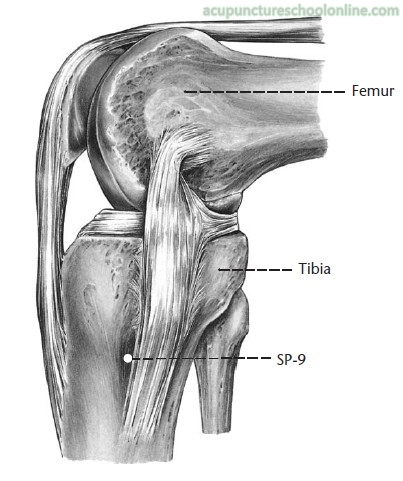
On the medial side of the lower leg, in a depression in the angle formed by the medial condyle of the tibia and the posterior boder of the tibia.
Perpendicular insertion 1 - 1.5 cun
"The Taiyin usually has much Qi and little Blood" (Su Wen 素問 ch. 24) implying this channel should normally be needled.
"The foot Taiyin is to be pierced 3 fen deep and remain inserted for four exhalations" (Ling Shu 靈樞 ch. 12).
"It is needled to a depth of five fen (the needle) is retained for a duration of seven exhalations, and it is moxaed with three cones" (Huangfu Mi 皇甫謐, 3rd Century, Zhenjiu Jiayi Jing 針灸甲乙經).
Regulates the Spleen and resolves Dampness
Opens and moves the water passages
Benefits the Lower Jiao
Superficial Innervation: Saphenous nerve, from femoral nerve (L2 - L4), emerging from deep fascia
Dermatome Segment: L4
Listed in the Wu Bei Zhi 武備志 (Treatise on Armament Technology) by Mao Yuanyi 茅元儀 (1621), Article 21: Delayed Death Touches with Twelve-Hour (Shichen 時辰) Diagrams. This point along with Yifeng SJ-17 and Renzhong Du-26 are associated with Chen 辰 Dragon (7-9 am) and if struck during this time is said to cause death before a person can take 7 steps from trauma to the articular artery (McCarthy, 2016, Bubishi: The Classic Manual of Combat).
As a He-Sea and Water point, in addition to great local
pain it will cause the body to fill up with water when struck right on target and if not corrected using acupuncture or other Chinese medicine, will eventually lead to early death (Montaigue, Dim Mak Locations, Taijiworld.com).
䷃ Meng 蒙 Youthful Folly, Ignorance.
Trigrams: Kan (Water) below, Gen (Mountain) above.
Danger within, stillness without — a spring blocked by a mountain. This is ignorance, inexperience, the folly of youth. The water wants to flow but cannot find its way out.
Nuclear Trigrams: Lines 2-3-4 form Zhen (Thunder). Lines 3-4-5 form Kun (Earth). Beneath the ignorance, there is movement (Zhen) and receptivity (Kun). The hidden message: the fool is not static — there is a stirring within. If properly guided, the movement will find its ground.
Judgement:
亨。匪我求童蒙,童蒙求我。
Opening.
The channel can be opened here and stagnation guided out.
匪我求童蒙,童蒙求我。
I do not seek the young and foolish; the young and foolish seek me.
The treatment must be sought with genuine intent and not imposed. Those not ready for serious engagement will not respond well.
初笨告,再三漄,漄則不告。
At the first divination, I inform him. If he asks two or three times, it is importunity. If he is importunate, I do not inform him.
Dampness is a stubborn condition that requires lifestyle change. The patient should be informed of this at the first treatment. If they are unhappy about this and continue to ask for alternatives, they are not ready for steady change and treatment should not be given.
利貞。
Burning is beneficial.
Fortification with moxa is appropriate for this point.
Overall: Ignorance is not a permanent condition, but it can be a very stubborn condition. Dampness is also a stubborn condition that often stems from ignorance of its causes in lifestyle factors. Treatment can help guide Dampness out through moxa, but it must be coupled with lifestyle advice that requires patience and discipline. If they are unable or unwilling to accept that, it should not be forced, but nor should treatment be pursued as acupuncture alone cannot reverse a lifestyle that refuses to change.
Lines:
| Line | Yin/Yang | Image | Literal Translation | Clinical Reading |
|---|---|---|---|---|
| 1 | Yin | 發蒙,利用刑人,用說栅梭,以往吝 | Disciplining the ignorant. Favourable to use punishment, to remove shackles; going on brings regret. | Dampness is starting to take hold and possible to rectify with draining. Strong stimulation to resolve obstruction will help. However, this harsh strategy will not work in the long term. |
| 2 | Yang | 包蒙吉,納婦吉,子克家 | Embracing the young and foolish is auspicious. Taking a wife is auspicious. The son is capable of managing the household. | The point and the patient is teachable and will respond to treatment if they are partnered with. This means using partnered points to enhance efficacy, and partnering with them to teach them better lifestyle habits. Then they can learn to manage their situation by themselves. |
| 3 | Yin | 勿用取女,見金夫,不有身,無悠利 | Do not take this woman. She sees a man of gold and loses herself. Nothing is favourable. | Gluttony and greed have become entrenched, accumulating Dampness, exhausting the point, but there is little that can be done until they recognise their errors. |
| 4 | Yin | 困蒙,吝 | Trapped in ignorance. Regret. | Dampness has escaped the point and is affecting the channel now. The person can see their errors but is unwilling to correct them. |
| 5 | Yin | 童蒙,吉 | Youthful folly. Auspicious. | The realisation of folly is made allowing treatment to be successful again. |
| 6 | Yang | 擊蒙,不利為寇,利御寇 | Striking the ignorant. Not favourable to be a robber; favourable to defend against robbers. | The Damp Qi has exhausted the channel and must be attacked forcefully. However, caution should be taken not to drain Zheng Qi, which must be protected. |
Image:
山下出泉,蒙。君子以果行育德。
A spring beneath a mountain: Meng. Thus the gentleman cultivates character through thoroughness.
The image is of water emerging from a mountain — clear, fresh, but uncertain of its path. The gentleman nourishes his virtue — he does not rush the process. He lets the spring find its course through patient cultivation.
Acupuncture Point Connections:
Shared with Neiting St-44. Their commentaries are slightly different because Neiting St-44 deals more with Damp-Heat and Shen disturbance, while this point treats simple Dampness but the principles are the same.
Inverted into ䷃ (Yongquan Kid-1 or Shugu Bl-65).
Opposed by ䷱ (Yinxi He-6 or Yanglao SI-6).
Hexagram attributions are my own with an explanation given in the glossary.
Translations are my own, assisted by DSeek and compared to Richard Rutt's interpretion (2002).
This is the main distal point for resolving dampness.
Ling Shu Ch. 1, On the Nine Needles and the Twelve Origins, suggests using this point to remove illness that is above and in the interior (i.e. affecting the upper body but in the Zang).
Ling Shu Ch. 19, on the Four Seasonal Qi, advises supplementing this point, described as above the three yin, for undigested food in the stool, with the needle retained until the heat moves (Unschuld, 2016). Conversely Wu & Wu (2010) interpret this line as pricking Sanyinjiao Sp-6 and this point with invigorating technique, stopping when heat appears under the needle.
Ling Shu Ch. 44, On the Qi Moving in Accordance with the Norms, indicates that the He-Sea points should be pierced in autumn or when the disease is a result of immoderate diet. The seasonal aspect should not be interpreted literally as it describes the flavours as "controlled by autumn", probably referring to the mouth, nose and throat where the metal channels run. It also describes the morning, afternoon, evening and night cycle of the day to be like the four seasons of the year with evening corresponding to autumn. Perhaps the most likely interpretation is during middle age, the autumn period of life, when the effects immoderate diet are likely to start to show.
Wang Yu-Ji often starts with this point and Chize Lu-5 as a means of harmonising the Taiyin Qi dynamic and function of fluid transformation. This is due to the Spleen governing the rising of clear Yang and the Lung governing the descent of True Qi creating a cyclical motion (Wang & Robertson, 2008, Applied Channel Theory).
In Tung acupuncture this point is known as Tian Huang, Heavenly Emperor (77.17) and is often combined with Ren Huang, Human Emperor (77.21), 3 cun above the medial malleolus at Sanyinjiao Sp-6, and Di Huang, Earth Emperor (77.19), 7 cun above the medial malleolus, 1 cun superior to Lougu Sp-7 to make Xia San Huang, the Lower Three Emperors. They all treat many disorders of the Spleen, Liver and Kidney, this one especially focuses on the Spleen (Chu, 2015).
Another point Shen Guan, Kidney Gate, or Tian Huang Fu, Heavenly Emperor Appendage (77.18) is located 1.5 cun below this point, midway between here and Diji Sp-8. It can be used singly for shoulder pain or in combination with Di Huang (1 cun above Lougu Sp-7) and Ren Huang (at Sanyinjiao Sp-6) for a variety of symptoms relating to Kidney Qi deficiency (ibid.)
According to Ma, Ma & Cho (2005) this point is similar to H1 (Quchi L.I.-11) in diagnosing a patients homeostatic imbalance and ability to self-heal. The more imbalanced they become the more tender points appear distal to this point along the course of the saphenous nerve (spleen channel) meaning a lower likelihood of responding to treatment.
According to the Taiwanese TCM Doctor I-Chun Peng threading a single needle from Yanglingquan GB-34 to Yinlingquan Sp-9 and combining with Zulinqi GB-41 can be used to treat cholecystitis, gallstones or gall bladder pain. Within 10 minutes the spasm will start to release and in an hour, there should be no more pain. https://youtu.be/XMYSYp0q5H8.
In Tibetan medicine:
Moxa point (AMNH, Tibetan Medical Paintings).
In Thai massage:
Point along the Kalatharee sen line and the Sahatsarangsi (left) and Tawaree (right) sen lines (Salguero & Roylance, 2011, Encyclopedia of Thai Massage).
Basic information on location, needle depth, TCM actions, indications and combinations is taken from Deadman et al (2001): A Manual of Acupuncture with additional anatomical information researched by reference to Gray's Anatomy (38th Ed., 1995) unless otherwise referenced. Images were found on acupunctureschoolonline.com and can be traced back to Claudia Focks (2008) Atlas of Acupuncture originally. I cannot claim any credit or rights over them. Other sources should be quoted in the text.
For some of the more unusual terms I have created a glossary here
Woodley Bioenergetics
90 Deane Croft Road,
Eascote, Pinner, Greater London. HA5 1SP
Tel/WhatsApp: +44 (0) 7946 174 829
Email: steve@steve-woodley.co.uk