 |
Location Guides: |
Shu-Stream and Earth point
Yuan-Source point
Child point of the Pericardium channel
Sun Si-miao Ghost point (2nd trinity)
Xu Qiufu Ghost point
Binding point of the hand Jueyin Sinews
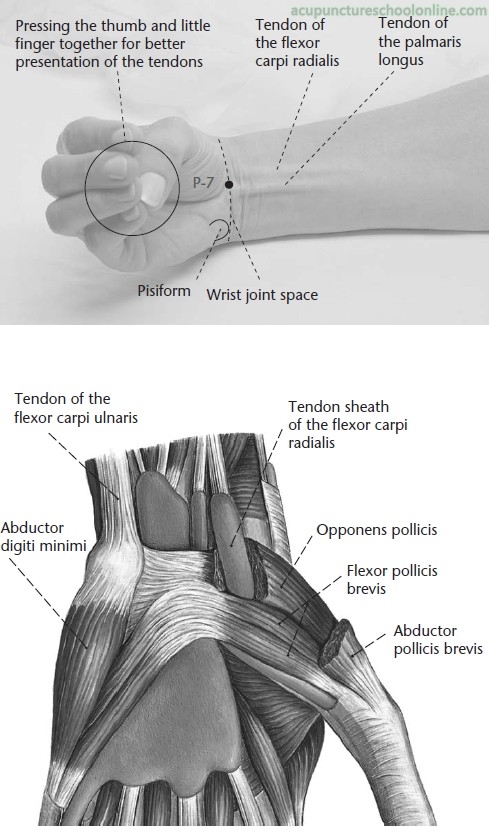
At the wrist joint, between the tendons of palmaris longus and flexor carpii radialis, level with Shenmen He-7.
Perpendicular insertion 0.3 - 0.5 cun, or oblique distal insertion along the carpal tunnel for carpal tunnel syndrome 0.5 - 1 cun, or transverse oblique proximal insertion up to 5 cun to join all points up to Ximen Pc-4 in "heart strengthening technique", Lingmen opposite needling and Ling Ze pointing to xi needling (Liu Yan, 2008, Diagrams of Acupuncture Manipulations, p.132-3).
"The Jueyin usually has much Blood and little Qi" (Su Wen 素問 ch. 24) implying this channel should normally be bled.
"The hand Yin and Yang receive their Qi via nearby paths so their Qi arrive swiftly. The depth of piercing must not exceed 2 fen and must not remain inserted for longer than one exhalation" (Ling Shu 靈樞 ch. 12).
"It is needled to a depth of six fen, and (the needle) is retained for a duration of seven exhalations. It is moxaed with three cones" (Huangfu Mi 皇甫謐, 3rd Century, Zhenjiu Jiayi Jing 針灸甲乙經).
Clears Heat from the Heart and calms the Shen
Harmonises the Stomach and Intestines
Unbinds the chest
Clears the Ying-Nutritive level and cools Blood
Superficial Innervation: Median nerve from C6 - C8
Dermatome Segment: C6, C7
Deeper Structures: Carpal tunnel where median nerve from C5 - T1 passes into hand
Striking here has immediate shocking effect of the Heart with added Heat enabling a set deadly strike to other Heart points (Montaigue, Dim Mak Locations, Taijiworld.com).
䷴ Jian 漸 Gradual Progression & ䷓ Guan 觀 Observing
As ䷓ Guan 觀 Observing:
Trigrams: Kun (Earth) below, Xun (Wind) above.
Receptivity within, penetration without — the wind blows over the earth. The gentle and penetrating moves across the receptive ground. This is contemplation: the wind of awareness moving over the ground of what is.
Nuclear Trigrams: Lines 2-3-4 form Kun (Earth). Lines 3-4-5 form Gen (Mountain). Beneath the contemplation, there is receptivity (Kun) and stillness (Gen). The hidden message: true contemplation is grounded in receptivity and contained within stillness. The wind may move over the earth, but the mountain beneath is still. The hidden dynamic reverses the surface: receptivity within, stillness without.
Judgement:
觀:盥而不薦,有孚顒若。
Contemplation. Washing the hands but not yet offering. There is sincerity, dignified and reverent.
Contemplation is the act of seeing clearly, without acting. It is the moment before the sacrifice, when everything is prepared and the attention is pure. The wind moves over the earth, observing. The one who contemplates is sincere and dignified.
Lines:
| Line | Yin/Yang | Image | Literal Translation | Commentary |
|---|---|---|---|---|
| 1 | Yin | 童觀,小人無咎,君子吝 | Childish contemplation. The small man has no trouble. The gentleman has Regret. | Yin at the bottom. The beginning of contemplation. The child sees only the surface. The small man is content with this. The gentleman has Regret because he knows there is more to see but has not yet seen it. |
| 2 | Yin | 閲觀,利女貞 | Peeping contemplation. Favourable for the woman's perseverance. | Yin at 2, central and correct. The contemplation is narrow — peeping through a crack. This is appropriate for the woman (the receptive, the inner), but not for the gentleman who must see the whole. |
| 3 | Yin | 觀我生,進退 | Contemplating my own life, advancing or retreating. | The threshold. The contemplation turns inward. The one who contemplates examines his own life and decides whether to advance or retreat. This is the crisis of contemplation — the moment when seeing becomes decision. |
| 4 | Yin | 觀國之光,利用賓于王 | Contemplating the light of the state. Favourable to be a guest of the king. | Yin at 4. The first yin line above the threshold. The contemplation now extends outward — the light of the state, the culture, the civilisation. It is favourable to serve the king because the seeing is now wide enough to be useful. |
| 5 | Yang | 觀我生,君子無咎 | Contemplating my own life. The gentleman has no trouble. | The ruler line. Yang at 5, central and correct. The contemplation returns to the self, but now from the place of honour. The gentleman examines his own life and finds it correct. No trouble because the seeing is clear and the life is aligned. |
| 6 | Yang | 觀其生,君子無咎 | Contemplating his life. The gentleman has no trouble. | Yang at the top. The contemplation is now complete. The one who contemplates sees his whole life, from the outside, as if it were another's. The gentleman has no trouble because he has seen clearly and accepted what he has seen. |
Image:
風行地上,觀。先王以省方觀民設教。
Wind moving over the earth: Guan. Thus the former kings inspected the regions, contemplated the people, and established teaching.
The wind moves over the earth, observing everything. The former kings inspected the regions (省方), contemplated the people (觀民), and established teaching (設教). Contemplation is not passive. It is the active observation that leads to understanding and then to teaching. The wind sees everything, and from that seeing comes the establishment of culture.
Acupuncture Point Connections:
Shared with Waiguan SJ-5.
Inverted into ䷒ (Zhongfu Lu-1 or Tianshu St-25).
Balanced by ䷡ (Lougou Liv-5 or Qiuxu GB-40).
As ䷴ Jian 漸 Gradual Progression:
䷴ is shared with Tianjing SJ-10 and balanced by ䷵ (Zhongfeng Liv-4 or Zuqiaoyin GB-44).
Hexagram attributions are my own with an explanation given in the glossary.
Translations are my own, assisted by DSeek and compared to Richard Rutt's interpretion (2002).
Tinel's sign: light percussion over the median nerve along the channel near this point will elicit a tingling or pins and needles feeling in the thumb, index and middle finger in cases of carpal tunnel syndrome.
Phalen's manoeuver: holding the wrists in complete and forced flexion (pushing the dorsal surfaces of the wrist together) for 30 - 60 seconds can induce burning, tingling or numb sensations in cases of carpal tunnel syndrome.
In five element acupuncture this point is reduced to drain excess in the Heart.
Ling Shu Ch. 1, On the Nine Needles and the Twelve Origins, describes this point as the origin of the Taiyang in the Yang.
Ling Shu Ch. 6 suggests piercing the Ying and Shu points of the Yin channels if a disease is in the Yin of the Yin realm (e.g. the Zang organs) suggesting this point and Laogong Pc-8 in diseases of the Heart (the Heart had no channel in Ling Shu, if disease had reached that far death was considered immanent).
Ling Shu Ch. 9, On Ends and Beginnings, advises that in the case of Heat associated with receding Yin Qi the Yang conduit should be pierced once and the Yin conduits twice. Based on other recommendation to use the He-Sea of the Yang conduits (Ch. 19) and the Yuan-Source with the Ying-Spring points (Chs. 6, 19 and 24) to clear Heat from the Zangfu, that would suggest this point, Tianjing SJ-10 and Laogong Pc-8 as a protocol to clear Heat in the Pericardium/San Jiao. Next it advises that in Cold associated with receding Yang Qi the Yang should be pierced twice and the Yin once but no such obvious protocol is evident for this situation. Another interpretation that would match with common practice today, based on the idea of odd numbers being Yang/moving/clearing while even numbers are Yin/tonifying/reinforcing, is that the points on the channel to be cleared are pierced on one side only while those on the channel to be tonified are pierced bilaterally.
Ling Shu Ch. 19, on the Four Seasonal Qi, advises using the Shu-Stream points, unless the diseases are in the Fu organs, in which case the He-Sea points are chosen.
Ling Shu Ch. 44, On the Qi Moving in Accordance with the Norms, indicates that the Shu-Stream points should be pierced in summer or when the disease becomes milder and then more severe again. The seasonal aspect should not be interpreted literally as it describes the time periods of weakness and severity as "controlled by summer". It also describes the morning, afternoon, evening and night cycle of the day to be like the four seasons of the year with afternoon corresponding to summer. Only five channels are discussed so this point must have served the for the Heart too.
In Lingmen opposite needling for blood in urine due to Heat in Heart Blood one needle is inserted from Daling Pc-7 to Ximen Pc-4 while another is inserted in the opposite direction from Ximen Pc-4 to Daling Pc-7 (Liu Yan, 2008, Diagrams of Acupuncture Manipulations, p.133).
In Ling Ze pointing to xi needling for palpitations one needle one needle is inserted from Daling Pc-7 to Ximen Pc-4 while another is inserted in the opposite direction from Quze Pc-3 to Ximen Pc-4 (Liu Yan, 2008, Diagrams of Acupuncture Manipulations, p.132).
Ghost Points:
The second trinity of ghost points, consisting of this point Shenmai Bl-62 and Fengfu Du-16, is concerned with the ghost trying to get you to search for the remnants of its past, either by dreamwork or literally going to places and seeking people it longs for. This is the most Yang phase of possession with many signs of Wind and Heat leading to agitation, uncontrollable movement and outbursts.
The name for this point Guixin, Ghost Heart, represents that the ghost is beginning to control the emotions of the person leading to sudden outbursts from Heat in the Blood. Therefore this point would be bled (Yuen, 2005, 3 Spirits & 7 Souls).
In the Twelve Branches the Ghost Points follow a cycle from top to bottom with this point representing Shen, 申 and the Bladder channel (Ayal, 2021, The 13 Ghost Points 十三鬼穴).
This point is also indicated for issues relating to the Third Level of Manifestation of the Soul, or the Manipura chakra, manifesting in difficulties switching the mind off, becoming unconscious and sleeping. The problem is that the Lung qi is unable to descend into the formless darkness of the Kidneys or the Kidneys are unable to hold it here.
The specific purpose of this point is open the chest enabling the mind's descent to the Kidneys (Source points connect to the Kidneys). The others in the set are Shuaigu GB-8, Shanzhong Ren-17 and Jimai Liv-12 or Ququan Liv-8 (Yuen, 2005, 3 Spirits & 7 Souls).
All the points in this set have an association with Jueyin with a focus on the Pericardium and therefore the descent of Fire.
In Sufism this level would relate to the Valley of Knowledge described by Attar in the Conference of the Birds as:
"No one can find a fixed road in this place
Because there are many roads and different destinations;
And since many paths the wanderer sees
Each rise as his wisdom guides or foresees;
Each person marches till he attain his own perfection
Yet moods dictate friendship and one's action ..."
Here there are many paths all leading to knowledge of the Divine, which comes from the Heart and its willingness to sink into formlessness, rather than intellectual knowledge of worldly forms, which are revealed to be utterly useless.
In ayurvedic medicine:
Manibandha marma point
Size: 2 angula (cun)
Structure: Tendon
Effect of Injury: Pain (riijakar marma)
(Harish Johari, 1996, Ayurvedic Massage, Sanatan Society; Anupama Bhattacharya, n.d. Marma Shastra)
Lad and Durve (2008) in Marma Points of Ayurveda call this point Manibandhaa and associate it with the doshas: Apana Vayu, Vyana Vayu and Shleshaka Kapha.
They give the following functions:
- Frees movement in the wrist joint
- Relieves localised pain
- Influences the reproductive organs
- Unfolds mental tranquility, balances emotions
- Strengthens the rectum and benefits sexual activity
In Thai massage:
Acupressure point along the Kalatharee sen line where the channel running from the navel Shenque Ren-8 to the hands splits into five lines going to the fingers (Salguero & Roylance, 2011, Encyclopedia of Thai Massage)
Basic information on location, needle depth, TCM actions, indications and combinations is taken from Deadman et al (2001): A Manual of Acupuncture with additional anatomical information researched by reference to Gray's Anatomy (38th Ed., 1995) unless otherwise referenced. Images were found on acupunctureschoolonline.com and can be traced back to Claudia Focks (2008) Atlas of Acupuncture originally. I cannot claim any credit or rights over them. Other sources should be quoted in the text.
For some of the more unusual terms I have created a glossary here
Woodley Bioenergetics
90 Deane Croft Road,
Eascote, Pinner, Greater London. HA5 1SP
Tel/WhatsApp: +44 (0) 7946 174 829
Email: steve@steve-woodley.co.uk