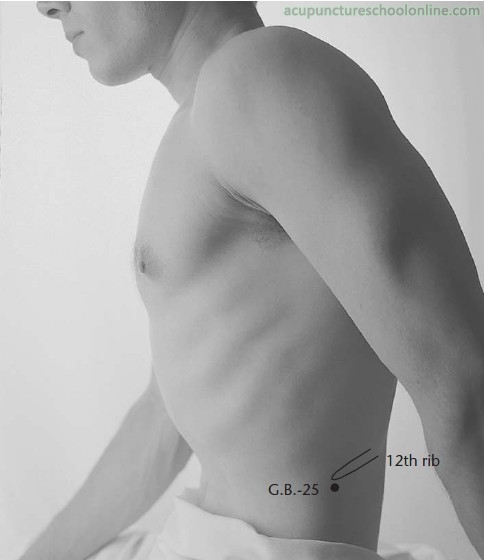
 |
Location Guides: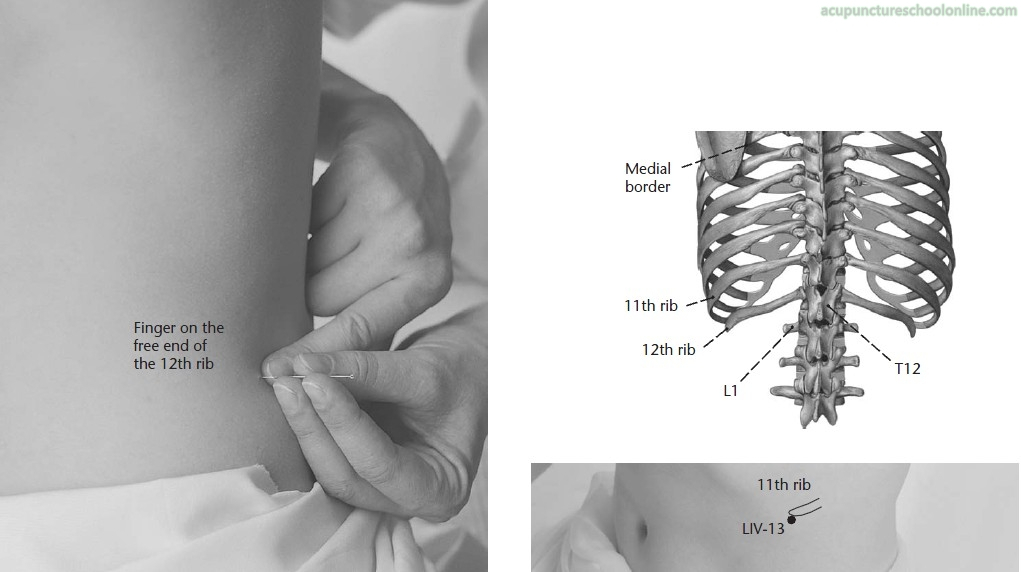 |
Front Mu of the Kidneys
Trigger point (Travell & Simons, 1998, Trigger Point Manual)
Meeting of Gall Bladder with Bladder Divergent, Kidney Divergent, Gall Bladder Divergent and Liver Divergent
Below the lateral aspect of the ribcage, anterior and inferior to the free end of the 12th rib. The Systematic Classic locates it in the lumbar region lateral to the spine, one cun and eight fen below the region of the free ribs. This is considerably different to the modern accepted location.
Perpendicular insertion 0.5 - 1 cun
In thin subjects deep needling may penetrate the peritoneal cavity.
"The Shaoyang usually has little Blood and much Qi" (Su Wen 素問 ch. 24) implying this channel should normally be needled.
"The foot Shaoyang is to be pierced 4 fen deep and remain inserted for five exhalations" (Ling Shu 靈樞 ch. 12).
"It is needled to a depth of three fen and (the needle) is retained for a duration of seven exhalations. It is moxaed with three cones" (Huangfu Mi 皇甫謐, 3rd Century, Zhenjiu Jiayi Jing 針灸甲乙經).
Tonifies the Kidneys and regulates the water passages
Fortifies the Spleen and regulates the Intestines
Strengthens the lumbar region
Hexagram attributions are my own with an explanation given in the glossary.
Superficial Innervation: Lateral cutaneous thoracic nerve from T12
Dermatome Segment: T12
Muscle:
Latissimus dorsi (inferior) and "belch button"
Location Notes:
Inferior latissimus dosi trigger point should be located slightly superior and posterior on the latissimus dorsi muscle.
"Belch button" is not consistently located on all people or found in a consistent location but below the angle of the 12th rib is the most common.
Pain Referral Pattern:
Latissimus dorsi: To subcostal region and anterior aspect of the shoulder.
"Belch Button": produces belching on pressure and possibly projectile vomiting in severe cases
Indications:
Mid-thoracic backache that is unresponsive to stretching or change of movement (latissimus dorsi) or stomach upset with gas ("belch button")
Striking this points sends a shock
wave which damages the kidneys. Struck hard, it will cause death through kidney failure, light to moderate strikes will cause bleeding from the penis and great pain in the kidney area (Montaigue, Dim Mak Locations, Taijiworld.com).
In seizing martial arts (Qin Na) striking the lower back at approximately at this point is a method of striking the organs (Da Qi Guan, 打器官) in order to injure the kidneys (Yang, 2004, Analysis of Shaolin Chin Na, 2nd Edition).
This is one of the eight non-striking or forbidden points in Northern Praying Mantis Kung Fu. Described as "The sides of the diaphragm" by Olson (2010, The Complete Guide to Northern Praying Mantis Kung Fu) and "the false ribs" by Wong Honfan (1946; in Ravenswood Academy, 2020, The Eight Forbidden Strikes of Praying Mantis Fist).
The Front Mu points make likely locations for application of leeches to reduce fevers according to François Broussais' (1772-1838) philosophy who believed in placing them over the diseased organs to reduce inflammation (Greenstone, 2010, The history of bloodletting, BCMJ, Vol. 52, No. 1, Pp 12-14).
Basic information on location, needle depth, TCM actions, indications and combinations is taken from Deadman et al (2001): A Manual of Acupuncture with additional anatomical information researched by reference to Gray's Anatomy (38th Ed., 1995) unless otherwise referenced. Images were found on acupunctureschoolonline.com and can be traced back to Claudia Focks (2008) Atlas of Acupuncture originally. I cannot claim any credit or rights over them. Other sources should be quoted in the text.
For some of the more unusual terms I have created a glossary here
Woodley Bioenergetics
90 Deane Croft Road,
Eascote, Pinner, Greater London. HA5 1SP
Tel/WhatsApp: +44 (0) 7946 174 829
Email: steve@steve-woodley.co.uk