 |
Location Guides: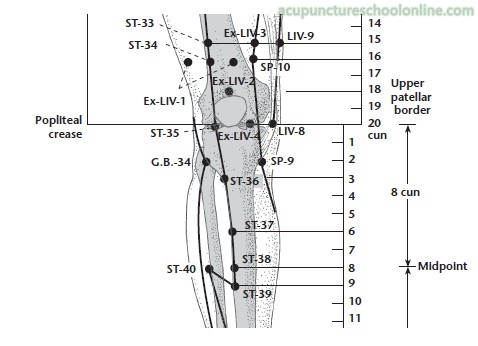 |
He-Sea and Earth point
Xu Qiufu Ghost point
Hui-Meeting point of Sinews
Ma Dan-yang Heavenly Star point
Binding point of the foot Taiyang, foot Shaoyang and foot Yangming Sinews
Trigger point (Travell & Simons, 1998, Trigger Point Manual; Melzack, Stillwell & Fox, 1977, Trigger Points and Acupuncture Points for Pain: Correlations and Implications, Pain 3, p3-23)
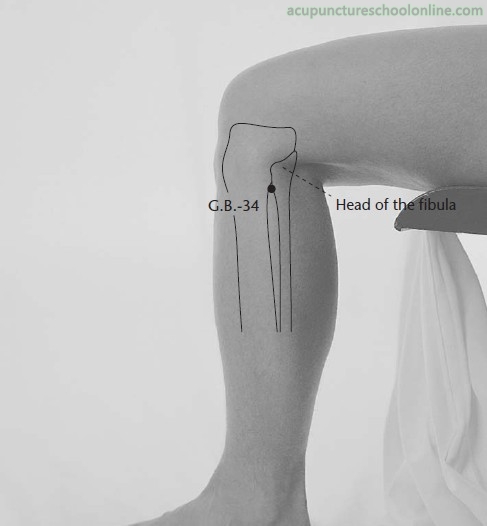
Below the lateral aspect of the knee, in the tender depression approximately 1 cun anterior and inferior to the end of the fibula.
Perpendicular or slightly oblique posterior insertion 1 - 1.5 cun, or through needles to Yinlingquan Sp-9, in which case locate in a slightly more distal position, or transverse insertion inferiorly for "Yang penetrating needling".
"The Shaoyang usually has little Blood and much Qi" (Su Wen 素問 ch. 24) implying this channel should normally be needled.
"The foot Shaoyang is to be pierced 4 fen deep and remain inserted for five exhalations" (Ling Shu 靈樞 ch. 12).
"It is needled to a depth of six fen, (the needle) is retained for a duration of ten exhalations, and it is moxaed with three cones" (Huangfu Mi 皇甫謐, 3rd Century, Zhenjiu Jiayi Jing 針灸甲乙經).
Benefits the sinews and joints
Activates the channel and alleviates pain
Spreads Liver Qi and benefits the lateral costal region
Clears Liver and Gallbladder Damp-heat
Harmonises Shaoyang
Shared with Taichong Liv-3. Balanced by ䷼ (Jianshi Pc-5 or Guanchong SJ-1).
Hexagram attributions are my own with an explanation given in the glossary.
Superficial Innervation: Lateral cutaneous nerve of the calf (L5 - S2)
Dermatome Segment: L5
Deeper Structures: Common peroneal nerve (L4 - S1)
Muscle:
Peroneus longus
Pain Referral Pattern:
On that lateral malleolus
Indications:
Strain of foot evertors
; Ankle sprain
See Montaigue, Dim Mak Locations, Taijiworld.com for explanation of effects.
The principle point for pain, cramping, contraction, stiffness or sprain of muscles and sinews anywhere in the body.
Ling Shu Ch. 1, On the Nine Needles and the Twelve Origins, suggests using this point to remove illness that is above and in the exterior (i.e. affecting the upper body but in the Fu).
Ling Shu Ch. 6 suggests piercing the He points of the Yang channels if a disease is in the Yang of the Yang realm (e.g. the skin). This would mean using this point, presumably needled at a very superficial level, to treat skin level disorders relating to this channel.
Combining this with the needling techniques described in Chapter 7 we could suggest using either superficial needling here to influence pathogens in the skin, or leopard spot needling (three needles aimed at letting blood from each side) for pathogens in the Blood.
Ling Shu Ch. 9, On Ends and Beginnings, advises that in the case of Heat associated with receding Yin Qi the Yang conduit should be pierced once and the Yin conduits twice. Based on other recommendation to use the He-Sea of the Yang conduits (Ch. 19) and the Yuan-Source with the Ying-Spring points (Chs. 6, 19 and 24) to clear Heat from the Zangfu, that would suggest this point, Taiching Liv-3 and Xingjian Liv-2 as a protocol to clear Heat in the Liver/Gall Bladder. Next it advises that in Cold associated with receding Yang Qi the Yang should be pierced twice and the Yin once but no such obvious protocol is evident for this situation. Another interpretation that would match with common practice today, based on the idea of odd numbers being Yang/moving/clearing while even numbers are Yin/tonifying/reinforcing, is that the points on the channel to be cleared are pierced on one side only while those on the channel to be tonified are pierced bilaterally.
Ling Shu Ch. 19, on the Four Seasonal Qi, advises using the He-Sea points in autumn when diseases are in the Fu organs.
A Tung point, Ce San Li, Side of the 3 Miles (77.22), is located midway between this point and Zusanli St-36, 0.5 - 1.5 cun anterior to this point. It is often combined with a second point, 2 cun inferior called Ce Xia San Li, Beside and Below 3 Miles (77.23) and together they are indicated for all problems of Yangming and Shaoyang channels (Chu, 2015).
In "Yang penetrative needling", to promote flow of qi through the foot shaoyang Gallbladder meridian, needle transversely through Yangqiao GB-35, Guangming GB-37 as far as Yangfu GB-38 (Liu Yan, 2008, Diagrams of Acupuncture Manipulations, p.140).
According to the Taiwanese TCM Doctor I-Chun Peng threading a single needle from Yanglingquan GB-34 to Yinlingquan Sp-9 and combining with Zulinqi GB-41 can be used to treat cholecystitis, gallstones or gall bladder pain. Within 10 minutes the spasm will start to release and in an hour, there should be no more pain. https://youtu.be/XMYSYp0q5H8.
Lad and Durve (2008) in Marma Points of Ayurveda call this point lateral Charana and associate it with the doshas: Apana Vayu, Vyana Vayu and Shleshaka Kapha.
They give the following functions:
- Promotes circulation in lower extremities
- Acts locally to relieve knee pain
- Supports the kidneys, bladder and adrenals
A medial Charana is located at Ququan Liv-8.
In Thai massage:
Acupressure point along the Sahatsarangsi (left) and Tawaree (right) sen lines. Probably the same as Zusanli St-36.
Indicated for gastrointestinal ailments, indigestion, insomnia, menstruation disorders, PMS, reproductive ailments and stomach ache.
(Salguero & Roylance, 2011, Encyclopedia of Thai Massage)
Basic information on location, needle depth, TCM actions, indications and combinations is taken from Deadman et al (2001): A Manual of Acupuncture with additional anatomical information researched by reference to Gray's Anatomy (38th Ed., 1995) unless otherwise referenced. Images were found on acupunctureschoolonline.com and can be traced back to Claudia Focks (2008) Atlas of Acupuncture originally. I cannot claim any credit or rights over them. Other sources should be quoted in the text.
For some of the more unusual terms I have created a glossary here
Steve Woodley Acupuncture & Traditional Medicine
90 Deane Croft Road,
Eascote, Pinner, Greater London. HA5 1SP
Tel/WhatsApp: +44 (0) 7946 174 829
Email: steve@steve-woodley.co.uk