 |
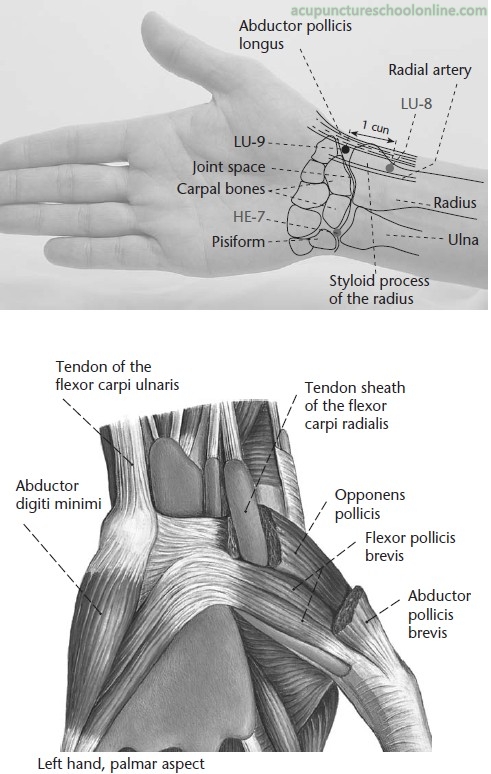
Location Guides: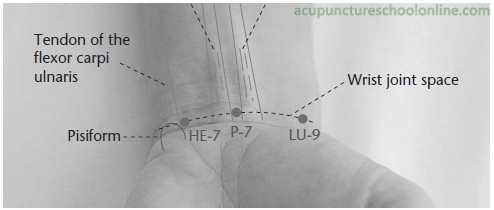 |
Shu-Stream and Earth point
Yuan-Source point
Hui-Meeting point of the Vessels
Mother point of the Lung channel
Binding point of the hand Taiyin Sinews
Shokanten Nine continents Pulse for Upper Jiao, Taiyin and Lungs
At the wrist joint, in the depression between the radial artery and the tendon of abductor pollicis longus, level with shenmen HE-7
Perpendicular insertion 0.3 - 5 cun, avoiding the radial artery, or transverse proximal insertion 2-3 cun to connect with Jingqu Lu-8 in "Lung-clearing technique" and "opposite sword blade needling between Kongzui and Taiyuan" taking care to avoid the radial artery.
"The Taiyin usually has much Qi and little Blood" (Su Wen 素問 ch. 24) implying this channel should normally be needled.
"The hand Yin and Yang receive their Qi via nearby paths so their Qi arrive swiftly. The depth of piercing must not exceed 2 fen and must not remain inserted for longer than one exhalation" (Ling Shu 靈樞 ch. 12).
"It is needled to a depth of two fen and (the needle) is retained for a duration of two exhalations. It is moxaed with three cones" (Huangfu Mi 皇甫謐, 3rd Century, Zhenjiu Jiayi Jing 針灸甲乙經).
Tonifies the Lung and transforms Phlegm
Promotes the descending function of the Lung
Regulates and harmonises the one hundred vessels
Activates the channel and alleviates pain
䷞ Xian 咸 Accord & ䷬ Cui 咸 Gathering together
Elementally shared with Quchi LI-11. Balanced by ䷨ (Lidui St-45 or Shangqiu Sp-5).
As a Source point, shared with Wenliu LI-6 and balanced by ䷙ (Gongsun Sp-4 and Chongyang St-42).
Hexagram attributions are my own with an explanation given in the glossary.
Superficial Innervation: Lateral cutaneous nerve of the forearm from C5 - C6
Dermatome Segment: C6
As an Earth, Yuan-Source and Shu-Stream point and a special meeting point of the vessels, this point causes great pain and Qi drainage. It must be struck right on the point making it quite difficult to use but if managed will will cause respiration to become erratic and the recipient to think he is going to be suffocated (Montaigue, Dim Mak Locations, Taijiworld.com).
Location of the radial pulse
In five element acupuncture this point is reinforced to tonify Lung deficiencies.
Ling Shu Ch. 1, On the Nine Needles and the Twelve Origins, describes this point as the origin of the Shaoyin in the Yang.
Ling Shu Ch. 6 suggests piercing the Ying and Shu points of the Yin channels if a disease is in the Yin of the Yin realm (e.g. the Zang organs) suggesting this point and Yuji Lu-10 in diseases of the Lung.
Ling Shu Ch. 9, On Ends and Beginnings, advises that in the case of Heat associated with receding Yin Qi the Yang conduit should be pierced once and the Yin conduits twice. Based on other recommendation to use the He-Sea of the Yang conduits (Ch. 19) and the Yuan-Source with the Ying-Spring points (Chs. 6, 19 and 24) to clear Heat from the Zangfu, that would suggest this point, Quchi LI-11 and Yuji Lu-10 as a protocol to clear Heat in the Lung/Large Intestine. Next it advises that in Cold associated with receding Yang Qi the Yang should be pierced twice and the Yin once but no such obvious protocol is evident for this situation. Another interpretation that would match with common practice today, based on the idea of odd numbers being Yang/moving/clearing while even numbers are Yin/tonifying/reinforcing, is that the points on the channel to be cleared are pierced on one side only while those on the channel to be tonified are pierced bilaterally.
Ling Shu Ch. 19, on the Four Seasonal Qi, advises using the Shu-Stream points, unless the diseases are in the Fu organs, in which case the He-Sea points are chosen.
Ling Shu Ch. 44, On the Qi Moving in Accordance with the Norms, indicates that the Shu-Stream points should be pierced in summer or when the disease becomes milder and then more severe again. The seasonal aspect should not be interpreted literally as it describes the time periods of weakness and severity as "controlled by summer". It also describes the morning, afternoon, evening and night cycle of the day to be like the four seasons of the year with afternoon corresponding to summer.
Ling Shu Ch. 52, On the Wei Qi, considers this to be the root of the hand Taiyin meridian with the tip being at Tianfu Lu-3.
The Pulse Classic of Wang Shu-He (2nd century) presents a number of systems for diagnosing through the pulse. Perhaps the most complete involves adding an inner and outer pulse to the usual proximal, middle and distal positions to make a 9 position square based on the Luoshu. In this system the outer pulses relate to the foot Yang Channels, the inner pulses relate to the foot Yin Channels and the middle pulses relate to the hand Yin Channels. These produce the following attributions:
| Outer | Middle | Inner | ||||
|---|---|---|---|---|---|---|
| Distal | Foot Taiyang | Hand Shaoyin | Foot Jueyin | |||
| Middle | Foot Yangming | Hand Jueyin | Foot Taiyin | |||
| Proximal | Foot Shaoyang | Hand Taiyin | Foot Shaoyin |
In ancient medical practice, pulses were assessed at various points on the body. The Maishu (from Zhangjiashan tomb, closed 186 BCE) advises taking pulses at the ankle, wrist and carotid, associated with the foot Shaoyin, hand Taiyin and hand Shaoyin respectively (Lo, 2018). Disease was located where there was roughness in one pulse but not the others.
This may suggest a system of evaluating the Jing, Qi and Shen or Lower, Middle and Upper Jiao. This pulse would be the pulse for the Qi and Middle Jiao, with the others being assessed at Taixi Kid-3 for the Jing and Lower Jiao, while Renying St-9 assessed the Shen and Upper Jiao.
In early Chinese medicine, the pulse felt near this point, at the wrist pulse, was taken as an indication of the health of the Lung channel (Wang et al., 2012).
In "opposite sword blade needling between Kongzui and Taiyuan" for cough, asthma, sore throat and hemoptysis, one needle is inserted up to 3 cun from Taiyuan Lu-9 towards Kongzui Lu-6 while another is inserted in the opposite direction from Kongzui Lu-6 to Taiyuan Lu-9. Electrical stimulation can then be applied (Liu Yan, 2008, Diagrams of Acupuncture Manipulations, p.135).
"Lung clearing technique" is used for clearing Heat in the Lung in conditions like bronchitis (ibid, p.134).
In pre-Ming times this point, as source point of the lung, was seen as symbolic of the air rushing down the infant's throat on its first breath and coming into contact with the world. It is therefore indicated for difficulty in relating to the physical, material world along with Renying St-9, Zhongwan Ren-12 and Tainshu St-25.
In the Ming Dynasty this was replaced with Lieque Lu-7 as the opening points for Extraordinary Vessels was laid down.
This set of points relates to the first Level of Manifestation of the Soul, roughly equivalent to the base or Muladhara chakra and basic consciousness, the awareness of being alive, materiality, the consolidation of Jing and transformation of Qi into Jing (Yuen, 2005, 3 Spirits & 7 Souls).
All of the points in this sequence are related to drawing the breath down to the abdomen. The inclusion of Tianshu St-25, the Front Mu of the Large Intestine, instead of any Kidney points, brings to mind the Su Wen Ch. 8 that described the Large Intestine as "transmitter of the Way".
In Sufism this level would relate to the Valley of the Quest described by Attar in the Conference of the Birds as:
"When you descend into the valley of quest
A hundred difficulties will assail you in that empire;
Here for years you must endeavour, you must try
Because in this field elements inverted lie..."
Here the mystic must set up the foundation with diligent practice and patience as they begin their spiritual journey.
The reference to inverted elements brings to mind several descriptions of inverting the process of creation (from the One to multiplicity) to reattain the original unity in Neidan texts.
A Shokanten pulse is used to assist in diagnosis where the radial pulse is unclear, or in the comparative analysis of meridians in the upper and lower portions of the body. They are particularly used in psycho-emotional disorders. This point relates to the Upper Jiao, Taiyin and Lungs.
In Thai massage:
Acupressure point indicated for asthma, breathing difficulties, lung conditions, motion sickness, nausea and vomiting (Salguero & Roylance, 2011, Encyclopedia of Thai Massage)
Basic information on location, needle depth, TCM actions, indications and combinations is taken from Deadman et al (2001): A Manual of Acupuncture with additional anatomical information researched by reference to Gray's Anatomy (38th Ed., 1995) unless otherwise referenced. Images were found on acupunctureschoolonline.com and can be traced back to Claudia Focks (2008) Atlas of Acupuncture originally. I cannot claim any credit or rights over them. Other sources should be quoted in the text.
For some of the more unusual terms I have created a glossary here
Woodley Bioenergetics
90 Deane Croft Road,
Eascote, Pinner, Greater London. HA5 1SP
Tel/WhatsApp: +44 (0) 7946 174 829
Email: steve@steve-woodley.co.uk