|
Location Guides: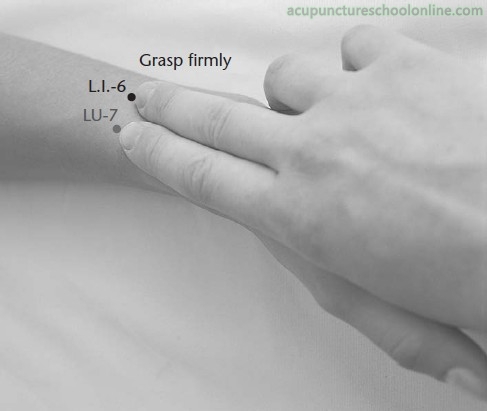 |
3 cun proximal to Yangxi L.I.-5 on the line connecting Yangxi L.I.-5 with Quchi L.I.-11
Transverse-oblique insertion, 0.5 - 1 cun
"The Yangming usually has much Qi and much Blood" (Su Wen 素問 ch. 24) implying this channel can normally be needled or bled.
"The hand Yin and Yang receive their Qi via nearby paths so their Qi arrive swiftly. The depth of piercing must not exceed 2 fen and must not remain inserted for longer than one exhalation" (Ling Shu 靈樞 ch. 12).
"It is needled to a depth of three fen, (the needle) is retained for a duration of seven exhalations, and it is moxaed with three cones" (Huangfu Mi 皇甫謐, 3rd Century, Zhenjiu Jiayi Jing 針灸甲乙經).
Expels Wind and clears Heat
Opens and regulates the water passages
Superficial Innervation: Lateral cutaneous nerve of the forearm from C5 - C6
Dermatome Segment: C6
Striking this point causes great Qi drainage and local pain. Struck hard enough will
cause knock out. Communication between the Upper and Lower Jiao is upset greatly causing internal damage to the flow of Qi. In the long term, emotional disturbances will build up because this strike causes the elimination of both bad emotions and bad thoughts to be held inside (Montaigue, Dim Mak Locations, Taijiworld.com).
Shared with Taiyuan Lu-9. Balanced by ䷙ (Chongyang St-42 or Gongsun Sp-4).
Hexagram attributions are my own with an explanation given in the glossary.
Translations are my own, assisted by DSeek and compared to Richard Rutt's interpretion (2002).
Ling Shu Ch. 6 suggests piercing the Luo points if a disease is in the Yang of the Yin realm (e.g. the Fu organs) implying this point for disorders of the Large Intestine.
Ling Shu Ch. 10, On Channels, describes the diseases relating to the Luo emanating from this point as:
Repletion: Teeth decay and hearing is impaired
Depletion: Teeth are cold with a blockage barrier
(Unschuld, 2016).
Ling Shu Ch. 19, On the Four Seasonal Qi, advises using the channels and Luo vessels for diseases which occur in spring. They are pierced deeply if severe and more shallow if mild. For the other seasons:
- in summer choose the Yang channels and Luo located in the partings between the skin and flesh
- in autumn choose the Shu-Stream points unless the disease in the Fu organs, then use the He-Sea points
- in winter choose Jing-Well and Ying-Spring opening and retain the needle.
Ling Shu Ch. 21, On Cold and Heat Diseases, repeats the advice to use Luo in spring but and adds that they can also treat diseases of the skin. For the other seasons it differs slightly from Ch. 19:
- in summer choose the partings in skin structures which also treat the muscle and flesh
- in autumn Taiyuan Lu-9 is chosen and can treat the sinews and vessels (this may also apply to other Shu-Stream points for this purpose, text is unclear)
- in winter one chooses the main channel points which also treat the bones and marrow.
Ling Shu Ch. 22, On Mania and Madness, advises to bleed this channel in instances of insanity. The original just states the division (eg. bleed hand Yangming) implying the main channel by omission but since it recommends bleeding the data is being entered under the Luo points unless a specific point is mentioned:
- It advises to bleed the vessels of arm Taiyang, Yangming and Taiyin at the onset when the patient is unhappy, the head feels heavy and they stare forward or upwards with red eyes, the heart is vexed and the complexion changes. Treatment is stopped once the colour changes (Unschuld, 2016, says "the colour of the blood changes", Wu & Wu, 2010, says "colour of the patient's complexion").
- If there is distortion of the mouth, shouting and wailing then only the Taiyang and Yangming are used on the opposite side to where there is excess.
- If in early stages of madness when sadness and hunger lead to the patient being grieved and forgetful, easily enraged with a tendency to be fearful, blood is removed from the hand Taiyang and Yangming. The foot Taiyin and Yangming can also be used (Unschuld, 2016, suggests it as an alternative, Wu & Wu, 2010, suggests it as an addition).
- If they sleep little, are not hungry, consider themselves extraordinary and are insulting to others then blood is removed from the hand Taiyang, Yangming and Taiyin as well as the Shaoyin point under the tongue (Lianquan Ren-23 which terminates at the Shaoyin meridian in Ling Shu, Ch. 5. Unschuld, 2016, cites a comment that also adds Shenmen He-7, Shaochong He-9 to this). Only vessels that show an abundance are bled, those without are spared.
- If a massive fright causes them to be easily startled, tend to laugh, sing and be happy then blood is removed from the hand Yangming, Taiyang and Taiyin.
- If they have absurd visions and shout then remove blood from the hand Taiyang, Taiyin and Yangming (Wu & Wu, 2010, add foot Taiyang too) and on the cheeks of the head (Unschuld, 2016, describes them as on the foot Taiyin but the channel does not go to here).
- If a major delight causes a person to see demon-spirits and laugh inside but be unable to express it then blood is removed from the foot Taiyin, Taiyang and Yangming, and then from the hand Taiyin and Yangming.
In Tung acupuncture the Qi Men, Cycle Gate, point is located 1 cun distal to this point, or 2 cun proximal to Yangxi LI-5, and the Qi Jiao, Cycle Horn, point is located 1 cun proximal to this point (4 cun proximal to Yangxi LI-5) on the Large Intestine line. Both of their indications include many problems of the lower abdomen (bowel, gynae and urinary) as well as the throat and neck. They are often combined with each other and Qi Zhen, 1 cun proximal to Weiliu LI-7 or 6 cun proximal to Yangxi LI-5 (Chu, 2015).
歴 refers as much to an experiential passage as a physical one, in a similar way to the term 道 Dao. The Su Wen Ch.8 describes the Large Intestine as the "Transmitter of the Way" 傳道 invoking an image of this point being related to when one deviates from the Way, seen most starkly in Dian Kuang; mental disorders most often connected with the Yangming channels with manic episodes.
Avicenna describes venesection along the accessory cephalic vein that runs approximately along the course of the arm Yangming Large Intestine channel in his treatise On Venesection:
"The cephalic vein drains more blood from the neck and above, and little from below the neck, but it does not exceed the epigastrium, and it does not significantly cleanse the lower parts... The accessory cephalic vein is similar to the cephalic." (Aspects of Treatment According to General Diseases, 21st section in Abu-Asab, Amri & Micozzi, 2013, Avicenna's Medicine).
The median cubital or basilic veins are used for the lower body.
Medieval phlebotomy point (Hans von Gersdorff, 1517: Feldtbüch der Wundartzney, www.nlm.nih.gov)
Basic information on location, needle depth, TCM actions, indications and combinations is taken from Deadman et al (2001): A Manual of Acupuncture with additional anatomical information researched by reference to Gray's Anatomy (38th Ed., 1995) unless otherwise referenced. Images were found on acupunctureschoolonline.com and can be traced back to Claudia Focks (2008) Atlas of Acupuncture originally. I cannot claim any credit or rights over them. Other sources should be quoted in the text.
For some of the more unusual terms I have created a glossary here
Woodley Bioenergetics
90 Deane Croft Road,
Eascote, Pinner, Greater London. HA5 1SP
Tel/WhatsApp: +44 (0) 7946 174 829
Email: steve@steve-woodley.co.uk