 |
Location Guides: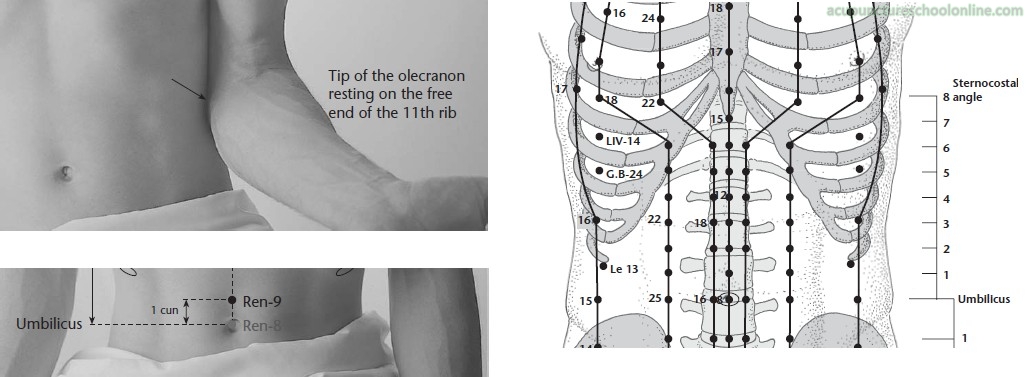 |
Front Mu of the Spleen
Hui-Meeting pointt of the Zang
Origin of the Dai Mai
Binding point of the foot Taiyin Sinews
Shokanten Nine Continents Point of the Upper Jiao, Taiyin and Liver
Meeting of Liver with Gall Bladder, Dai Mai, Gall Bladder Divergent, Liver Divergent, Stomach Divergent and Spleen Divergent
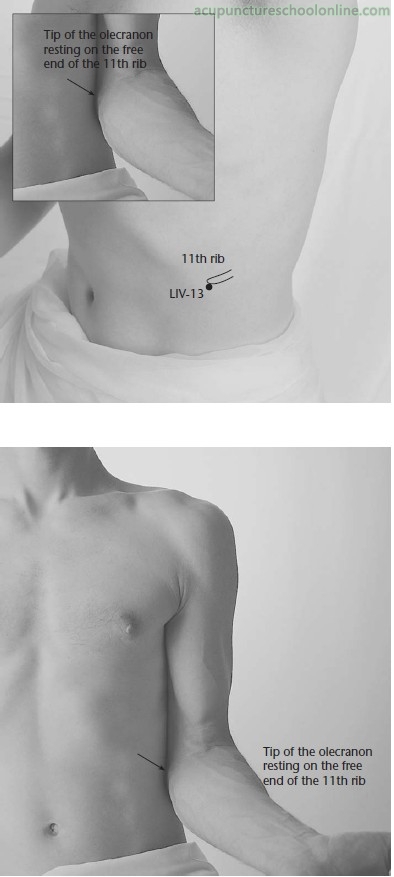
Directly anterior and inferior to the free end of the eleventh rib. This point is usually lies just above the level of the umbilicus and on or near the mid-axillary line.
Transverse of oblique insertion medially or laterally, along the line of the rib 0.5 - 1 cun
Deep perpendicular needling may damage an enlarged liver or spleen
"The Jueyin usually has much Blood and little Qi" (Su Wen 素問 ch. 24) implying this channel should normally be bled.
"The foot Jueyin is to be pierced 1 fen deep and remain inserted for two exhalations" (Ling Shu 靈樞 ch. 12).
"Locate with the patient lying on their side with the upper leg bent, the
lower extended, and the arm raised. It is needled to a depth of eight fen, and (the needle) is retained for a duration of six exhalations. It is moxaed with three cones" (Huangfu Mi 皇甫謐, 3rd Century, Zhenjiu Jiayi Jing 針灸甲乙經).
Harmonises the Liver and Spleen
Regulates the Middle and Lower Jiao
Fortifies the Spleen
Spreads the Liver and regulates Qi
Hexagram attributions are my own with an explanation given in the glossary.
Superficial Innervation: Lateral cutaneous thoracic nerve from T11
Dermatome Segment: T11
In seizing martial arts (Qin Na) striking the right side of the abdomen, just the under the ribcage, located approximately at this point, is a method of striking the organs (Da Qi Guan, 打器官) in order to cause a rupture the liver (Yang, 2004, Analysis of Shaolin Chin Na, 2nd Edition).
Presumably striking the left side would have a similar impact on the spleen.
One of the 36 vital points of Feng Yiyuan 馮一元 listed in the Wu Bei Zhi 武備志 (Treatise on Armament Technology) by Mao Yuanyi 茅元儀 (1621) (McCarthy, 2016, Bubishi: The Classic Manual of Combat).
Great physical damage and even rupture of the Spleen or Liver can be done as well as great electrical damage. It can cause emotional disturbances later in life (Montaigue, Dim Mak Locations, Taijiworld.com).
This is one of the eight non-striking or forbidden points in Northern Praying Mantis Kung Fu. Described as "The sides of the diaphragm" by Olson (2010, The Complete Guide to Northern Praying Mantis Kung Fu) and "the false ribs" by Wong Honfan (1946; in Ravenswood Academy, 2020, The Eight Forbidden Strikes of Praying Mantis Fist).
As the Front Mu of the Spleen on the Liver channel this point is especially useful for Liver/Spleen disharmony. However, it can also be used to fortify the Spleen in the absence of Liver pathology, or soothe the Liver in without involvement of the Spleen. Its classification as the Hui of the Zang makes it useful regardless of where the Liver Qi Stagnation is causing problems.
This point is also on the 3rd trajectory of the Chong mai connecting the Chong with the Du (Yuen, 2005, The Extraordinary Vessels).
Ling Shu Ch. 59, On Abnormal Wei Qi, advises this point combined with Renying St-9, Tiantu Ren-22, Lianquan Ren-23 (referred to as Houzhong) Qichong St-30 and Zusanli St-36 to drain accumulations in the chest and abdomen. In severe cases a "chicken claw" technique, using three needles positioned like the character 个 Ge, are to be used. If the pulse is large and wiry and the the abdomen is tense it must not be pierced.
Shang Han Lun, line 343, advises using moxa on Jueyin if a Jueyin pattern has lasted 6 or 7 days and is accompanied by faint pulse, reversal cold of the extremities, vexation and agitation. If it fails to restore the reversal the condition was considered fatal. Zhang Xi-Ju suggests this means using this point and Xingjian Liv-2 while Chang Qi-Zhi suggests Taichong Liv-3. (Mitchell, Ye and Wiseman, 1999, Shang Han Lun).
The cathartic release of emotion through the Liver is explained as follows:
- Bleed Ligou Liv-5 to clear Cold in the Liver that gives rise to an inability to act.
- Tonify Ququan Liv-8 (Mother of Liver), Zhangmen Liv-13 and Qimen Liv-14 to help the patient cope with the release.
- Disperse Guangming GB-37 to help illuminate one's path in life. When we let go of our emotional fixations we can have a clear vision of the world. (Chin, 2003, The Luo Vessels, The Luo Vessels).
Jin's Three Needles for Weight Reduction are located at Zhongwan Ren-12, Zusanli St-36 and a point 1.8 cun inferior to this point threaded along the Dai Mai towards the umbilicus with a 4 cun needle and stimulated with tense and disperse electrical stimulation. They are indicated for obesity, especially belly fat (eLotus, 2021).
Shokanten points are often used in Japanese acupuncture to treat conditions arising from a psycho-emotional background. This point affects the Upper Jiao, Taiyin, Lungs and Liver.
The Front Mu points make likely locations for application of leeches to reduce fevers according to François Broussais' (1772-1838) philosophy who believed in placing them over the diseased organs to reduce inflammation (Greenstone, 2010, The history of bloodletting, BCMJ, Vol. 52, No. 1, Pp 12-14).
Lad and Durve (2008) in Marma Points of Ayurveda call this point Parshva Sandhi and associate it with the doshas: Prana Vayu, Udana Vayu Sadhaka Pitta, Ranjaka Pitta and Avalambaka Kapha.
They give the following functions:
- Enhances flow of prana
- Benefits the lungs and respiration
- Benefits liver, spleen and kidney function
- Relieves pain locally
Basic information on location, needle depth, TCM actions, indications and combinations is taken from Deadman et al (2001): A Manual of Acupuncture with additional anatomical information researched by reference to Gray's Anatomy (38th Ed., 1995) unless otherwise referenced. Images were found on acupunctureschoolonline.com and can be traced back to Claudia Focks (2008) Atlas of Acupuncture originally. I cannot claim any credit or rights over them. Other sources should be quoted in the text.
For some of the more unusual terms I have created a glossary here
Woodley Bioenergetics
90 Deane Croft Road,
Eascote, Pinner, Greater London. HA5 1SP
Tel/WhatsApp: +44 (0) 7946 174 829
Email: steve@steve-woodley.co.uk