|
Location Guides: |
 |
Luo Harmonizing point
Binding point of the foot Yangming Sinews
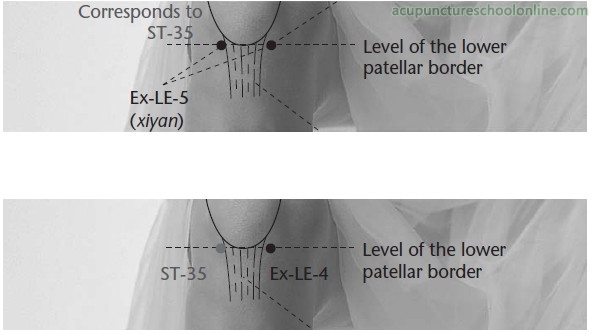
On the knee, in the hollow formed when the knee is flexed, immediately below the patella and lateral to the patellar ligament.
With the knee flexed and supported by a rolled pillow: perpendicular insertion directed towards Weizhong Bl-40, 1 - 2 cun, or oblique insertion in a medial and superior direction, behind the patella 1 - 2 cun, or behind the patella ligaement to join with medial Xiyan (MN-LE-16)
"The Yangming usually has much Qi and much Blood" (Su Wen 素問 ch. 24) implying this channel can normally be needled or bled.
"The foot Yangming is to be pierced 6 fen deep and remain inserted for ten exhalations" (Ling Shu 靈樞 ch. 12).
"It is needled to a depth of six fen, and it is moxaed with three cones" (Huangfu Mi 皇甫謐, 3rd Century, Zhenjiu Jiayi Jing 針灸甲乙經).
Dispels Wind-Damp and reduces swelling
Activates the channel and alleviates pain
Superficial Innervation: Lateral femoral cutaneous nerve of the calf from L4 - S1
Dermatome Segment: L5
Striking this point causes local pain and knee injury immediately followed by severe Kidney Qi drainage and damage causing immediate loss of power and tiredness (Montaigue, Dim Mak Locations, Taijiworld.com).
Ling Shu Ch. 26, On Miscellaneous Diseases, advises this point is pierced for pain in the knee. It is recommended to be employed at brief intervals.
At the end of a Stomach Luo treatment this point is needled, deqi grasped and removed immediately to normalize the circulation of blood (Cecil-Sterman, 2012, Advanced Acupuncture).
In Mayan medicine:
Used to treat pain in the lower limbs (Garcia, Sierra, Balam, 1999: Wind in the Blood)
Medieval phlebotomy point (Hans von Gersdorff, 1517: Feldtbüch der Wundartzney, www.nlm.nih.gov)
Basic information on location, needle depth, TCM actions, indications and combinations is taken from Deadman et al (2001): A Manual of Acupuncture with additional anatomical information researched by reference to Gray's Anatomy (38th Ed., 1995) unless otherwise referenced. Images were found on acupunctureschoolonline.com and can be traced back to Claudia Focks (2008) Atlas of Acupuncture originally. I cannot claim any credit or rights over them. Other sources should be quoted in the text.
For some of the more unusual terms I have created a glossary here
Woodley Bioenergetics
90 Deane Croft Road,
Eascote, Pinner, Greater London. HA5 1SP
Tel/WhatsApp: +44 (0) 7946 174 829
Email: steve@steve-woodley.co.uk