 |
Spirit point
Master Tung's Five Mountain Ranges
Master Tung's Nine Monkeys
Master Tung's Three Metals
Master Tung's Capital Points
Master Tung's Behind the Heart Points
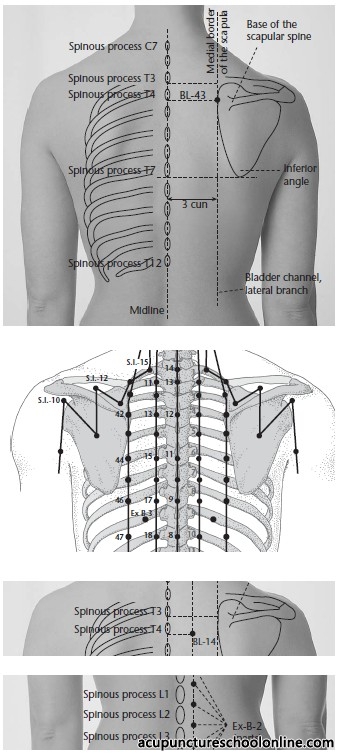
3 cun lateral to the midline, level with the lower border of the spinous process of the fourth thoracic vertebra (T4) and level with Jueyinshu Bl-14.
Oblique insertion 0.3 - 0.5 cun
Deep perpendicular or deep oblique needling in a medial direction carries a substantial risk of causing a pneumothorax.
"The Taiyang usually has much Blood and little Qi" (Su Wen 素問 ch. 24) implying this channel should normally be bled.
"The foot Taiyang is to be pierced 5 fen deep and remain inserted for seven exhalations" (Ling Shu 靈樞 ch. 12).
Tonifies and nourishes the Lung, Heart, Kidneys, Spleen and Stomach
Nourishes Yin and clears Heat
Calms the Shen
Fosters the original Qi
Resolves Phlegm
Superficial Innervation: Posterior cutaneous thoracic nerves from T4
Dermatome Segment: T4
In seizing martial arts (Qin Na) this point is a breath sealing point (Bi Qi, 閉氣). Striking this cavity may cause the lung to contract and seal the breath (Yang, 2004, Analysis of Shaolin Chin Na, 2nd Edition).
One of the 36 vital points of Feng Yiyuan 馮一元 listed in the Wu Bei Zhi 武備志 (Treatise on Armament Technology) by Mao Yuanyi 茅元儀 (1621) (McCarthy, 2016, Bubishi: The Classic Manual of Combat).
See Montaigue, Dim Mak Locations, Taijiworld.com for explanation of effects.
In five element acupuncture indicated for a fire cf, weakness from chronic diseases, generalized fatigue.
Wang Zhizhong (12th century) in Supporting Life with Acupuncture and Moxibustion, claims that this point treats everything including marked emaciation, seminal loss while dreaming, counterflow Qi ascent with cough, mania and forgetfulness, and more. It is especially effective if combined with Zusanli St-36 and Yongquan Kid-1 (Lu & Wilcox, 2014).
For Gu Poison apply vigorous garlic moxibustion to this point (Qugu Ranxi Lu, Master Ranxi’s Treatise on Expelling Gu Toxins, 1893, in Fruehauf, 1998, Driving Out the Demons and Snakes).
In Master Tung's system this point is one of the five mountain ranges (Wu Ling). They consist of five sets of points in three lines representing the phases of the Wu Xing in a series of lines:
The first set is along the midline, below each vertebrae from T2 to T11. From T2 to T8 relate to Fire, T9 to T11 relate to Earth.
The second set is 3 cun from the midline. from T2 to T9. From T2 to T6 relate to Metal, T7 to T9 relate to Wood.
The third set is 6 cun from the midline from T2 to T8. From T2 to T4 relate to Metal, T5 to T8 relate to Wood.
They are indicated for fever, common cold, hypertension, headache, lumbar pain, numbness of the hands and feet, hemiplegia, acute stomachache, vomiting or acute enteritis by releasing heat, wind and stagnation from the organs relating to their phase and treated with a pricking method to release a drop of blood (McCann, 2014, Pricking the Vessels).
This point is also one of the Nine Monkeys (Jiu Hou) in Tung Lineage acupuncture. They are located at 1.5 cun and 3 cun lateral from the midline level with T2, T3 and T4 and 6 cun from the midline, level with T1, T2 and T3. They are pricked to bleed in cases of scarlet fever and phlegm stuck in the bronchia that cannot be expelled (ibid.).
It is also the location of Tung's Three Metals (San Jin) located at Bl-42, Bl-43 and Bl-44 for knee pain (ibid.).
Tung's Capital (Ding Zhu) points are located 3 cun lateral to the midline from T4 to T9 and 6 cun lateral to the midline from T4 to T8 indicated for lumbar pain, especially when associated with arteriosclerosis, acute back sprain and chest pain upon breathing (ibid.)
Tung's Behind the Heart (Hou Xin or Bei Xin) points are located under spinous processes from T4 to T9, 1.5 cun laterally to T4 to T7 and 3 cun laterally from T4 to T6. They are indicated for "wool like furuncles", clove sores, weakness and debility of the Heart zang, Stomach diseases, acute heart disease leading to numbness and paralysis, wind-cold entering the interior, severe wind-cold, stroke, externally contracted diseases that manifest with papules. They clear heat from the Heart and Lung and release the exterior so are useful in dermatological disorders (ibid.).
This sort of technique may make greater sense than regular needles as shallow depth without retention may be safer over the spine and lungs and the larger gauge used may provide better stimulation to this relatively insensitive area.
Basic information on location, needle depth, TCM actions, indications and combinations is taken from Deadman et al (2001): A Manual of Acupuncture with additional anatomical information researched by reference to Gray's Anatomy (38th Ed., 1995) unless otherwise referenced. Images were found on acupunctureschoolonline.com and can be traced back to Claudia Focks (2008) Atlas of Acupuncture originally. I cannot claim any credit or rights over them. Other sources should be quoted in the text.
For some of the more unusual terms I have created a glossary here
Woodley Bioenergetics
90 Deane Croft Road,
Eascote, Pinner, Greater London. HA5 1SP
Tel/WhatsApp: +44 (0) 7946 174 829
Email: steve@steve-woodley.co.uk