 |
Location Guides: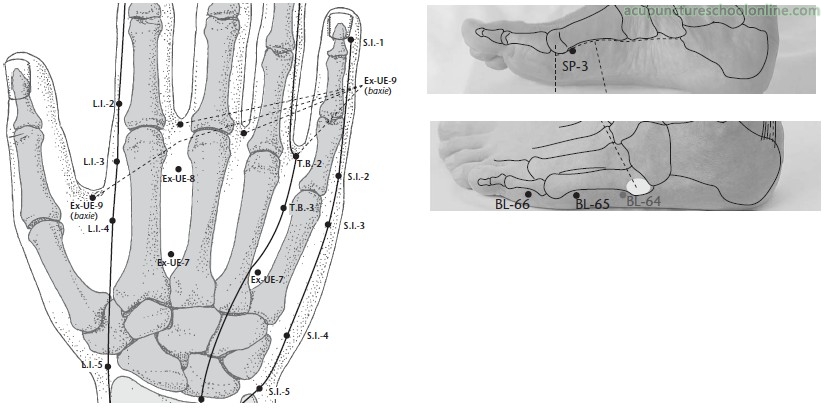 |
Shu-Stream and Wood point
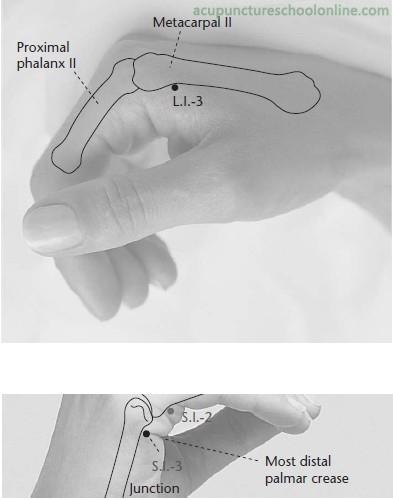
On the radial side of the index finger, in the substantial depression proximal to the head of the second metacarpal bone
Perpendicular insertion 0.5 - 2 cun, directed towards Houxi SI-3, or transverse insertion to Hegu LI-4 as part of "Jian Xi to Gu Needling".
"The Yangming usually has much Qi and much Blood" (Su Wen 素問 ch. 24) implying this channel can normally be needled or bled.
"The hand Yin and Yang receive their Qi via nearby paths so their Qi arrive swiftly. The depth of piercing must not exceed 2 fen and must not remain inserted for longer than one exhalation" (Ling Shu 靈樞 ch. 12).
"It is needled to a depth of three fen, (the needle) is retained for a duration of three exhalations, and it is moxaed with three cones" (Huangfu Mi 皇甫謐, 3rd Century, Zhenjiu Jiayi Jing 針灸甲乙經).
Expels Wind and Heat
Clears Heat and benefits the throat and teeth
Dispels fullness and treats diarrhoea
Shared with Shaoshang Lu-11. Balanced by ䷑ (Liangqiu St-34 or Diji Sp-8).
Hexagram attributions are my own with an explanation given in the glossary.
Superficial Innervation: Superficial branch of radial nerve from C6 - C8
Dermatome Segment: C7
Combined with Erjian LI-2, a strike at this point can cause temporary blindness but is very difficult to achieve (Montaigue, Dim Mak Locations, Taijiworld.com).
Ling Shu Ch. 19, on the Four Seasonal Qi, advises using the Shu-Stream points, unless the diseases are in the Fu organs, in which case the He-Sea points are chosen.
In Tung acupuncture this equates to the Da Bai, Big White, point (22.04) and is often combined with Ling Gu at the other end of the bone, between the first and second metacarpals, slightly proximal to LI-4. Their location on the arm Yangming which controls Qi and Blood in the entire body together with their ability to move Qi and Blood make them applicable for most diseases (Chu, 2015).
In "Jian Xi to Gu Needling" Sanjian LI-3 and Yangxi LI-5 are needled transversely to meet at Hegu LI-4 in treatment of pain and heat in the upper body. Electro-stimulation can be applied too (Liu Yan, 2008, Diagrams of Acupuncture Manipulations, p.136).
In the Maoshan Daoist tradition, when the 12 earthly branches, I Ching trigrams and elements are mapped onto the hand the knuckle of the index finger next to this point equates to the branch 寅 Yin, the Trigram ☵ Kan, Water and the element of Wood (Read, 2020, FB Post; 17QQ.com, 2020, Eight trigrams and twelve Branches of the earth palm).
In ayurvedic medicine:
Kshipra marma point
Size: 1/2 angula (cun)
Structure: Tendon
Effect of Injury: Belatedly fatal (kalantarpranahar marma)
(Harish Johari, 1996, Ayurvedic Massage, Sanatan Society; Anupama Bhattacharya, n.d. Marma Shastra)
Basic information on location, needle depth, TCM actions, indications and combinations is taken from Deadman et al (2001): A Manual of Acupuncture with additional anatomical information researched by reference to Gray's Anatomy (38th Ed., 1995) unless otherwise referenced. Images were found on acupunctureschoolonline.com and can be traced back to Claudia Focks (2008) Atlas of Acupuncture originally. I cannot claim any credit or rights over them. Other sources should be quoted in the text.
For some of the more unusual terms I have created a glossary here
Woodley Bioenergetics
90 Deane Croft Road,
Eascote, Pinner, Greater London. HA5 1SP
Tel/WhatsApp: +44 (0) 7946 174 829
Email: steve@steve-woodley.co.uk