|
Location Guides: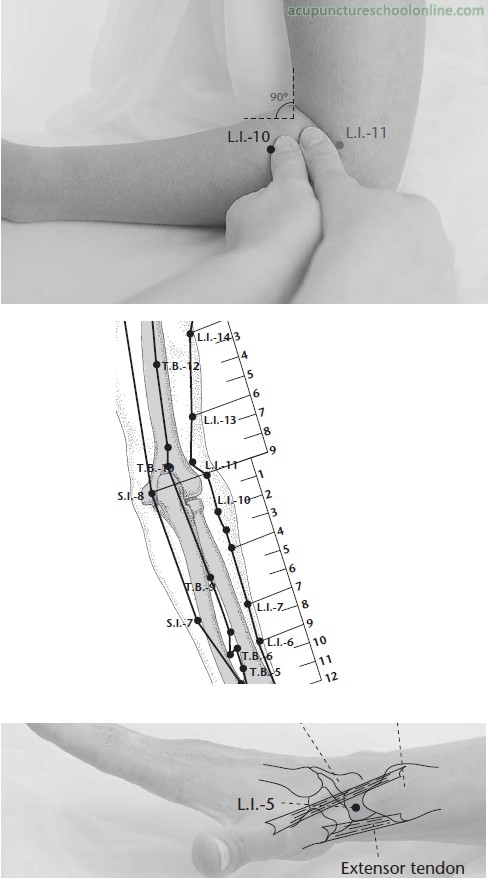 |
Binding point of the hand Yangming Sinews
Homeostatic point 1 (Ma, Ma & Cho, 2005, Biomedical Acupuncture for Pain Management)
Trigger point (Travell & Simons, 1998, Trigger Point Manual)
On the radial side of the forearm, 2 cun distal to Quchi L.I.-11 on the line connecting Quchi L.I.-11 with Yangxi L.I.-5
Perpendicular or oblique insertion, 0.5 - 1.5 cun
"The Yangming usually has much Qi and much Blood" (Su Wen 素問 ch. 24) implying this channel can normally be needled or bled.
"The hand Yin and Yang receive their Qi via nearby paths so their Qi arrive swiftly. The depth of piercing must not exceed 2 fen and must not remain inserted for longer than one exhalation" (Ling Shu 靈樞 ch. 12).
"It is needled to a depth of three fen and moxaed with three cones" (Huangfu Mi 皇甫謐, 3rd Century, Zhenjiu Jiayi Jing 針灸甲乙經).
Regulates Qi and Blood, activates the channel and alleviates pain
Harmonises the Intestines and Stomach
Superficial Innervation: Posterior cutaneous nerve of the forearm (C6 - C8)
Dermatome Segment: C5
Deeper Structures: Deep radial from the posterior branch of the brachial plexus (C5 - T1)
Muscle:
Brachioradialis
Pain Referral Pattern:
To lateral elbow and dorsal aspect of base of thumb
Indications:
Pain in lateral elbow, wrist and hand
One of the 36 vital points of Feng Yiyuan 馮一元 listed in the Wu Bei Zhi 武備志 (Treatise on Armament Technology) by Mao Yuanyi 茅元儀 (1621). Also listed in Article 9: Twelve-Hour (Shichen 時辰) Vital Points Revealed as the vital point associated with the Mao 卯 Rabbit (5 - 7 am) and the Large Intestine meridian. Article 24: Bronze Man Statue, which divides the body into zones associated with the Twelve-Hour branches (Shichen 時辰) going from top downwards, the lower bicep and elbow (He-3, SJ-10, SI 8, LI 10, LI 11, LI 12 & Lu 5) and the xiphoid process (Juque Ren-14) are the vital points of Wu 午 Horse (11 am - 1 pm) and considered most vulnerable to a palm thrust during this time (McCarthy, 2016, Bubishi: The Classic Manual of Combat).
Striking will paralyse the arm, and in some cases stop the heart. It causes a shock wave to rise up the arm into the upper body and neck, causing knock out if struck hard enough. Due to its affect on the neck, it can be combined with Renying St-9 for a deathblow. Struck slightly upwards, the lower body will lose Qi with nausea. When struck slightly downwards (down the forearm towards the fingers), the bowels may open on the spot! When struck straight in, the lower abdomen will go into spasm, the arm becomes paralysed and there may be residual diarrhoea for a number of days (Montaigue, Dim Mak Locations, Taijiworld.com).
This point is the arm equivalent of Zusanli St-36 and can be used as its replacement if Zusanli St-36 is unavailable or inappropriate. Classical texts sometime simply refer to Sanli implying either or both and suggests this point has a far wider range of actions than given in TCM including tonifying, cooling, calming the mind and reviving the spirit.
Furthermore, in the 12 Earthly Branches system from which the Chinese Clock is derived, the Large Intestine and Kidney are opposite one another suggesting that they balance or complement each other and both are located in the Lower Jiao. This may suggest that this point can have a stronger influence on the Kidneys and Yuan Qi.
According to Ma, Ma & Cho (2005) this point the best indicator of homeostatic decline and self-healing potential. It is the first to become sensitive to palpation when homeostasis is disrupted and as homeostasis and self-healing potential declines more points along the radial nerve (Large Intestine channel) become tender. The more points are tender the less responsive to acupuncture the patient may be.
Avicenna describes venesection along the accessory cephalic vein that runs approximately along the course of the arm Yangming Large Intestine channel in his treatise On Venesection:
"The cephalic vein drains more blood from the neck and above, and little from below the neck, but it does not exceed the epigastrium, and it does not significantly cleanse the lower parts... The accessory cephalic vein is similar to the cephalic." (Aspects of Treatment According to General Diseases, 21st section in Abu-Asab, Amri & Micozzi, 2013, Avicenna's Medicine).
The median cubital or basilic veins are used for the lower body.
In Thai massage:
Acupressure point (Salguero & Roylance, 2011, Encyclopedia of Thai Massage)
Basic information on location, needle depth, TCM actions, indications and combinations is taken from Deadman et al (2001): A Manual of Acupuncture with additional anatomical information researched by reference to Gray's Anatomy (38th Ed., 1995) unless otherwise referenced. Images were found on acupunctureschoolonline.com and can be traced back to Claudia Focks (2008) Atlas of Acupuncture originally. I cannot claim any credit or rights over them. Other sources should be quoted in the text.
For some of the more unusual terms I have created a glossary here
Woodley Bioenergetics
90 Deane Croft Road,
Eascote, Pinner, Greater London. HA5 1SP
Tel/WhatsApp: +44 (0) 7946 174 829
Email: steve@steve-woodley.co.uk