 |
Location Guides: |
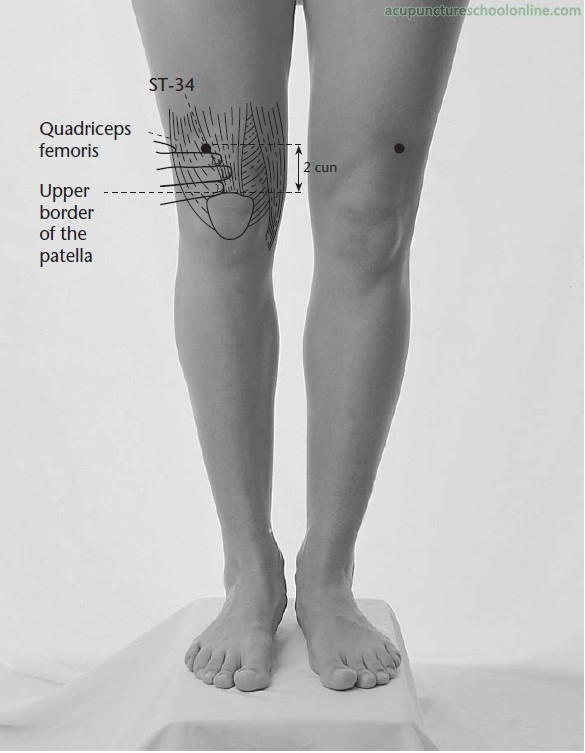
On the thigh, on a line drawn between the lateral border of the patella and the ASIS, in a depression 2 cun proximal to the superior border of the patella.
Perpendicular or oblique insertion 1 - 1.5 cun
"The Yangming usually has much Qi and much Blood" (Su Wen 素問 ch. 24) implying this channel can normally be needled or bled.
"The foot Yangming is to be pierced 6 fen deep and remain inserted for ten exhalations" (Ling Shu 靈樞 ch. 12).
"It is needled to a depth of three fen and moxaed with three cones" (Huangfu Mi 皇甫謐, 3rd Century, Zhenjiu Jiayi Jing 針灸甲乙經).
Activates the channel and alleviates pain
Harmonises the Stomach and alleviates pain
Moderates acute conditions
Superficial Innervation: Intermediate femoral cutaneous nerve of the thigh from L2 - L4
Dermatome Segment: L3
As a Xi-cleft point where accumulates, striking it causes loss of power due to a hindrance of Qi and Blood. Local pain and loss of leg power is immediately apparent (Montaigue, Dim Mak Locations, Taijiworld.com).
䷑ Gu 蠱 Decaying, cursed, poison
蠱 (gu) is composed of:
蟲 (chong) — worms, insects, venomous creatures
皿 (min) — a vessel, a bowl, a container
The original image is of insects in a dish or a sealed vessel. This originally referred to spoiled grain that has become infested with insects, described as "flying grain" because, when disturbed, the insects would fly out. It was obviously toxic to eat and inauspicious for an offering. In Han times, the character was repurposed to refer to this as a means of cursing someone: poisonous insects were placed together in a container and left to devour one another. The survivor, having absorbed all the poisons of the others, was considered the most potent. This creature was called 蠱 Gu, and it was used to inflict harm upon others by devouring its target from within. It was notoriously hard to treat and has led some modern writers to consider that it may have been referring to complex disorders that involve disturbance of the microbiome and metabolism with chronic inflammation.
Trigrams: Xun (Wind) below, Gen (Mountain) above.
Penetration within, stillness without — wind beneath the mountain. The wind is trapped and cannot circulate. What is sealed inside begins to fester. This is gu: poison, curse, decay. Something alive and harmful is trapped within, consuming from within. On a more literal level, the mountain is earth, the Spleen and Stomach, and the Dai Mai, the binding vessel, while wind indicates a pathogen trapped within.
Nuclear Trigrams: Lines 2-3-4 form Dui (Lake). Lines 3-4-5 form Zhen (Thunder). Beneath the decay, there is joy (Dui) and movement (Zhen). The hidden message: the poison is alive. It is not passive rot. It is active, working, consuming. But the joy and movement also mean it can be transformed.
Judgement:
元亨,利涉大川。先甲三日,後甲三日。
Supreme opening. Beneficial to cross the great river. Before the first day, three days; after the first day, three days.
Even poison can be transmuted. The work of purification is not just cleaning up — it is alchemy, the transformation of a curse into a blessing, working on the Yuan level. Dealing with poison requires courage. You cannot purify what has been cursed without entering the dangerous territory where the poison lives. You cannot purify a poison without understanding its origin and its destiny.
Overall: Gu is poison, curse, decay — something alive and harmful trapped within. But it can be purified. The work requires courage (crossing the great river) and understanding (the full cycle of before and after). What has been cursed can be transformed.
Lines:
| Line | Yin/Yang | Image | Literal Translation | Clinical Reading |
|---|---|---|---|---|
| 1 | Yin | 幹父之蠱,有子,考無咎,厲終吉 | Working on the father's gu. There is a son. The deceased father has no trouble. Danger, but in the end auspicious. | The father's poison suggests it is the initial seed. The fact that the father is dead though, implies decay. However, its origin is unimportant and hence no trouble. What matters is the offspring it has created, the current Gu, which is dangerous and should be resolved immediately. |
| 2 | Yang | 幹母之蠱,不可貞 | Working on the mother's gu. It cannot be burned. | The mother's poison implies it is gestating within and becoming established at the point. Do not apply moxa now as warmth will encourage its growth, just as it speeds up decay. |
| 3 | Yang | 幹父之蠱,小有悔,無大咎 | Working on the father's gu. Small remorse, no great trouble. | Once again it is working on the seed, but this time, it is because it threatens to escape the point and fertilise other areas. It is recognised that it could have been dealt with sooner, but it is still possible to resolve without great difficulty because it is essentially seeding. |
| 4 | Yin | 裕父之蠱,往見吝 | Indulging the father's gu. Going brings regret. | The Gu has not been dealt with at the point level and is now seeded elsewhere. Allowing it to go further will bring regret. |
| 5 | Yin | 幹父之蠱,用誉 | Working on the father's gu, using praise. | A more systemic approach is required, seeking a renowned practitioner as the situation is complex and always spreading. |
| 6 | Yang | 不事王侯,高尚其事 | Not serving kings and lords, highly esteeming one's own affairs. | The poison is dominating and corrupting the Zheng Qi, so it no longer serves the Zangfu (the kings and lords). Instead it pursues its own goals of corruption and decay. |
Image:
山下有風,蠱。君子以振民育德。
Wind beneath the mountain: Gu. Thus the gentleman stirs the people and nourishes virtue.
Wind is beneath the mountain — the air is trapped and stagnant. This is the sealed vessel where the poison breeds. The gentleman stirs the people and nourishes virtue. The work of purification is not just fixing what is broken. It is revitalising what has become stagnant and cultivating the virtue that prevents future decay. You do not just purge the poison — you create the conditions where poison cannot breed again.
Acupuncture Point Connections:
Shared with Diji Sp-8.
Inverted into and balanced by ䷐ (Sanjian LI-3 or Shaoshang Lu-11).
Hexagram attributions are my own with an explanation given in the glossary.
Translations are my own, assisted by DSeek and compared to Richard Rutt's interpretion (2002).
The Hexagram associated with this point is ䷑ 蠱 Gu, referring to a worm or insect that causes spoilage and was used as a means of cursing enemies. This point's grouping as a Xi-Cleft point on the Stomach channel gives it actions on acute gastrointestinal symptoms common in Gu illness.
In Mayan medicine:
Used for pain in the feet and legs (Garcia, Sierra, Balam, 1999: Wind in the Blood)
In ayurvedic medicine:
Ani marma point
Size: 1/2 angula (cun)
Structure: Tendon
Effect of Injury: Disability (vaikalyakar marma)
(Harish Johari, 1996, Ayurvedic Massage, Sanatan Society; Anupama Bhattacharya, n.d. Marma Shastra)
In Tibetan medicine:
Moxa point (AMNH, Tibetan Medical Paintings)
In Thai massage:
Point along the Itha (left) and Pingala (right) sen lines running from the navel Shenque Ren-8 to this point where it turns to the back of the knee Weizhong Bl-40.
Also point along the Sahatsarangsi (left) and Tawaree (right) sen lines ascending up the outer leg to the chest and terminating in the eyes Chengqi St-1.
Indicated for knee pain/injury/arthritis.
(Salguero & Roylance, 2011, Encyclopedia of Thai Massage)
Basic information on location, needle depth, TCM actions, indications and combinations is taken from Deadman et al (2001): A Manual of Acupuncture with additional anatomical information researched by reference to Gray's Anatomy (38th Ed., 1995) unless otherwise referenced. Images were found on acupunctureschoolonline.com and can be traced back to Claudia Focks (2008) Atlas of Acupuncture originally. I cannot claim any credit or rights over them. Other sources should be quoted in the text.
For some of the more unusual terms I have created a glossary here
Woodley Bioenergetics
90 Deane Croft Road,
Eascote, Pinner, Greater London. HA5 1SP
Tel/WhatsApp: +44 (0) 7946 174 829
Email: steve@steve-woodley.co.uk