|
Location Guides: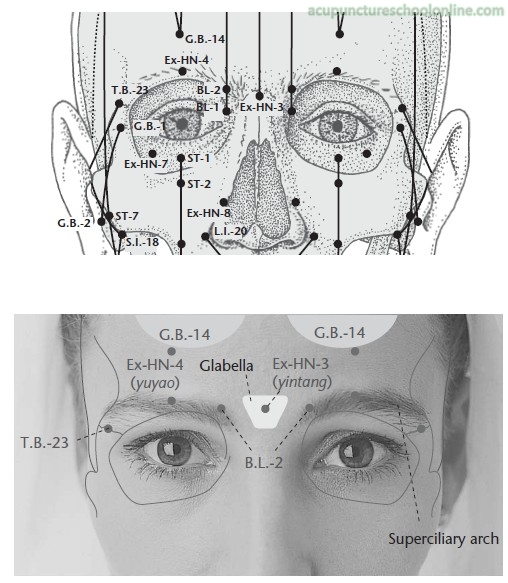 |
Entry point from Yingqiang LI-20
Master point of the Spleen and Stomach Divergent Meridians (Chace, The Merging of Ways).
Meeting of Stomach with Yang Qiao Mai, Ren and Stomach Divergent
With the eyes looking directly forwards, this point is located directly below the pupil between the eyeball and the infraorbital ridge.
With the patients eyes closed and looking straight up, use a finger to move the eyeball upwards and insert the needle, at first slightly inferiorly, then perpedicularly, between the eyeball and the inferior wall of the orbit, 0.5 - 1 cun.
Needle should be inserted slowly without lifting, thrusting or rotating. Immediately on withdrawal, press firmly with a cotton but for about a minute to prevent haematoma. According to several classical texts this point is contradindicated to moxibustion
"The Yangming usually has much Qi and much Blood" (Su Wen 素問 ch. 24) implying this channel can normally be needled or bled.
"The foot Yangming is to be pierced 6 fen deep and remain inserted for ten exhalations" (Ling Shu 靈樞 ch. 12).
"It is needled to a depth of three fen, and moxibustion is prohibited" (Huangfu Mi 皇甫謐, 3rd Century, Zhenjiu Jiayi Jing 針灸甲乙經).
Benefits the eyes and stops lacrimation
Eliminates Wind and clears Heat
Superficial Innervation: CN V1 ophthalamic branch of trigeminal
Dermatome Segment: CN V1 ophthalamic branch of trigeminal
Besides obvious damage to the eyeball, this point is extremely sensitive and even a light blow can cause extreme nausea and drainage of Qi from the upper body. A medium strike can cause knock out and a hard blow may even cause death. Through its connection to the Large Intestine channel it disrupts the entire Yangming and drains the Yang Qi from the body. The liver is also affected due to its governance over the eyes (Montaigue, Dim Mak Locations, Taijiworld.com).
This point would also be on the upper trajectory of the Chong mai in Jeffrey Yuen's descriptions (Yuen, 2005, The Extraordinary Vessels).
When used as part of a Divergent Meridian treatment is paired with the He Sea point, or less commonly with the Yuan Source or Luo Connecting point of the channels (Chace, The Merging of Ways).
Jin's Three Needles for the Eyes are located at this point, Jingming Bl-1 and a third extra point between the eyeball and the supraorbital ridge. All three are needled perpendicularly 1.2-1.5 cun, pushing the eyeball away while inserting and no stimulation is applied except stroking the handle upwards with the fingernail. They are indicated for optic nerve atrophy, macular degeneration, retinal detachment and other visual or eye disorders (eLotus, 2021).
Medieval phlebotomy point (Hans von Gersdorff, 1517: Feldtbüch der Wundartzney, www.nlm.nih.gov). From the diagram it looks as though a leech may have been applied to the eyeball or the inner membrane itself.
Lad and Durve (2008) in Marma Points of Ayurveda call this point Madhya Vartma and group it with two others Antara Vartma below Bl-1 and Bahya Vartma below GB-1. They are associated with the doshas: Alochaka Pitta, Sadhaka Pitta and Tarpaka Kapha.
They give the following actions:
- Benefits the eyes and nose
- Enhances circulation of aqueous and vitreous humor
Lubricates and decongests nasal passages
- Regulates lacrimation
- Releases suppressed emotions
- Improves kidney and adrenal functions
In Thai massage:
Location where the Sahatsarangsi (left) and Tawaree (right) sen lines terminate (Salguero & Roylance, 2011, Encyclopedia of Thai Massage)
Basic information on location, needle depth, TCM actions, indications and combinations is taken from Deadman et al (2001): A Manual of Acupuncture with additional anatomical information researched by reference to Gray's Anatomy (38th Ed., 1995) unless otherwise referenced. Images were found on acupunctureschoolonline.com and can be traced back to Claudia Focks (2008) Atlas of Acupuncture originally. I cannot claim any credit or rights over them. Other sources should be quoted in the text.
For some of the more unusual terms I have created a glossary here
Woodley Bioenergetics
90 Deane Croft Road,
Eascote, Pinner, Greater London. HA5 1SP
Tel/WhatsApp: +44 (0) 7946 174 829
Email: steve@steve-woodley.co.uk