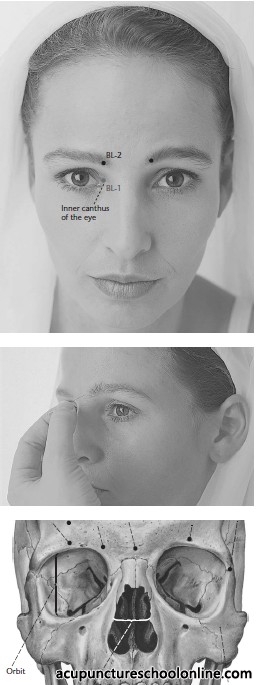
 |
Location Guides: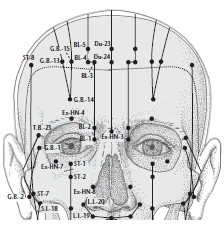 |
Binding point of the foot Taiyang Sinews
Homeostatic point 23 (Ma, Ma & Cho, 2005, Biomedical Acupuncture for Pain Management)
Superior to the inner canthus, in a depression on the eyebrow, close to its medial end.
Transverse-oblique insertion inferiorly towards Jingming Bl-1 for eye diseases, or Transverse lateral insertion to join with Yuyao (M-HN-6) for supraorbital pain, or prick to bleed for heat disorders.
According to several classical texts this point is contraindicated to moxibustion
"The Taiyang usually has much Blood and little Qi" (Su Wen 素問 ch. 24) implying this channel should normally be bled.
"The foot Taiyang is to be pierced 5 fen deep and remain inserted for seven exhalations" (Ling Shu 靈樞 ch. 12).
"It is needled to a depth of three fen, (the needle) is retained for a duration of six exhalations, and it is moxaed with three cones" (Huangfu Mi 皇甫謐, 3rd Century, Zhenjiu Jiayi Jing 針灸甲乙經).
Eliminates Wind and clears Heat
Benefits the eyes
Clears the head and alleviates pain
Superficial Innervation: Supraorbital nerve, from ophthalamic branch of trigeminal nerve (CN V1)
Dermatome Segment: CN V1 ophthalamic branch of trigeminal
Causes extreme Qi drainage, damage and nausea. A light strike can cause headaches for months, while an upward strike can make the head feel like it is exploding and even death if struck hard enough (Montaigue, Dim Mak Locations, Taijiworld.com).
The frontalis trigger point is located 1 cun above this at the level of yangbai GB-14 (Travell & Simons, 1998, Trigger Point Manual)
Ling Shu Ch. 28, On Oral Inquiry, advises to supplement this point to stop sneezing, along with Tonggu Bl-66.
The Ling Shu ch. 52 describes four Qi "Streets" (街 Jie, "street or market") on the head, chest, abdomen and shins. The Head Qi Street refers to the points located along the Bladder and Gall Bladder channel of the head and are said to have a special connection with the brain.
This point's indications for frontal headache, the Yangming section of the head, manic behaviour, red face and cheek pain (also Yangming region of the face), and its combinations with the Stomach channel for intoxication headache would make it a suitable candidate for the Bladder Qi Street point relating to Yangming disorders.
A medieval phlebotomy point is located near here, 1 cun above, level with yangbai Bl-14 (Hans von Gersdorff, 1517: Feldtbüch der Wundartzney, www.nlm.nih.gov)
Lad and Durve (2008) in Marma Points of Ayurveda locate a point slightly above this called Bhruh Antara and associate it with the doshas: Alochaka Pitta, Sadhaka Pitta, Vyana Vayu, Tarpaka Kapha.
They give the following actions:
- Benefits eyes, enhances circulation of aqueous and vitreous humor
- Relieves headaches
- Enhances circulation in frontal lobe of brain
- Releases suppressed emotions in the form of tears
- Relieves stress, calms the mind
They also locate a point slightly below called Ashru Antara associated with Alochaka Pitta, Sadhaka Pitta, Vyana Vayu amd Tarpaka Kapha.
They give the following actions:
- Stimulates lacrimal secretion
- Releases suppressed emotions
- Relieves headaches
- Benefits eyes
- Relieves stress, clams the mind, balances emotions
Basic information on location, needle depth, TCM actions, indications and combinations is taken from Deadman et al (2001): A Manual of Acupuncture with additional anatomical information researched by reference to Gray's Anatomy (38th Ed., 1995) unless otherwise referenced. Images were found on acupunctureschoolonline.com and can be traced back to Claudia Focks (2008) Atlas of Acupuncture originally. I cannot claim any credit or rights over them. Other sources should be quoted in the text.
For some of the more unusual terms I have created a glossary here
Woodley Bioenergetics
90 Deane Croft Road,
Eascote, Pinner, Greater London. HA5 1SP
Tel/WhatsApp: +44 (0) 7946 174 829
Email: steve@steve-woodley.co.uk