|
Location Guides: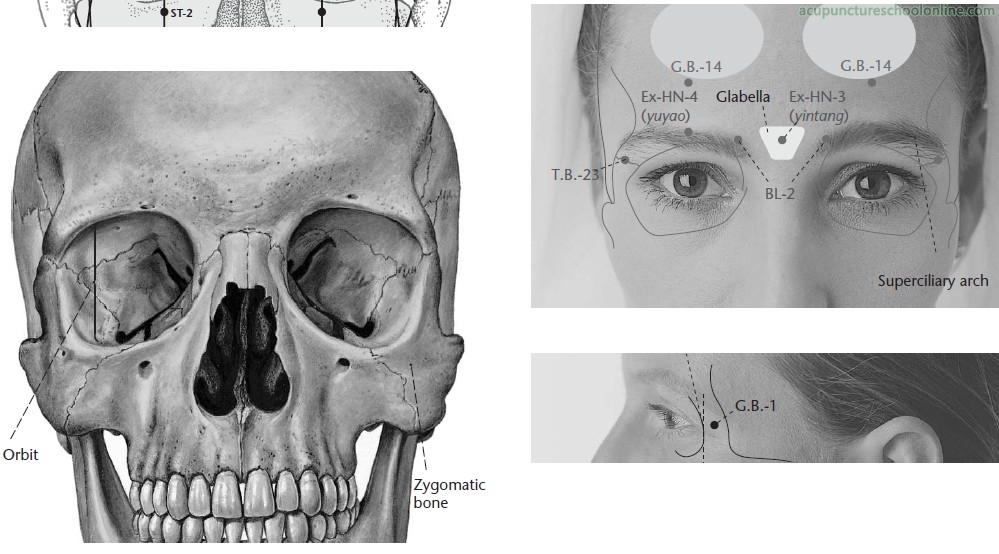 |
In the depression on the supraorbital margin, at the lateral end of the eyebrow.
Treansverse insertion, medially along the eyebrow or posteriorly 0.5 - 1 cun
According to several classical texts, this point is contraindicated to moxibustion.
"The Shaoyang usually has little Blood and much Qi" (Su Wen 素問 ch. 24) implying this channel should normally be needled.
"The hand Yin and Yang receive their Qi via nearby paths so their Qi arrive swiftly. The depth of piercing must not exceed 2 fen and must not remain inserted for longer than one exhalation" (Ling Shu 靈樞 ch. 12).
"It is needled to a depth of three fen deep," (and the needle) is retained for a duration of three exhalations. Moxibustion is prohibited as it may cause unfortunate narrowing of the eyes and blindness" (Huangfu Mi 皇甫謐, 3rd Century, Zhenjiu Jiayi Jing 針灸甲乙經).
Eliminates Wind and alleviates pain
Benefits the eyes
Superficial Innervation: Lacrimal nerve from ophthalamic branch of trigeminal nerve (CN V1)
Dermatome Segment: CN V1 ophthalamic branch of trigeminal
See Montaigue, Dim Mak Locations, Taijiworld.com for explanation of effects.
The trigger point for the orbicularis oculi muscle lies slightly inferior and medial to this point (Travell & Simons, 1998, Trigger Point Manual)
Ling Shu Ch. 52, On the Wei Qi, considers this point or Jiaosun SJ-20 to be the tip of the hand Shaoyang meridian with the root being at Yemen SJ-2.
There are points along the Gall Bladder channel that affect associated Zangfu, Primary Channels and Extraordinary Vessels that I refer to as "head-Shu" points. This point, as the "silken bamboo hollow" at the lateral end of the eyebrow may have equally meant Taiyang, making this point an obvious candidate for a head-Shu for the Chong Mai.
This would make sense as it is from the end of the San Jiao channel that the Gall Bladder channel originates, and from the Chong Mai that the other vessels and channels emerge.
In Mayan medicine:
A few drops of blood are released from the parietal artery at this point in cases of fever and accompanied by a vapor bath (Garcia, Sierra, Balam, 1999: Wind in the Blood)
In ayurvedic medicine:
Avarta marma point
Size: 1/2 angula (cun)
Structure: Bone
Effect of Injury: Disability (vaikalyakar marma); Loss of sight
(Harish Johari, 1996, Ayurvedic Massage, Sanatan Society; Anupama Bhattacharya, n.d. Marma Shastra)
Lad and Durve (2008) in Marma Points of Ayurveda locate a point slightly above this called Bhruh Agra and associate it with the doshas: Alochaka Pitta, Sadhaka Pitta, Vyana Vayu, Tarpaka Kapha.
They give the following actions:
- Benefits eyes, enhances circulation of aqueous and vitreous humor
- Relieves headaches
- Enhances circulation in frontal lobe of brain
- Releases suppressed emotions in the form of tears
- Relieves stress, calms the mind
They also locate a point slightly below called Ashru Agra associated with Alochaka Pitta, Sadhaka Pitta, Vyana Vayu amd Tarpaka Kapha.
They give the following actions:
- Stimulates lacrimal secretion
- Releases suppressed emotions
- Relieves headaches
- Benefits eyes
- Relieves stress, clams the mind, balances emotions
In Tibetan medicine:
Bleeding point (AMNH, Tibetan Medical Paintings)
Basic information on location, needle depth, TCM actions, indications and combinations is taken from Deadman et al (2001): A Manual of Acupuncture with additional anatomical information researched by reference to Gray's Anatomy (38th Ed., 1995) unless otherwise referenced. Images were found on acupunctureschoolonline.com and can be traced back to Claudia Focks (2008) Atlas of Acupuncture originally. I cannot claim any credit or rights over them. Other sources should be quoted in the text.
For some of the more unusual terms I have created a glossary here
Woodley Bioenergetics
90 Deane Croft Road,
Eascote, Pinner, Greater London. HA5 1SP
Tel/WhatsApp: +44 (0) 7946 174 829
Email: steve@steve-woodley.co.uk