 |
Location Guides: |
Ying-Spring and Water point
Child point of the Large Intestine channel
One of the "59 piercings" for clearing Heat in Ling Shu Ch. 23
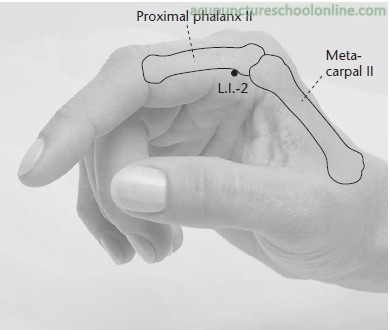
On the radial border of the index finger, in a depression just distal to the metacarpo-phalangeal joint
Oblique proximal or disal insertion 0.2 - 0.3 cun or perpendicular-oblique insertion towards the palm 0.5 cun
"The Yangming usually has much Qi and much Blood" (Su Wen 素問 ch. 24) implying this channel can normally be needled or bled.
"The hand Yin and Yang receive their Qi via nearby paths so their Qi arrive swiftly. The depth of piercing must not exceed 2 fen and must not remain inserted for longer than one exhalation" (Ling Shu 靈樞 ch. 12).
"It is needled to a depth of three fen, (the needle) is retained for a duration of six exhalations, and it is moxaed with three cones" (Huangfu Mi 皇甫謐, 3rd Century, Zhenjiu Jiayi Jing 針灸甲乙經).
Expels Wind, clears Heat and reduces swelling
Alleviates pain
Superficial Innervation: Median nerve branch to fingers from C6 - C8
Dermatome Segment: C7
Combined with Yangxi LI-5 grasping and digging a finger into these two points can cause knock out but due to the location is not a realistic point to use (Montaigue, Dim Mak Locations, Taijiworld.com).
Shared with Chize Lu-5. Balanced by ䷕ (Jiexi St-41 or Dadu Sp-2).
Hexagram attributions are my own with an explanation given in the glossary.
Translations are my own, assisted by DSeek and compared to Richard Rutt's interpretion (2002).
In five element acupuncture this point is reduced to drain excess in the Large Intestine.
Ling Shu Ch. 19, on the Four Seasonal Qi, advises selecting the Jing-Well and Ying-Spring openings in winter, piercing deeply and retaining for a while. However, the character for "retain" 留 is a combination of 田 "a field," possibly referring to the idea of waiting for things to grow, and 卯 which is the 4th Earthly Branch (Mao, Rabbit, ䷡, 5-7 am, Large Intestine) and said to derive from a Shang Dynasty glyph, originally referring to a blood sacrifice (a person or animal cut in half) before coming to mean bloodletting and "pouring out" (Smith, 2011). This might suggest it was actually referring to bleeding these points, and maybe even letting the points bleed for a time rather than retaining the needle.
Ling Shu Ch. 23, On Heat Diseases, gives a different list of points for the "59 Piercings" to Su Wen Ch. 61. They include three on the outer and three on the inner side of the hands which most likely includes this point.
In Tung acupuncture a pair of points called Mu Xue, Wood Point, are located on the palmar-ulnar aspect of the proximal segment of the index finger. They are at 1/3 and 2/3 of the distance from the proximal crease. They are indicated for Liver Yang rising signs such as tinnitus, shoulder and neck pain stiffness or pain, hyperlipidemia and bitter taste in the mouth, especially if combined with Liver points (Chu, 2015).
In the Maoshan Daoist tradition, when the 12 earthly branches, I Ching trigrams and elements are mapped onto the hand this section of the finger equates to the branch 卯 Mao, the Trigram ☲ Li, Fire and the element of Earth. The middle segment of the finger relates to the branch 辰 Chen, the Trigram ☶ Gen, Mountain and the element of Earth (Read, 2020, FB Post; 17QQ.com, 2020, Eight trigrams and twelve Branches of the earth palm).
Basic information on location, needle depth, TCM actions, indications and combinations is taken from Deadman et al (2001): A Manual of Acupuncture with additional anatomical information researched by reference to Gray's Anatomy (38th Ed., 1995) unless otherwise referenced. Images were found on acupunctureschoolonline.com and can be traced back to Claudia Focks (2008) Atlas of Acupuncture originally. I cannot claim any credit or rights over them. Other sources should be quoted in the text.
For some of the more unusual terms I have created a glossary here
Woodley Bioenergetics
90 Deane Croft Road,
Eascote, Pinner, Greater London. HA5 1SP
Tel/WhatsApp: +44 (0) 7946 174 829
Email: steve@steve-woodley.co.uk