|
Location Guides: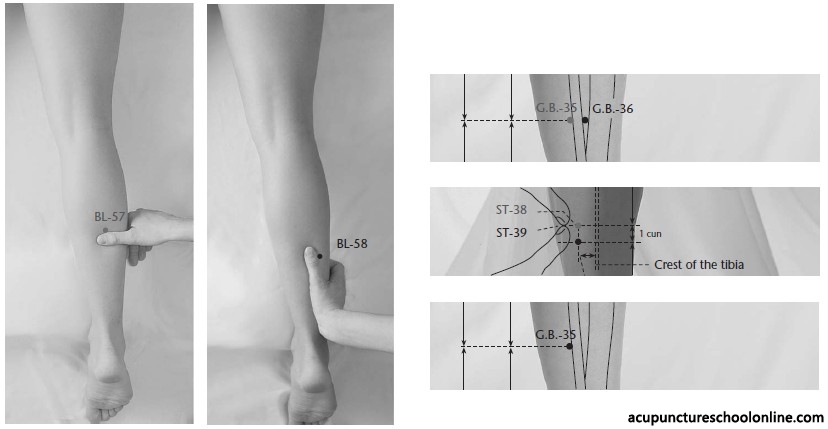 |
Luo-Connecting point
Trigger point (Travell & Simons, 1998, Trigger Point Manual)
On the lower leg, 7 cun directly superior to Kunlun Bl-60, lateral to and approximately 1 cun inferior to Chengshan Bl-57.
Perpendicular or oblique insertion directed proximally or distally, 1 - 1.5 cun
"The Taiyang usually has much Blood and little Qi" (Su Wen 素問 ch. 24) implying this channel should normally be bled.
"The foot Taiyang is to be pierced 5 fen deep and remain inserted for seven exhalations" (Ling Shu 靈樞 ch. 12).
"It is needled to a depth of three fen and moxaed with three cones" (Huangfu Mi 皇甫謐, 3rd Century, Zhenjiu Jiayi Jing 針灸甲乙經).
Harmonises the upper and lower
Expels Wind from taiyang channel
Treats haemorrhoids
Activates the channel and alleviates pain
Shared with Taixi Kid-3 and balanced by ䷄ (Tongli He-5 or Jinggu Bl-64).
Hexagram attributions are my own with an explanation given in the glossary.
Superficial Innervation: Sural nerve (L5 - S2)
Dermatome Segment: S2
Deeper Structures: Sural nerve (L5 - S2)
Muscle:
Soleus
Pain Referral Pattern:
To ipsilateral face and jaw (exceptional pattern recorded by Travell & Simons, 1998)
Indications:
Tenderness in the heel
See Montaigue, Dim Mak Locations, Taijiworld.com for explanation of effects.
Ling Shu Ch. 6 suggests piercing the Luo points if a disease is in the Yang of the Yin realm (e.g. the Fu organs) implying this point for disorders of the Bladder.
Ling Shu Ch. 10, On Channels, describes the diseases relating to the Luo emanating from this point as:
Repletion: Nose is blocked, head and back ache
Depletion: Nasal flow and nosebleed
(Unschuld, 2016).
Ling Shu Ch. 19, On the Four Seasonal Qi, advises using the channels and Luo vessels for diseases which occur in spring. They are pierced deeply if severe and more shallow if mild. For the other seasons:
- in summer choose the Yang channels and Luo located in the partings between the skin and flesh
- in autumn choose the Shu-Stream points unless the disease in the Fu organs, then use the He-Sea points
- in winter choose Jing-Well and Ying-Spring opening and retain the needle.
Ling Shu Ch. 21, On Cold and Heat Diseases, repeats the advice to use Luo in spring but and adds that they can also treat diseases of the skin.
For the other seasons it differs slightly from Ch. 19:
- in summer choose the partings in skin structures which also treat the muscle and flesh
- in autumn Taiyuan Lu-9 is chosen and can treat the sinews and vessels (this may also apply to other Shu-Stream points for this purpose, text is unclear)
- in winter one chooses the main channel points which also treat the bones and marrow.
Later it suggests using these Luo vessels when the lower abdomen is swollen and there is difficulty urinating along with Luo of the Jueyin (Ligou Liv-5) if they are knotted with blood. If it reaches the stomach then Zusanli St-36 is added.
The same chapter opens by advising pricking the Luo collaterals of the Taiyang emanating from here in cases of alternating cold and heat with supplementation of an additional channel based on the specific presentation:
- if the hot and cold sensations are in the skin, they cannot approach the sleeping mat, the nose is dried up and they are unable to sweat, supplement the Hand Taiyin Lung channel
- if the hot and cold sensations are in the muscles, the lips are dry and they are unable to sweat, supplement the Foot Taiyin Spleen channel
- if the hot and cold sensations are in the bones and they sweat ceaselessly then this point is not used but the Luo of the Foot Shaoyin, Dazhong Kid-4, is chosen instead. If the teeth have dried up or the bones have ceasing Qi then no cure is possible.
Ling Shu Ch. 22, On Mania and Madness, advises to bleed this channel in instances of insanity. The original just states the division (eg. bleed foot Taiyang) implying the main channel by omission but since it recommends bleeding the data is being entered under the Luo points unless a specific point is mentioned:
- If a manic patient's back is stiff and bent backwards like a bow with pain in the spine (opisthotonos?) then the hand and foot Taiyang (Wu and Wu, 2010), and the foot Yangming and Taiyin (Unshculd, 2016) are bled.
- If a major delight causes a person to see demon-spirits and laugh inside but be unable to express it then blood is removed from the foot Taiyin, Taiyang and Yangming, and then from the hand Taiyin and Yangming.
The name 飛陽 "Flying Yang" suggests the role of this Luo in protecting us from danger. It both indicates the anatomical function of calves to enable us to leap up and take flight, and in the role of Taiyang to protect us from illness by sending Wei Qi flying to the exterior to protect from pathogenic invasion.
Basic information on location, needle depth, TCM actions, indications and combinations is taken from Deadman et al (2001): A Manual of Acupuncture with additional anatomical information researched by reference to Gray's Anatomy (38th Ed., 1995) unless otherwise referenced. Images were found on acupunctureschoolonline.com and can be traced back to Claudia Focks (2008) Atlas of Acupuncture originally. I cannot claim any credit or rights over them. Other sources should be quoted in the text.
For some of the more unusual terms I have created a glossary here
Woodley Bioenergetics
90 Deane Croft Road,
Eascote, Pinner, Greater London. HA5 1SP
Tel/WhatsApp: +44 (0) 7946 174 829
Email: steve@steve-woodley.co.uk