 |
Location Guides: |
Shu-Stream and Wood point
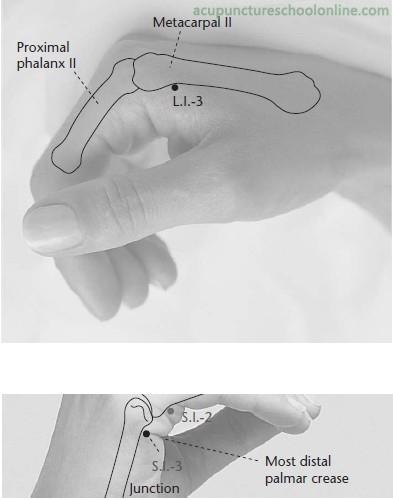
On the radial side of the index finger, in the substantial depression proximal to the head of the second metacarpal bone
Perpendicular insertion 0.5 - 2 cun, directed towards Houxi SI-3, or transverse insertion to Hegu LI-4 as part of "Jian Xi to Gu Needling".
"The Yangming usually has much Qi and much Blood" (Su Wen 素問 ch. 24) implying this channel can normally be needled or bled.
"The hand Yin and Yang receive their Qi via nearby paths so their Qi arrive swiftly. The depth of piercing must not exceed 2 fen and must not remain inserted for longer than one exhalation" (Ling Shu 靈樞 ch. 12).
"It is needled to a depth of three fen, (the needle) is retained for a duration of three exhalations, and it is moxaed with three cones" (Huangfu Mi 皇甫謐, 3rd Century, Zhenjiu Jiayi Jing 針灸甲乙經).
Expels Wind and Heat
Clears Heat and benefits the throat and teeth
Dispels fullness and treats diarrhoea
Superficial Innervation: Superficial branch of radial nerve from C6 - C8
Dermatome Segment: C7
Combined with Erjian LI-2, a strike at this point can cause temporary blindness but is very difficult to achieve (Montaigue, Dim Mak Locations, Taijiworld.com).
Trigrams: Zhen (Thunder) below, Dui (Lake) above.
Movement within, joy without — thunder within the lake. The strong moves and the gentle responds with joy. This is following: the natural attraction of the young man to the young woman, the leader to the people, the people to the leader.
Nuclear Trigrams: Lines 2-3-4 form Gen (Mountain). Lines 3-4-5 form Xun (Wind). Beneath the following, there is stillness (Gen) and gentle penetration (Xun). The hidden message: following is not blind. It is grounded in stillness and guided by gentle influence.
Judgement:
元亨利貞,無咎。
Supreme opening. Beneficial burning. No trouble.
The point can open the Yuan level and be tonified with moxa without complication.
Overall: Following is the natural response of the yin to the yang, the weak to the strong, the people to the leader. When the one who is followed is correct, the following is blameless. The gentleman goes to rest at nightfall — following is not constant activity.
Lines:
| Line | Yin/Yang | Image | Literal Translation | Clinical Reading |
|---|---|---|---|---|
| 1 | Yang | 官有渝,貞吉。出門交有功 | Office has betrayal. Burning is auspicious. Going out the door and meeting brings laborious merit. | When Xie Qi first settles in the upper end of the channel, it usually manifests as Cold. Moxa is good here to remove it before it takes root, but may require long work and assistance from other points or channels. |
| 2 | Yin | 係小子,失丈夫 | Binding the small child, losing a husband. | The Xie Qi is bound to the point. Caution is warned that leaving it here may result in the loss of something greater. Especially when treating teeth, Xie Qi left in latency can erode Jing and weaken the teeth. |
| 3 | Yin | 係丈夫,失小子。隨有求得,利居貞 | Binding the husband, losing the small child. Following, there is seeking and obtaining. Beneficial to dwell in burning. | It is necessary to bind the Jing to protect the structure of the teeth, even if the Xie Qi will be lost from its captivity in the point. The point is failing now anyway, so the Xie Qi must be followed, sought and cleared with moxa. |
| 4 | Yang | 隨有獲,貞凶。有孚在道,以明,何咎 | Following, there is gain. Burning is inauspicious. There is a captive in the way; with clarity, what trouble? | The Cold has turned to Heat and so moxa will not help. It must still be hunted down, to where it is obstructing the channel, and bled. If it can be identified clearly, it can be removed with no trouble. |
| 5 | Yang | 孚于嘉,吉 | Captives from a good place. Auspicious. | Xie Qi is affecting deeper places, which are usually reserved for good things, such as Zheng Qi and Jing. However, it can be released from here through bleeding and so is still auspicious. |
| 6 | Yin | 拘係之,乃從維之。王用亨于西山 | Bound and tied, then followed and fastened. The king uses this to sacrifice at the Western Mountain. | The Xie Qi is firmly entangled with the person's regular Qi making separation difficult. A supreme effort, a sacrifice worthy of a king, will be needed to separate them now. The western mountain indicates metal and the west, the direction of death and decay. No mention of success or failure is made, suggesting it could work, but there is no guarantee. |
Image:
澤中有雷,隨。君子以向暗入宴息。
Thunder within the lake: Sui. Thus the gentleman goes to rest at nightfall.
Thunder is within the lake — the movement is contained, not explosive. The gentleman goes to rest at nightfall. Following is not constant activity. It is knowing when to move and when to rest. The thunder within the lake is the movement that is at peace.
Acupuncture Point Connections:
Shared with Shaoshang Lu-11.
Inverted and opposed by into ䷑ (Diji Sp-8 or Liangqiu St-34).
Hexagram attributions are my own with an explanation given in the glossary.
Translations are my own, assisted by DSeek and compared to Richard Rutt's interpretion (2002).
Ling Shu Ch. 19, on the Four Seasonal Qi, advises using the Shu-Stream points, unless the diseases are in the Fu organs, in which case the He-Sea points are chosen.
In Tung acupuncture this equates to the Da Bai, Big White, point (22.04) and is often combined with Ling Gu at the other end of the bone, between the first and second metacarpals, slightly proximal to LI-4. Their location on the arm Yangming which controls Qi and Blood in the entire body together with their ability to move Qi and Blood make them applicable for most diseases (Chu, 2015).
In "Jian Xi to Gu Needling" Sanjian LI-3 and Yangxi LI-5 are needled transversely to meet at Hegu LI-4 in treatment of pain and heat in the upper body. Electro-stimulation can be applied too (Liu Yan, 2008, Diagrams of Acupuncture Manipulations, p.136).
In the Maoshan Daoist tradition, when the 12 earthly branches, I Ching trigrams and elements are mapped onto the hand the knuckle of the index finger next to this point equates to the branch 寅 Yin, the Trigram ☵ Kan, Water and the element of Wood (Read, 2020, FB Post; 17QQ.com, 2020, Eight trigrams and twelve Branches of the earth palm).
In ayurvedic medicine:
Kshipra marma point
Size: 1/2 angula (cun)
Structure: Tendon
Effect of Injury: Belatedly fatal (kalantarpranahar marma)
(Harish Johari, 1996, Ayurvedic Massage, Sanatan Society; Anupama Bhattacharya, n.d. Marma Shastra)
Basic information on location, needle depth, TCM actions, indications and combinations is taken from Deadman et al (2001): A Manual of Acupuncture with additional anatomical information researched by reference to Gray's Anatomy (38th Ed., 1995) unless otherwise referenced. Images were found on acupunctureschoolonline.com and can be traced back to Claudia Focks (2008) Atlas of Acupuncture originally. I cannot claim any credit or rights over them. Other sources should be quoted in the text.
For some of the more unusual terms I have created a glossary here
Woodley Bioenergetics
90 Deane Croft Road,
Eascote, Pinner, Greater London. HA5 1SP
Tel/WhatsApp: +44 (0) 7946 174 829
Email: steve@steve-woodley.co.uk