 |
Hui-Meeting point of the Marrow
Group Luo Point for the Three Leg Yang (Stomach, Gall Bladder & Bladder)
Trigger point (Travell & Simons, 1998, Trigger Point Manual)
Meeting of Gall Bladder with Bladder and Stomach
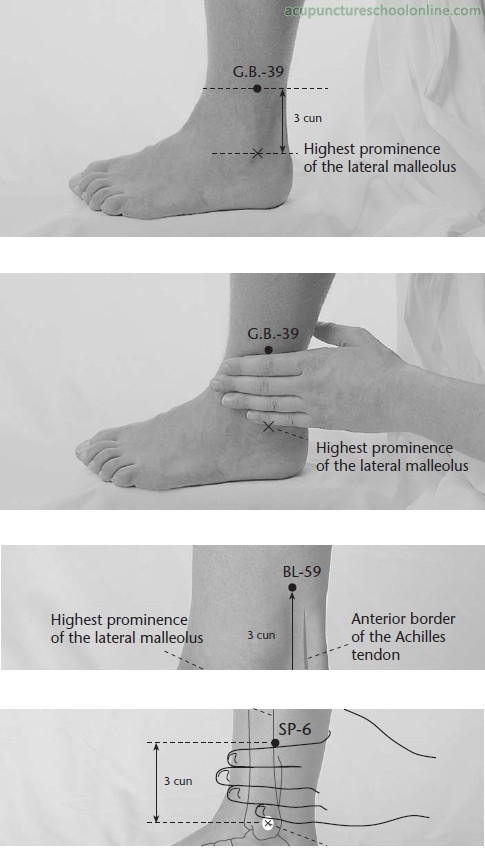
Above the ankle joint, 3 cun superior to the prominence of the lateral malleolus, between the posterior border of the fibula and the tendons of peroneus longus and brevis.
Perpendicular insertion 1 - 1.5 cun. The practitioner should use the index finger from one hand to separate the peroneal tendons from the fibula and emphasise the groove, then needle into the groove, at first slightly posteriorly for 0.5 cun and then perpendicularly, to avoid hitting the fibula.
Movement of the patient's ankle after needling can result in a bent needle. For this reason the point should be needles last and the patient instructed not to move the leg after needling.
"The Shaoyang usually has little Blood and much Qi" (Su Wen 素問 ch. 24) implying this channel should normally be needled.
"The foot Shaoyang is to be pierced 4 fen deep and remain inserted for five exhalations" (Ling Shu 靈樞 ch. 12).
"It is needled to a depth of six fen, (the needle) is retained for a duration of seven exhalations, and it is moxaed with five cones" (Huangfu Mi 皇甫謐, 3rd Century, Zhenjiu Jiayi Jing 針灸甲乙經).
Benefits the sinews and bones
Benefits the neck
Dispels Wind-Damp
Clears Gallbladder Fire
Activates the channel and alleviates pain
Superficial Innervation: Superficial fibular (peroneal) nerve (S4 - S1)
Dermatome Segment: L5
Muscle:
Peroneus tertius
Pain Referral Pattern:
To heel and dorsum of foot
Indications:
Strain of foot evertors
; Ankle sprain
See Montaigue, Dim Mak Locations, Taijiworld.com for explanation of effects.
As Hui of marrow this point is used mainly for weakness, flaccidity, contraction and pain of the limbs.
The Systematic Classic of Acupuncture and Moxibustion by Huangfu Mi (282 CE) refers to this point as "located at a pulsating vessel three cun above
the lateral malleolus and is the connecting vessel of the three Foot Yang. Locate it by occluding the foot Yangming vessel."
This suggests that it is the Yang counterpart to Sanyinjiao Sp-6 as the meeting of the foot Yin Channels.
Although a pulse is rarely ever found in this location, Wang et al. (2012) suggest it was originally "on the outer face of the ankle," which could imply somewhere closer to Qiuxu GB-40 where the lateral tarsal artery can be felt, or alternatively, that it might be located in front of the fibula, along the path of the anterior tibial artery that would supply the dosalis pedis artery that can be felt at Chongyang St-42.
In early Chinese medicine, the pulse felt near the original location for this point, on the outer face of the ankle (probably closer to Qiuxu GB-40), was taken as an indication of the health of the Gall Bladder channel (Wang et al., 2012).
There is little written about the Group Luo except that they are used in cases where 3 related meridians are imbalanced. The only detailed protocol that could be found was from Pialoux (2008), Guide to Acupuncture and Moxibustion, where it states that they can "switch the energies from one side to the other by tonifying deficiencies and dispersing excesses".
To do this, the Group Luo relating to the type of energy (Yin or Yang) in excess is reduced on the affected side after the opposite Group Luo is tonified on the opposite side. Alternatively a trauma affecting all three channels on one limb could be resolved tonifying all its paired opposites - arm/leg and yin/yang on the same side, the same point on the opposite side, and then reducing the affected Group Luo point (i.e. an injury causing swelling affecting all three leg Yang channels can be resolved by tonifying the Group Yang Luo on the affected side arm and opposite leg, and the Group Yin Luo on the affected side, then reducing the the Group Yang Luo on the affected side).
Some sources place the Leg Yang Group Luo point at Yangqiao GB-35 instead.
In Tung acupuncture the Yi Zhong, First Layer, point is located here. It is often combined with Er Zhong, First Layer, 2 cun above at Guangming GB-37, and San Zhong Third Layer, 4 cun above this point Waiqu GB-36, all anterior to the fibula. They are all used for symptoms of the Gall Bladder channel, especially those in the neck and throat (goiter, thyroid, soreness or pain), Wind or Yang rising (Bell's Palsy, migraine, Parkinsons) and problems of the liver and spleen (Chu, 2015).
In Thai massage:
Point along the Sahatsarangsi (left) and Tawaree (right) sen lines ascending up the outer leg (Salguero & Roylance, 2011, Encyclopedia of Thai Massage)
Basic information on location, needle depth, TCM actions, indications and combinations is taken from Deadman et al (2001): A Manual of Acupuncture with additional anatomical information researched by reference to Gray's Anatomy (38th Ed., 1995) unless otherwise referenced. Images were found on acupunctureschoolonline.com and can be traced back to Claudia Focks (2008) Atlas of Acupuncture originally. I cannot claim any credit or rights over them. Other sources should be quoted in the text.
For some of the more unusual terms I have created a glossary here
Woodley Bioenergetics
90 Deane Croft Road,
Eascote, Pinner, Greater London. HA5 1SP
Tel/WhatsApp: +44 (0) 7946 174 829
Email: steve@steve-woodley.co.uk