 |
Location Guides: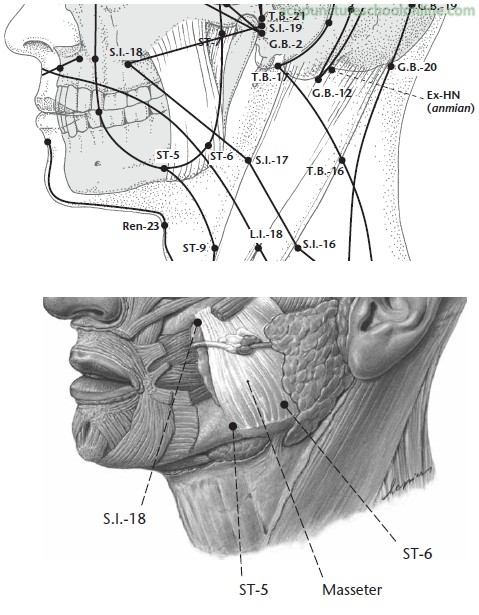 |
 |
Sun Si-miao Ghost point (3rd trinity)
Xu Qiufu Ghost point
Binding point of the hand Shaoyang Sinews
Trigger point (Travell & Simons, 1998, Trigger Point Manual)
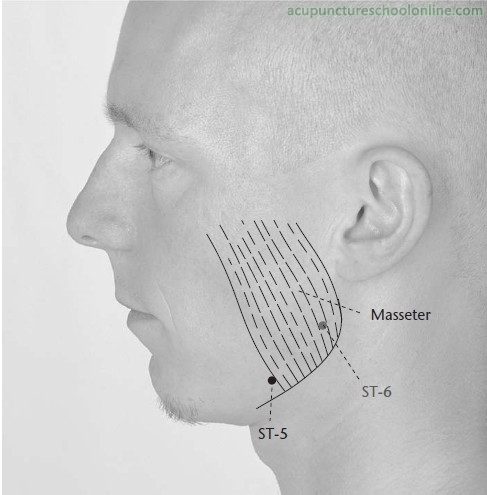
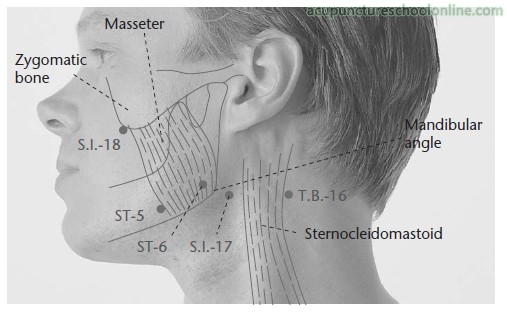
Approximately 1 fingerbreadth anterior and superior to the angle of the jaw at the prominence of the masseter muscle.
Perpendicular insertion 0.5 cun
Transverse insertion to join with such points as Dicang ST-4, Daying ST-5, Xiaguan ST-7, etc
Transverse insertion towards te upper or lower jaw for toothache
"The Yangming usually has much Qi and much Blood" (Su Wen 素問 ch. 24) implying this channel can normally be needled or bled.
"The foot Yangming is to be pierced 6 fen deep and remain inserted for ten exhalations" (Ling Shu 靈樞 ch. 12).
"It is needled to a depth of three fen and moxaed with three cones" (Huangfu Mi 皇甫謐, 3rd Century, Zhenjiu Jiayi Jing 針灸甲乙經).
Eliminates Wind and benefits the jaw and teeth
Activates the channal and alleviates pain
Superficial Innervation: Mandibular branch of trigeminal nerve (CN V3)
Dermatome Segment: CN V3 mandibular branch of trigeminal
Muscle:
Masseter
Pain Referral Pattern:
To lower jaw and molars and possibly to eyebrow
Indications:
Facial myalgia
; Toothache
; Headache
; Tempero-mandibular joint pain
Similar to Daying St-5, this point causes instant knock out. It may also cause concussion by way of a shock to the brain, causing nausea, loss of memory and emotional instability in mild cases and prolonged unconsciousness, dilated pupils, changes in vision and equilibrium. Either case requires examination by a physician and observation by a responsible person (Montaigue, Dim Mak Locations, Taijiworld.com).
In seizing martial arts (Qin Na) this point is a cavity striking point (Da Xue 打穴) which can be struck with the back of the fist causing collapse, fainting, or even death if strong enough (Yang, 1995, Tai Chi Chin Na; Yang, 2004, Analysis of Shaolin Chin Na, 2nd Edition).
Ling Shu Ch. 26, On Miscellaneous Diseases, advises the abounding vessels at this point are bled for pain in the cheeks. Later it suggests that if this does end the pain then press on Renying St-9.
Ghost Point:
The third trinity of Ghost Points, consisting of this point, Chengjiang Ren-24 and Laogong Pc-8, is mainly concerned with extreme isolation as the body attempts to deprive itself of any stimulation in order move into a state of suicidal ideation. It generally refers to institutionalised situations, including catatonic states. In a modern clinical setting this trinity is probably better represented by depression with social isolation, loss of appetite, tension in the jaw and extreme rumination.
The name of this point, Guichuang, Ghost Bed, refers to the tendency to isolate oneself in bed and its location on the jaw reflects their inability to process ("chew") new information as the pure Yang of the Stomach fails to ascend to nourish the senses. They may grind their teeth a lot, bring up froth or dry heave as this attempts to break through. There may also starve themselves of food literally too and the neck and jaw will be very rigid.
This point is generally treated with moxa to release the Cold rigidity (Yuen, 2005, 3 Spirits & 7 Souls).
In the Twelve Branches the Ghost Points follow a cycle from top to bottom with this point representing Chen, 辰 and the Stomach channel (Ayal, 2021, The 13 Ghost Points 十三鬼穴).
Ge Hong (4th century) relates a cure for sexual possession of a woman due to having intercourse with a malignant spirit. The symptoms include talking and laughing to herself, depression and delirium.
The cure involves a ritual and acupuncture. First the master conceals 5 needles in his hair and sets up a vessel full of water with three strips of red cloth placed over the top and a sword laid flat over the top. Next, he calls out the patient's name. She will try to run but must not be allowed to leave. Then, he takes a mouthful of water and sprays it over her, glaring furiously. After repeating this three times he wipes the water from her face and snaps his fingers above her forehead by the hairline and asks her if she wants to be cured. She will not answer until doing this twice, snapping the fingers 7 times each.
Then insert a needle at Renzhong Du-26, this point, Shangxing Du-23 and Yintang. Cross examine her thoroughly and she will gradually regain consciousness and the possession will come to an end.
Strickmann, M. (2002), Chinese Magical Medicine, p. 242. Stanford University Press.
Lad and Durve (2008) in Marma Points of Ayurveda locate a point superior to this, on the anterior border of the masseter muscle, called Kapola Madhya and associate it with the doshas: Bodhaka Kapha, Apana Vayu, Samana Vayu, Kledaka Kapha and Pachaka Pitta.
They give the following functions:
- Regulates salivary secretion
- Enkindles agni
- Promotes digestion of carbohydrates
- Improves absorption and assimilation in the colon
- Stimulates the parotid glad
- Benefits face, relieves local pain
- Improves colour complexion
Basic information on location, needle depth, TCM actions, indications and combinations is taken from Deadman et al (2001): A Manual of Acupuncture with additional anatomical information researched by reference to Gray's Anatomy (38th Ed., 1995) unless otherwise referenced. Images were found on acupunctureschoolonline.com and can be traced back to Claudia Focks (2008) Atlas of Acupuncture originally. I cannot claim any credit or rights over them. Other sources should be quoted in the text.
For some of the more unusual terms I have created a glossary here
Woodley Bioenergetics
90 Deane Croft Road,
Eascote, Pinner, Greater London. HA5 1SP
Tel/WhatsApp: +44 (0) 7946 174 829
Email: steve@steve-woodley.co.uk