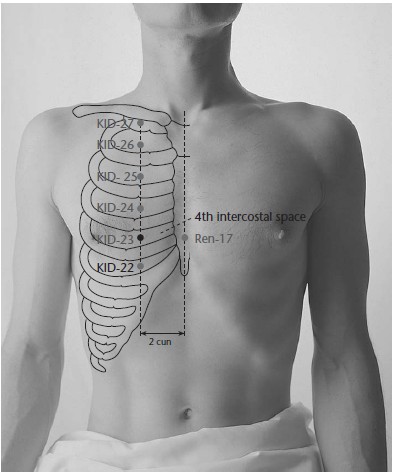
 |
Location Guides: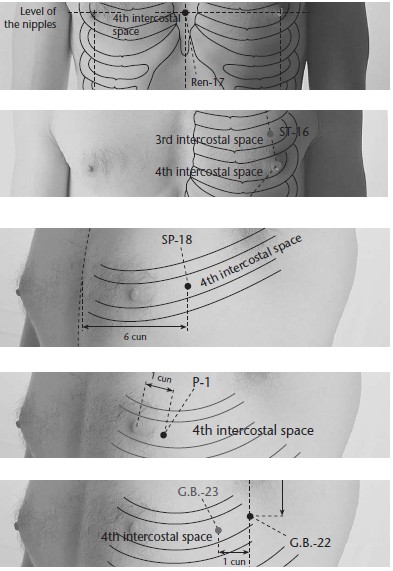 |
Spirit point
Front Shu of the Chest for the post-natal Spleen and pre-natal Heart on the upper Chong Mai trajectory (Yuen, 2005, The Extraordinary Vessels, Cecil-Sterman, 2012, Advanced Acupuncture)
Trigger point (Travell & Simons, 1998, Trigger Point Manual; Melzack, Stillwell & Fox, 1977)
In the forth intercostal space, 2 cun lateral to the midline.
Transverse-oblique insertion, directed laterally along the intercostal space 0.5 - 1 cun
Deep perpendicular or oblique needling may puncture the lung.
"The Shaoyin usually has little Blood and much Qi" (Su Wen 素問 ch. 24) implying this channel should normally be needled.
"The foot Shaoyin is to be pierced 2 fen deep and remain inserted for three exhalations" (Ling Shu 靈樞 ch. 12).
"Locate it with (the patient) lying supine. It is needled to a depth of four fen and moxaed with five cones" (Huangfu Mi 皇甫謐, 3rd Century, Zhenjiu Jiayi Jing 針灸甲乙經).
Unbinds the chest
Lowers rebellious Lung and Stomach Qi
Benefits the breasts
Superficial Innervation: Anterior cutaneous thoracic nerve from T5
Dermatome Segment: T5
Deeper Structures: Neuromuscular junction of medial pectoral nerve with the pectoral muscle ( C8 - T1)
Muscle:
Pectoralis major (sternal head)
Pain Referral Pattern:
Local to point and across chest
Indications:
Strain of pectoralis muscle
; Cardiac syndromes
See Montaigue, Dim Mak Locations, Taijiworld.com for explanation of effects.
One of the twelve shu points of the chest mentioned in the Su Wen Ch. 58, along with Bulang Kid-22, Linxu Kid-24, Shencang Kid-25, Yuzhong Kid-26 and Shufu Kid-27.
In TCM these are employed for wheezing, dyspnoea and coughing due to 'fullness above and deficiency below' due to weak kidney qi not grasping lung qi (Deadman et al, 2001).
for wheezing, dyspnoea and coughing due to 'fullness above and deficiency below' due to weak kidney qi not grasping lung qi (Deadman et al, 2001).
Yuen (2005, The Extraordinary Vessels) believes these points, when related to the front Shu points of the Chong mai are located at 0.5 cun from the midline.
The "Nine Flowers" is a combination of points that aims to open the Diaphragm and allow new life to enter (Jeffrey Yuen protocol, learned via discussion group).
In five element acupuncture indicated for a lack of connection with ones own spirit or identity/self, low spirit.
In Mayan medicine:
Combined with Bulang Kid-22, Linxu Kid-24, Shencang Kid-25 and Yuzhong Kid-26 to reinforce Tiantu Ren-22 in treatments of asthma (Garcia, Sierra, Balam, 1999: Wind in the Blood)
In ayurvedic medicine:
Ampastambha marma point
Size: 1/2 angula (cun)
Structure: Blood vessels
Effect of Injury: Premature death (kalantarpranahar marma)
(Harish Johari, 1996, Ayurvedic Massage, Sanatan Society; Anupama Bhattacharya, n.d. Marma Shastra)
Lad and Durve (2008) in Marma Points of Ayurveda call the six point from Kid-22 to Kid-23 (three each side) Hrid and associate them with Prana Vayu, Vyana Vayu, Udana Vayu Sadhaka Pitta and Avalambaka Kapha.
They give the following functions:
- Regulates cardiac function and heart rate
- Improves coronary circulation
- Maintains optimal function of lungs and airways
- Relieves congestion in breast tissue
- Enhances lymphatic circulation in chest area
- Calms mind, balances emotions, relieves stress
In Tibetan medicine:
Moxa point (AMNH, Tibetan Medical Paintings)
In Thai massage:
One of a set of acupressure points circling the perimeter of the breast (Salguero & Roylance, 2011, Encyclopedia of Thai Massage)
Basic information on location, needle depth, TCM actions, indications and combinations is taken from Deadman et al (2001): A Manual of Acupuncture with additional anatomical information researched by reference to Gray's Anatomy (38th Ed., 1995) unless otherwise referenced. Images were found on acupunctureschoolonline.com and can be traced back to Claudia Focks (2008) Atlas of Acupuncture originally. I cannot claim any credit or rights over them. Other sources should be quoted in the text.
For some of the more unusual terms I have created a glossary here
Woodley Bioenergetics
90 Deane Croft Road,
Eascote, Pinner, Greater London. HA5 1SP
Tel/WhatsApp: +44 (0) 7946 174 829
Email: steve@steve-woodley.co.uk