 |
Back Shu point of the Pericardium
Master Tung's Double Phoenixes
Master Tung's Nine Monkeys
Master Tung's Behind the Heart points
Trigger point (Travell & Simons, 1998, Trigger Point Manual)
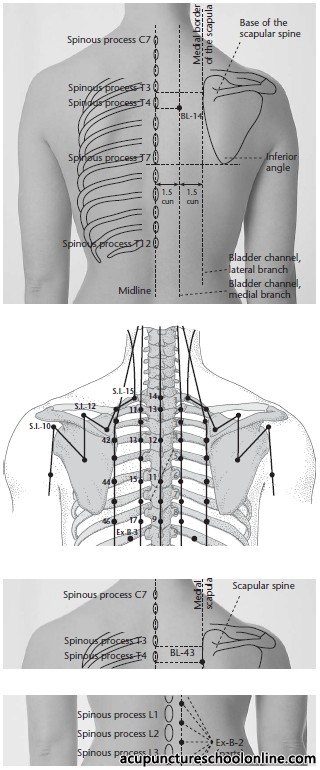
1.5 cun lateral to the lower border of the spinous process of the fourth thoracic vertebra (T4).
Oblique insertion towards the spine 0.5 - 1 cun, or transverse-oblique insertion 1 - 1.5 cun
Perpendicular needling or oblique needling away from the spine carries a substantial risk of causing a pneumothorax.
"The Taiyang usually has much Blood and little Qi" (Su Wen 素問 ch. 24) implying this channel should normally be bled.
"The foot Taiyang is to be pierced 5 fen deep and remain inserted for seven exhalations" (Ling Shu 靈樞 ch. 12).
Spreads Liver Qi and unbinds the chest
Regulates the Heart
Regulates and descends Qi
Superficial Innervation: Posterior cutaneous thoracic nerves from T4
Dermatome Segment: T4
Muscle:
Multifidus
Pain Referral Pattern:
Local to point and around midline
Indications:
Back pain
Listed in the Wu Bei Zhi 武備志 (Treatise on Armament Technology) by Mao Yuanyi 茅元儀 (1621), Article 9: Twelve-Hour (Shichen 時辰) Vital Points Revealed as the vital point associated with the Xu 戌 Dog (7 - 9 pm) and the Pericardium meridian (McCarthy, 2016, Bubishi: The Classic Manual of Combat).
Striking this point affects the Heart in the instant and long term by disrupting the protecting function of the Pericardium. It may also disturb the Shen, upsetting the "humanity" of the recipient and affect the Kidney Jing (Montaigue, Dim Mak Locations, Taijiworld.com).
Shared with Sanjiaoshu Bl-22 and with Baihui Du-20 in the Rising and Falling Hexagram sequence.
Hexagram attributions are my own with an explanation given in the glossary.
Translations are my own, assisted by DSeek and compared to Richard Rutt's interpretion (2002).
One of the Aggressive Energy Drain points in five element acupuncture, along with Feishu Bl-13, Xinshu Bl-15, Ganshu Bl-18, Pishu Bl-20 and Shenshu Bl-23, indicated where psychological or emotional issues are blocking treatment. They are needled from left to right, top to bottom, with the exception of Xinshu Bl-15 that is needled last, along with controls outside the Bladder channel at the same levels. If aggressive energy is present the points should become redder than the test points and are left until the redness disappears. If not then needles can be removed and treatment continued.
In Master Tung's system a line of points corresponding to the inner back Shu points from T2 to T8, known as the double phoenix points (Shuang Feng), can be pricked to release a drop of blood in cases of pain or numbness in the extremities or arteriosclerosis.
They all relate to the Fire element and the Heart and so have the function of quickening the Blood in the Heart and the extremities (McCann, 2014, Pricking the Vessels).
This point is also one of the Nine Monkeys (Jiu Hou) in Tung Lineage acupuncture. They are located at 1.5 cun and 3 cun lateral from the midline level with T2, T3 and T4 and 6 cun from the midline, level with T1, T2 and T3. They are pricked to bleed in cases of scarlet fever and phlegm stuck in the bronchia that cannot be expelled (ibid.).
Tung's Behind the Heart (Hou Xin or Bei Xin) points are located under spinous processes from T4 to T9, 1.5 cun laterally to T4 to T7 and 3 cun laterally from T4 to T6. They are indicated for "wool like furuncles", clove sores, weakness and debility of the Heart zang, Stomach diseases, acute heart disease leading to numbness and paralysis, wind-cold entering the interior, severe wind-cold, stroke, externally contracted diseases that manifest with papules. They clear heat from the Heart and Lung and release the exterior so are useful in dermatological disorders (ibid.).
One consideration of this point and its Ministerial Fire pair, Sanjiaoshu Bl-22, is that they sit just above the back Shu points for the Heart and Kidneys and so can be argued to represent the connecting pathways between the Heart and Kidneys, the two Shaoyin organs. One role of the Pericardium is to act as an envoy, transmitting the Sovereign Fire from the Heart via the San Jiao, the pathways of water, with the location of these points seeming to suggest this. Jueyinshu Bl-14 being above Xinshu Bl-15 enables it to capture Heat as it rises and then transmit to its pair, Sanjiaoshu Bl-22, which can then flow down to Sanjiaoshu Bl-23.
In Tibetan medicine:
Moxa point (AMNH, Tibetan Medical Paintings)
In Thai massage:
Acupressure point along the Itha (left) and Pingala (right) sen lines running from the navel Shenque Ren-8 to the knee and up the back to the neck and head.
Indicated for asthma, back pain/injury/arthritis, breathing difficulties, cough, gastrointestinal ailments, indigestion, lung disorders, menstruation problems, PMS, Reproductive system ailments and stomach ache.
(Salguero & Roylance, 2011, Encyclopedia of Thai Massage)
Basic information on location, needle depth, TCM actions, indications and combinations is taken from Deadman et al (2001): A Manual of Acupuncture with additional anatomical information researched by reference to Gray's Anatomy (38th Ed., 1995) unless otherwise referenced. Images were found on acupunctureschoolonline.com and can be traced back to Claudia Focks (2008) Atlas of Acupuncture originally. I cannot claim any credit or rights over them. Other sources should be quoted in the text.
For some of the more unusual terms I have created a glossary here
Woodley Bioenergetics
90 Deane Croft Road,
Eascote, Pinner, Greater London. HA5 1SP
Tel/WhatsApp: +44 (0) 7946 174 829
Email: steve@steve-woodley.co.uk