 |
Location Guides: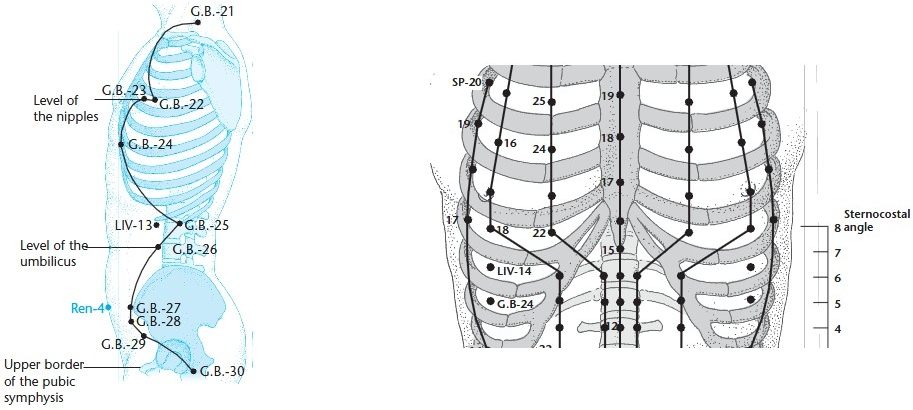 |
Front Mu of the Gall Bladder
Trigger point (Travell & Simons, 1998, Trigger Point Manual)
Meeting of Gall Bladder with Spleen, Gall Bladder Divergent and Liver Divergent
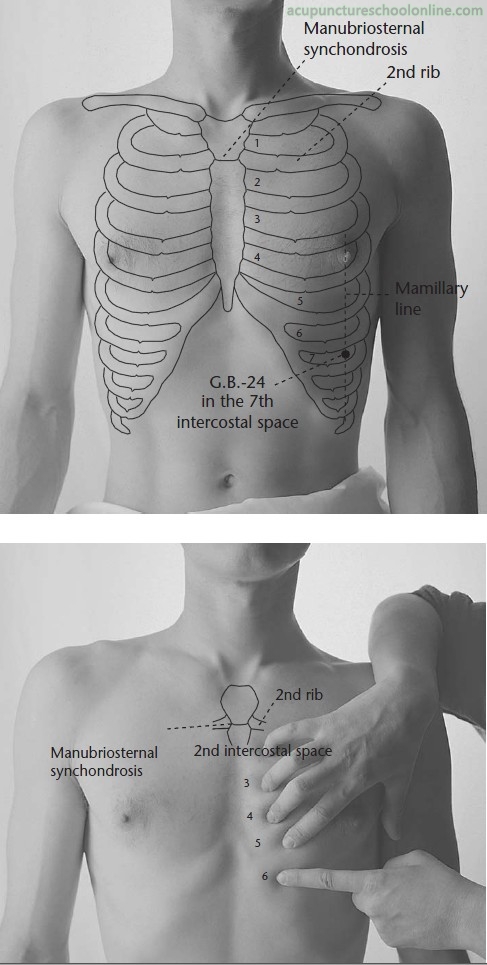
On the anterior chest wall, in the seventh intercostal space, directly below the nipple, 4 cun lateral to the midline.
Transverse-oblique insertion along the intercostal space 0.5 - 1 cun
Deep or perpendicular needling may induce a pneumothorax.
"The Shaoyang usually has little Blood and much Qi" (Su Wen 素問 ch. 24) implying this channel should normally be needled.
"The foot Shaoyang is to be pierced 4 fen deep and remain inserted for five exhalations" (Ling Shu 靈樞 ch. 12).
"It is needled to a depth of seven fen and moxaed with five cones" (Huangfu Mi 皇甫謐, 3rd Century, Zhenjiu Jiayi Jing 針灸甲乙經).
Benefits the Gallbladder and spreads Liver Qi
Lowers rebellious Qi and harmonises the Middle Jiao
Resolves Damp Heat
Superficial Innervation: Lateral cutaneous thoracic nerve from T8
Dermatome Segment: T8
Muscle:
External oblique and intercostals
Location Notes:
Intercostals can produce trigger points anywhere in the intercostal space. See other Liv-14 for details.
Pain Referral Pattern:
To the area medial to the ribcage and under the sternum (Zhongwan Ren-12 and Liangmen St-21) with spillover across the inferior aspect of the ribs and sternum and radiating to opposite flank
Indications:
Abdominal pain and digestive discomfort
In seizing martial arts (Qin Na) this point is a cavity press point (Dian Xue, 點穴) struck with, fist, Phoenix Eye Fist, elbow, side of the foot or heel causing possible sealing of the breath and liver shock or rupture (Yang, 1995, Tai Chi Chin Na).
One of the 36 vital points of Feng Yiyuan 馮一元 listed in the Wu Bei Zhi 武備志 (Treatise on Armament Technology) by Mao Yuanyi 茅元儀 (1621). Also listed in Article 9: Twelve-Hour (Shichen 時辰) Vital Points Revealed as the vital point associated with the Zi 子 Rat (11 pm - 1 am) and the Gallbladder meridian (McCarthy, 2016, Bubishi: The Classic Manual of Combat).
Struck hard this point can cause death, or knock out if only struck medium (Montaigue, Dim Mak Locations, Taijiworld.com).
This is one of the eight striking points in Northern Praying Mantis Kung Fu. These are the nonfatal areas on an attacker's body that can be struck when just defending or wanting to defeat an attacker. Although described as "The point in the middle of the ribs" the diagram shows it towards the bottom of the sternum, around Ren-16 (Olson, 2010, The Complete Guide to Northern Praying Mantis Kung Fu). However, Wong Honfan (1946) describes it as "the lungs under the upper ribs [the flanks]" suggesting that it may mean in between the ribs on the flanks at this point or Liv-14 (Ravenswood Academy, 2020, The Eight Forbidden Strikes of Praying Mantis Fist).
Trigrams: Zhen (Thunder) below, Kun (Earth) above.
Movement within, receptivity without — thunder within the earth. The yang is returning. It is barely visible, at the very bottom, but it is real. This is return: the turning point of the cycle, the first stirring of new life.
Nuclear Trigrams: Lines 2-3-4 form Kun (Earth). Lines 3-4-5 form Kun (Earth). The nuclear trigrams are both Kun. Beneath the return, there is pure receptivity — the earth waiting to receive the returning yang. The yang is hidden but present, and the ground is ready.
Judgement:
復:亨。出入無疾,朋來無咎。反復其道,七日來復。利有攸往。
Return. Success. Going out and coming in without illness. Friends come, no trouble. Repeating the way, returning after seven days. Favourable to have somewhere to go.
The yang is returning. This is the turning point of the cycle. The path is open. Move with the return, because the time for action has come again.
Lines:
| Line | Yin/Yang | Image | Literal Translation | Commentary |
|---|---|---|---|---|
| 1 | Yang | 不遠復,無祗悔,元吉 | Returning not far. No remorse. Supreme Gain. | Yang at the bottom. The beginning of the return. The yang returns quickly, without going far astray. No remorse because the return is immediate. Supreme Gain because the return is pure and complete. |
| 2 | Yin | 休復,吉 | Resting return. Gain. | Yin at 2, central and correct. The return is now resting. It is not forced. Gain because the return is natural and unhurried. |
| 3 | Yin | 頻復,厲無咎 | Frequent return. Danger, no trouble. | The threshold. The return is now frequent — repeated, perhaps obsessive. Danger because the repetition is unstable. No trouble because the return itself is correct. |
| 4 | Yin | 中行獨復 | Walking in the middle, returning alone. | Yin at 4. The first yin line above the threshold. The return is now solitary. Walking in the middle, returning alone. This is the return of the individual, not the group. |
| 5 | Yin | 敦復,無悔 | Generous return. No remorse. | Yin at 5, the place of honour. The return is now generous and complete. No remorse because the return is wholehearted. |
| 6 | Yin | 迷復,凶,有災盩。用行師,終有大敗,以其國君凶,至于十年不克征 | Deluded return. Loss. There is disaster. Using the army, in the end there will be great defeat. The ruler of the state brings Loss. For ten years, no campaign can succeed. | Yin at the top. The return has become deluded — lost, confused. Loss because the return has gone wrong. The army cannot succeed. Ten years of failure. This is the danger of returning for the wrong reason. |
Image:
雷在地中,復。先王以至日閉關,商旅不行,后不省方。
Thunder within the earth: Fu. Thus the former kings closed the passes on the winter solstice. Merchants and travellers did not move. The ruler did not inspect the regions.
Thunder is within the earth — the yang is returning, but it is still hidden. The former kings closed the passes (閉關) on the winter solstice. They did not act. They waited. The return is real, but it is not yet time for movement. The seed is present, but it has not yet sprouted. Wait.
Acupuncture Point Connections:
Shared with Qimen Liv-14, or within the Rising and Falling Qi within the Microcosmic Orbit, with Taodao Du-13.
Inverted into ䷖ (Taibai Sp-3 or Fenglong St-40).
Balanced by ䷫ (Jueyinshu Bl-14 or Sanjiaoshu Bl-22).
Hexagram attributions are my own with an explanation given in the glossary.
Translations are my own, assisted by DSeek and compared to Richard Rutt's interpretion (2002).
Near to this point, just below the costal margin on the right side, is where to elicit Murphy's sign as a test for gallstones. Placing a hand here during exhalation and asking the patient to inhale will push the gallbladder against the examiners fingers and elicit a reaction if tender. To confirm pain must not be elicited on the left side too.
The image of this points name, "Sun-Moon," suggests the unification of Yin and Yang, and the pivoting and harmonising properties of the Shaoyang meridians. It may also refer to the influence of the Gall Bladder on the Curious Organs which are also places where the Shen and Jing combine to generate consciousness (Jingshen).
The Front Mu points make likely locations for application of leeches to reduce fevers according to François Broussais' (1772-1838) philosophy who believed in placing them over the diseased organs to reduce inflammation (Greenstone, 2010, The history of bloodletting, BCMJ, Vol. 52, No. 1, Pp 12-14).
Lad and Durve (2008) in Marma Points of Ayurveda locate two point with different names and functions on the left and right between here and Fuhai Sp-16, directly below the nipple on the costal margin. Both are associated with the doshas: Ranjaka Pitta, Pachaka Pitta, Samana Vayu, Apana Vayu and Kledaka Kapha.
The point on the right side is called Yakrut has the following functions:
- Regulates the function of the liver and gallbladder
- Stimulates bhuti agni (liver metabolism) and detoxifies ama
- Regulates digestion and metabolism of all seven dhatus (tissues)
- Regulates functions of small intestine and colon
- Relieves pain locally
- Pacifies fiery emotions
The point on the left side is called Pliha and has the following functions:
- Regulates spleen functions
- Regulates and detoxifies blood
- Enhances immunity
- Enhances lymphatic circulation
- Regulates functions of small intestine and colon
- Relieves pain locally
- Balances emotions
Basic information on location, needle depth, TCM actions, indications and combinations is taken from Deadman et al (2001): A Manual of Acupuncture with additional anatomical information researched by reference to Gray's Anatomy (38th Ed., 1995) unless otherwise referenced. Images were found on acupunctureschoolonline.com and can be traced back to Claudia Focks (2008) Atlas of Acupuncture originally. I cannot claim any credit or rights over them. Other sources should be quoted in the text.
For some of the more unusual terms I have created a glossary here
Woodley Bioenergetics
90 Deane Croft Road,
Eascote, Pinner, Greater London. HA5 1SP
Tel/WhatsApp: +44 (0) 7946 174 829
Email: steve@steve-woodley.co.uk