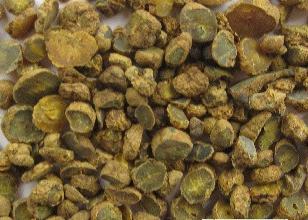
Properties: Pungent, bitter, warm
Meridans Entered:
Primary: Liver, Spleen
Traditional Actions/Indications:
- Invigorates the Blood, regulates Qi and alleviates pain
Chest and rib-side pain
pain in stomach duct and abdomen, gastrointestinal spasm
neuralgia
Amenorrhea and dysmenorrhea, postpartum stasis stagnation abdominal pain
Neuralgia
Painful swelling from knocks and
falls
- Promotes sleep
Insomnia
Suggested Daily Dosage: 3-10g in decoction.
Cautions: Avoid in pregnancy.
Notable Constituents:
- Dehydrocorybulbine (DHCB)
Alkaloid that binds to D1 dopamine receptors, that may be responsible for alleviating neuropathic pain.
- Berberine
Alkaloid with antibiotic, anti-fungal, antidiarrheal, antilipemic, hypoglycemic and antioxidant properties. It also functions as a potassium channel blocker and an antineoplastic agent, among other things. It is slowly soluble in water.
- Palmatine
Berberine alkaloid also found in Coptis (Huang Lian) and Goldenthread (Berberis).
- Tetrahydropalmatine
Berberine alkaloid which is palmatine with two hydrogen molecules attached. It is a dopamine antagonist that has been synthesized as Levo-tetrahydropalmatine (Levo-THP) and marketed as an alternative to anxiolytic and sedative drugs of the benzodiazepine group and analgesics such as opiates. It is also under investigation for the treatment of schizophrenia.
- Corydaline
Acetylcholinesterase inhibitor preventing breakdown of acetylcholine, thereby increasing its level and duration.
- Protopine
Dibenzazecine that inhibits histamine H1 receptors and platelet aggregation, and acts as an analgesic. Also found in opium poppies and greater celandine, both toxic plants, making this the safest source.
- Glaucine
Aporphine alkaloid bronchodilator and anti-inflammatory through blocking calcium channels in bronchial smooth muscles, D1 dopamine receptor antagonist and a weak PDE4 inhibition effect.
- Chelerythrine
Benzophenanthridine alkaloid with roles as a protein kinase C inhibitor, an antibacterial agent and an antineoplastic agent.
- Allocryptopine
Dibenzazecine alkaloid
Notes:
延胡索 Yan Hu Suo refers to Corydalis yanhusuo, while the other accepted species are:
C. ambigua : 东北延胡索 Dong Bei Yan Hu Suo
C. glaucescens : 新疆元胡 Xin Jiang Yuan Hu
C. repens : 全叶延胡索 Quan Ye Yan Hu Suo
C. ternata : 三裂延胡索 San Lie Yan Hu Suo (official species in Korean pharmacopoeia)
C. turtschaninovii : 齿瓣延胡索 Chi Ban Yan Hu Suo
Appears in 20 formulae listed on this site: (click to display)
An Zhong San (Calm the Middle Powder)
From: Formulary of the Pharmacy Service for Benefiting the People of the Taiping Era by Tai Yi Ju (Imperial Medical Bureau) (1107)
Da Chang Tu Shi Chen Liao Yang Cao Yao Fang (Large Intestine Rabbit Time Recuperative Herbal Prescription)
From: Treatise on Armament Technology by Mao Yuanyi (1621)
Dang Gui Yan Hu Jiu (Tangkuei and Corydalis Wine)
From: Chinese Medicinal Wines and Elixirs (2008) by Various
Ge Xia Zhu Yu Tang (Drive Out Stasis from Below the Diaphragm Decoction)
From: Correction of Errors Among Physicians by Wang Qing-Ren (1830)
Jia Wei Wu Yao Tang (Augmented Lindera Decoction)
From: Fine Formulas of Wonderful Efficacy (1470)
Jin Ling Zi San (Melia Toosendan Powder)
From: Formulary of the Pharmacy Service for Benefiting the People of the Taiping Era by Tai Yi Ju (Imperial Medical Bureau) (1107)
Ju He Wan (Tangerine Seed Pill)
From: Formulas to Aid the Living by Yan Yong-He (1253)
Long Chi Qing Hun San (Dragon's Tooth Powder to Clear the Ethereal Soul)
From: Comprehensive Medicine According to Master Zhang (1695) by Zhang Lu-Yu / Shi-Wan
Niu Xi San (Achyranthes Powder)
From: Formulary of the Pharmacy Service for Benefiting the People of the Taiping Era by Tai Yi Ju (Imperial Medical Bureau) (1107)
Qing Yi Tang (Clear the Pancreas Decoction)
From: Integrated Chinese and Western Medical Treatment of the Acute Abdomen (1973)
Shao Fu Zhu Yu Tang (Drive Out Stasis from the Lower Abdomen Decoction)
From: Correction of Errors Among Physicians by Wang Qing-Ren (1830)
Shou Nian San (Pinch Powder)
From: Essential Teachings of Dan-Xi by Zhu Dan-Xi (1732)
Sun Shang Yao Jiu (Detriment and Damage Wine)
From: Chinese Medicinal Wines and Elixirs (2008) by Various
Yan Hu Suo Er Hao (Corydalis Formula 2)
From: Anhui University School of Medicine by Anhui University School of Medicine (1990)
Yan Hu Suo San (Corydalis Powder)
From: Formulas to Aid the Living by Yan Yong-He (1253)
Yan Hu Suo Tang (Corydalis Decoction)
From: Formulas to Aid the Living by Yan Yong-He (1253)
Yan Hu Suo Yi Hao (Corydalis Formula 1)
From: Anhui University School of Medicine by Anhui University School of Medicine (1990)
Yuan Hu Zhi Tong Pian (Corydalis Pain Relief Tablets)
From: Pharmacopoeia of Chinese Medicine. Vol. 1 by People's Republic of China (2000)
Zhe Chong Yin (Drink to Turn Back the Penetrating Vessel)
From: Formulas from the Discussions on Women's Precious Delivery (1851)
Zi Jing Wu Jia Jiu (Redbud and Acanthopanax Wine)
From: A+ Medical Encyclopedia (2011)
Research Links & References: (click to display)
Research Links:
Reference Notes:
Individual herb information has sourced mainly from TCM Wiki and American Dragon for basic data and then updated manually with my own notes. Zhou, Xie and Yan (2011): Encyclopedia of Traditional Chinese Medicines, Vol. 5, and A+ Medical Encyclopaedia have been used for entries not available from those sources with additional material searched for and filled in where available. Western herbs not appearing in the Chinese literature have used Ross (2010): Combining Western Herbs and Chinese Medicine: A Clinical Materia Medica, White Rabbit Institute of Healing and therapeutika.ch. Choices of which source to use or combine have been my own.
These pages are intended to assist clinicians and are not intended for self-diagnosis or treatment for which a qualified professional should be consulted. Actions and indications are taken from traditional uses and do not necessarily reflect the evidence base which should be researched independently. Dosages are for guidance only and will vary dependening on the potency of the batch and the tolerance of the individual so should be evaluated by a professional based on individual needs.