 |
Location Guides: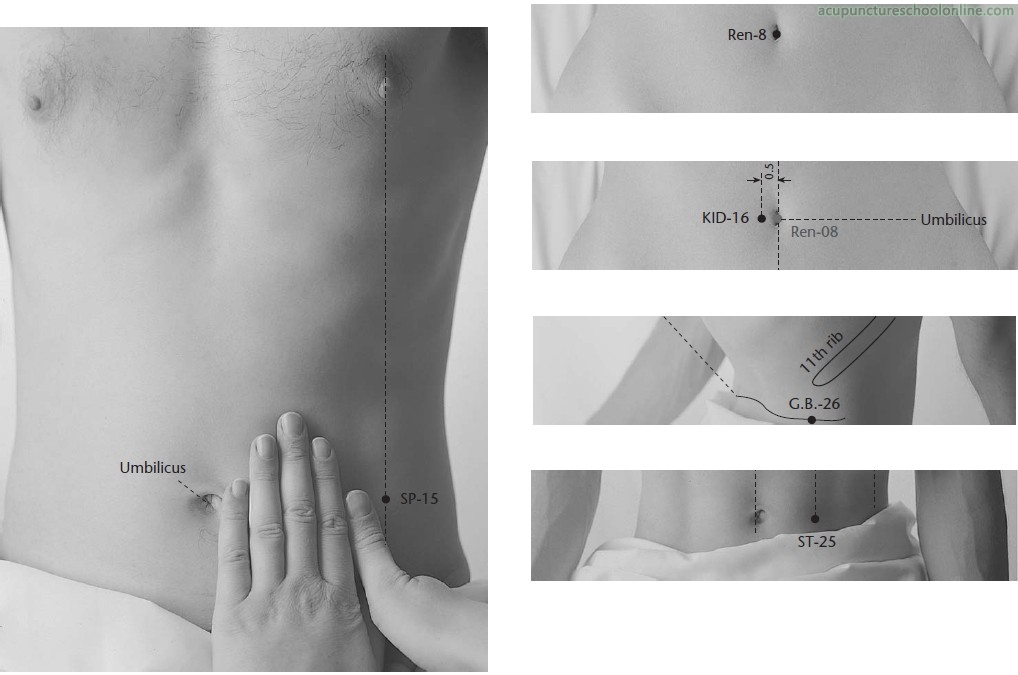 |
Meeting of Spleen with Yin Wei Mai and Dai Mai
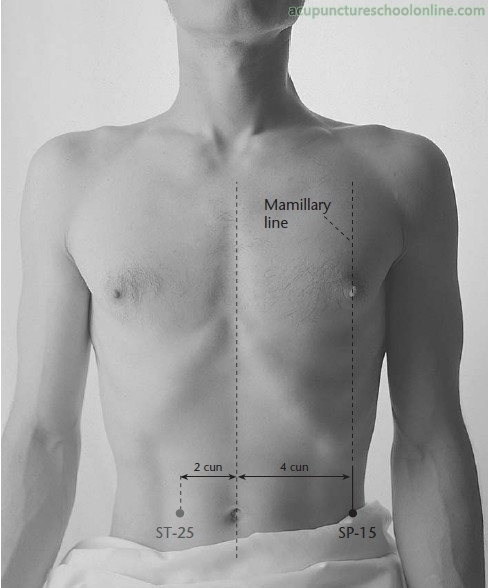
On the abdomen, in the depression at the lateral border of the rectus abdominis muscle, 4 cun from the midline, level with the umbilicus.
Perpendicular insertion 0.5 - 1 cun.
In thin patients, deep needling may penetrate the peritoneal cavity. Deep needling at this point may penetrate a substantially enlarged spleen or liver.
"The Taiyin usually has much Qi and little Blood" (Su Wen 素問 ch. 24) implying this channel should normally be needled.
"The foot Taiyin is to be pierced 3 fen deep and remain inserted for four exhalations" (Ling Shu 靈樞 ch. 12).
"It is needled to a depth of seven fen and moxaed with five cones" (Huangfu Mi 皇甫謐, 3rd Century, Zhenjiu Jiayi Jing 針灸甲乙經).
Moves Qi and regulates the Intestines
Superficial Innervation: Lateral cutaneous thoracic nerve from T11
Dermatome Segment: T11
Striking this point can cause instant diarrhoea and great nausea but is too well protected by the external obliques to strike easily, especially on a trained opponent (Montaigue, Dim Mak Locations, Taijiworld.com).
Classical texts such as the Nei Jing and Ling Shu which considered the Dai mai as simple a circle around the waist, would include this as a point on the Dai mai, along with others level to Shenque Ren-8 and Mingmen Du-4 instead of the traditional points (Yuen, 2005, The Eight Extraordinary Vessels).
横 "Horizontal" comprises of the characters for Wood and Yellow, the colour associated with Earth, suggesting a role in imbalances of Wood and Earth. This also happens to be the horizontal line on the traditional 5 element pentagram showing the controlling Ko cycle. Other meanings can imply cutting across or going against the grain such as "unreasonable, perverse, unexpected" which may also support this.
Daheng is also a homonym for 大恆 "Great Constant" which is the name used for Taiji in the early silk manuscript of the I Ching found in the Mawangdui tombs, from 168 BC (Adler, J.A., 2012, On Translating Taiji).
Heng 恆 is a classical Chinese philosophical expression method that maintains the dynamic balance of nature. Heng is the unified state of Yu and Wu. Heng is defined as "Yu and Wu produce each other 有無相生; difficult and easy complement each other" (Chapter 2), which is the mutual generation of Yu and Wu without dividing them into two opposites.
Neither Yu nor Wu is true; they are merely names 名. What can truly represent the Tao is Heng Yu or Heng Wu, meaning both contain Yu and Wu, which is non-dualism of Yu and Wu. If there is too much Wu. balance it with a bit more Yu; if there is too much Yu, balance it with a bit more Wu. The Tao cannot be discussed in terms of Yu and Wu; it must be discussed using Heng. Among them, the Tao Te Ching serves to return to the essence. "Reversal is the movement of the Tao" (Chapter 40), and "Truthful words seem reverse" (Chapter 78) — taking the reverse and returning to the essence Heng by adding the opposite.
The greatest contribution of the Mawangdui Silk Texts (pre-168 BCE) is the use of Heng as the essence. Later, the received version was changed to Chang 常, causing traditional Taoism to lose Heng. When we restore the meaning of Heng, the logic of the "Philosophy of Heng Tao" emerges in the first chapter of the Tao Te Ching, placing the Tao Te Ching on par with world thought.
Wang, WL (2026). The New Tao Te Ching and New Logic of Tao philosophy.
In nine palaces abdominal acupuncture, this point is located in the region associated with ☳ Zhen, Thunder, the east and the Liver and Gallbladder organs on the right; and ☱ Dui, Lake, the west and the Lung and Large Intestine on the left (Schelbert, 2014, Ryan, 2009).
In Tibetan medicine:
Moxa point (AMNH, Tibetan Medical Paintings)
In Thai massage:
Point along the Sahatsarangsi (left) and Tawaree (right) sen lines ascending up the outer leg to the abdomen and chest (Salguero & Roylance, 2011, Encyclopedia of Thai Massage)
Basic information on location, needle depth, TCM actions, indications and combinations is taken from Deadman et al (2001): A Manual of Acupuncture with additional anatomical information researched by reference to Gray's Anatomy (38th Ed., 1995) unless otherwise referenced. Images were found on acupunctureschoolonline.com and can be traced back to Claudia Focks (2008) Atlas of Acupuncture originally. I cannot claim any credit or rights over them. Other sources should be quoted in the text.
For some of the more unusual terms I have created a glossary here
Woodley Bioenergetics
90 Deane Croft Road,
Eascote, Pinner, Greater London. HA5 1SP
Tel/WhatsApp: +44 (0) 7946 174 829
Email: steve@steve-woodley.co.uk