 |
Location Guides: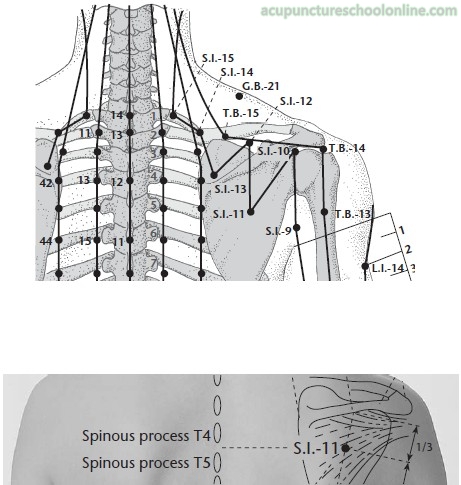 |
Binding point of the foot Taiyang Sinews
Trigger point (Travell & Simons, 1998, Trigger Point Manual)
Meeting of Small Intestine with Large Intestine and San Jiao and Gall Bladder
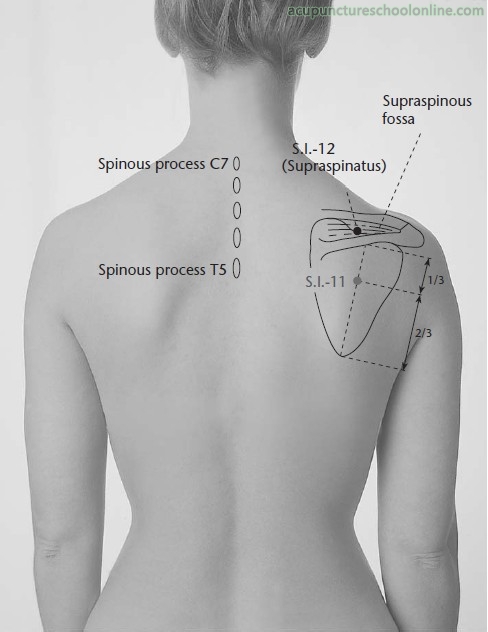
In the centre of the suprascapular fossa, directly above Tianzhong S.I.-11, in a depression formed when the arm is raised.
Oblique medial insertion towards the spine 0.5 - 1 cun
Deep perpendicular insertion, especially in this patients, carries a substantial risk of inducing a pneumothorax
"The Taiyang usually has much Blood and little Qi" (Su Wen 素問 ch. 24) implying this channel should normally be bled.
"The hand Yin and Yang receive their Qi via nearby paths so their Qi arrive swiftly. The depth of piercing must not exceed 2 fen and must not remain inserted for longer than one exhalation" (Ling Shu 靈樞 ch. 12).
"Locate it with the" (patient’s) arm raised. It is needled to a depth of five fen, and is moxaed with five cones" (Huangfu Mi 皇甫謐, 3rd Century, Zhenjiu Jiayi Jing 針灸甲乙經).
Expels Wind and benefits the shoulder and scapula
Superficial Innervation: Suprascapular nerve from C5 - C6
Dermatome Segment: C4
Muscle:
Supraspinatus
Pain Referral Pattern:
To lateral aspects of shoulder and elbow, with spillover across top of shoulder and all down lateral and radial aspects of the arm
Indications:
Pain of shoulder, especially on abduction of arm
If struck quite hard, this point will cause an energy rush to the head which can result in knock out. There will be a sickly feeling in the upper body for some time afterwards. The scapular can be knocked out of position with tendon damage as well (Montaigue, Dim Mak Locations, Taijiworld.com).
One of the 18 tender spots used in the diagnosis of fibromyalgia (Wang, Acupuncture and Traditional Chinese Medical Approaches for Fibromyalgia, Acupuncture Today, vol.6 no.3, 2005).
This point is part of a group of seven on the Small Intestine channel which trace the Big Dipper constellation over the shoulder (Kim, 2020). This point would be equivalent to Megrez (天权 Tianquan, Celestial Authority).
Alternatively, since there is already a point named 天樞 Tianshu St-25 on the front of the body, which may represent a set of points correlating to the Big Dipper, this set of points on the back may correlate to the Little Dipper instead which was known in the Han dynasty as 勾陳七星 Gouchen Qixing, the seven stars of the god Gou Chen ("Old Hook"). This point would be ζ-Ursae Minoris (勾陳四 Gou Chen Si, "Old Hook Four").
Basic information on location, needle depth, TCM actions, indications and combinations is taken from Deadman et al (2001): A Manual of Acupuncture with additional anatomical information researched by reference to Gray's Anatomy (38th Ed., 1995) unless otherwise referenced. Images were found on acupunctureschoolonline.com and can be traced back to Claudia Focks (2008) Atlas of Acupuncture originally. I cannot claim any credit or rights over them. Other sources should be quoted in the text.
For some of the more unusual terms I have created a glossary here
Woodley Bioenergetics
90 Deane Croft Road,
Eascote, Pinner, Greater London. HA5 1SP
Tel/WhatsApp: +44 (0) 7946 174 829
Email: steve@steve-woodley.co.uk