 |
Location Guides: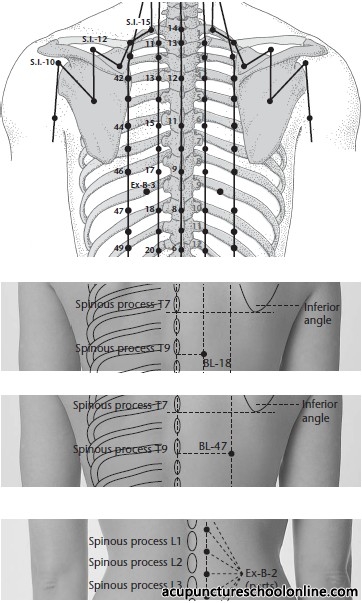 |
Master Tung's Five Mountain Ranges
Master Tung's Behind the Heart points
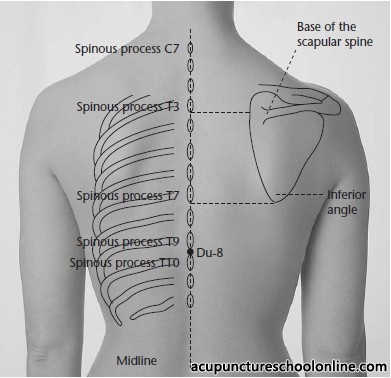
On the midline of the back, in the depression below the spinous process of the ninth thoracic vertebra (T9).
Oblique superior insertion 0.5 - 1 cun, or transverse inferior insertion up to 6 cun in "xiangwei needling" to connect with Zhongshu Du-7, Jizhong Du-6 and Xuanshu Du-5.
The spinal canal lies between 1.25 and 1.75 cun deep to the skin surface, varying according to body build.
"Bend (the patient’s head forward) to locate it. It is needled to a depth of five fen and moxaed with three cones" (Huangfu Mi 皇甫謐, 3rd Century, Zhenjiu Jiayi Jing 針灸甲乙經).
Soothes the Liver, pacifies Wind and relieves spasm
Calms the Shen
Superficial Innervation: Medial branches of dorsal rami of T9
Dermatome Segment: T9
This is one of the eight striking points in Northern Praying Mantis Kung Fu. These are the nonfatal areas on an attacker's body that can be struck when just defending or wanting to defeat an attacker. Described as "The point on the center of the back" although the diagram shows it much higher, around this point (Olson, 2010, The Complete Guide to Northern Praying Mantis Kung Fu). Wong Honfan (1946) simply says "[the sutures of] the spine" implying all the Du points from Du-3 to Du-14 (Ravenswood Academy, 2020, The Eight Forbidden Strikes of Praying Mantis Fist). However Zhongwu Sports considers it to be at the base of the scapula, at Bl-46 (Zhongwu Sports, 2018, Chinese martial arts "eight hits and eight don't hits"). Arguably this makes most sense as damage to the spine will lead to severe disability or death so hardly seems appropriate for non-lethal situations. The literal translation of "Beihou Gu Feng" is "back bone sutures" and not one of the usual terms for spine such as "Ji" so most likely indicates any of the joins where the ribs connect to the spine or where the scapula is anchored.
See Montaigue, Dim Mak Locations, Taijiworld.com for explanation of effects.
This point is also on the 3rd trajectory of the Chong mai connecting the Chong with the Du for Invigorating Yang in cases of Bi Obstruction due to Blood Stagnation (Yuen, 2005, The Extraordinary Vessels).
From Yuen's school, this point along with Yinjiao Ren-7, relate to the Sixth Level of Manifestation of the Soul (Po).
The sixth Po is related to the spiritual evolution of the Heart and compassion. After overcoming life's difficulties one is capable of truly understanding others, experiencing empathy but also returning to oneself. It transcends judgement and dialectics like right-wrong, good-bad. Obstruction at this level causes inability to understand others and empathise, constantly criticising others and society in all their aspects.
Treatment typically involves the Po Activation points Changqiang Du-1 and Jiuwei Ren-15 which are the Luo of the Ren and Du channels, accessing emotion at the level of the Jing, followed by the points associated with the particular level of blockage.
Berardinis & Navarra (2017). The succession of Po in the ladder of life. https://www.acupuncturesida.com/The-succession-of-Po-in-the-ladder-of-life.aspx
In "xiangwei needling" the Du is needled transversely against the direction of the channel in order to reduce excess conditions, in this case in disorders of the Liver, Gallbladder, Stomach, Spleen and back (Liu Yan, 2008, Diagrams of Acupuncture Manipulations, p.121).
Ling Shu Ch. 26, On Miscellaneous Diseases, advises pressing this point, piercing abd then pressing again for pain in the Heart. If it does not end immediately the spine is palpated up or down to find a new point and this is pierced.
In Master Tung's system this point is one of the five mountain ranges (Wu Ling). They consist of five sets of points in three lines representing the phases of the Wu Xing in a series of lines:
The first set is along the midline, below each vertebrae from T2 to T11. From T2 to T8 relate to Fire, T9 to T11 relate to Earth.
The second set is 3 cun from the midline. from T2 to T9. From T2 to T6 relate to Metal, T7 to T9 relate to Wood.
The third set is 6 cun from the midline from T2 to T8. From T2 to T4 relate to Metal, T5 to T8 relate to Wood.
They are indicated for fever, common cold, hypertension, headache, lumbar pain, numbness of the hands and feet, hemiplegia, acute stomachache, vomiting or acute enteritis by releasing heat, wind and stagnation from the organs relating to their phase and treated with a pricking method to release a drop of blood (McCann, 2014, Pricking the Vessels).
Tung's Behind the Heart (Hou Xin or Bei Xin) points are located under spinous processes from T4 to T9, 1.5 cun laterally to T4 to T7 and 3 cun laterally from T4 to T6. They are indicated for "wool like furuncles", clove sores, weakness and debility of the Heart zang, Stomach diseases, acute heart disease leading to numbness and paralysis, wind-cold entering the interior, severe wind-cold, stroke, externally contracted diseases that manifest with papules. They clear heat from the Heart and Lung and release the exterior so are useful in dermatological disorders (ibid.).
Tung's prick to bleed technique may make greater sense than regular needles as shallow depth without retention may be safer over the spine and lungs and the larger gauge used may provide better stimulation to this relatively insensitive area.
In Tibetan medicine:
Edelweiss flowers are burnt in cones like moxa over crushed garlic at this point as a gall bladder point to relieve indigestion, yellow eyes, jaundice, gallstones, loss of appetite, constant headaches and lack of digestive heat (Bradley, 2000: Principles of Tibetan Medicine)
Basic information on location, needle depth, TCM actions, indications and combinations is taken from Deadman et al (2001): A Manual of Acupuncture with additional anatomical information researched by reference to Gray's Anatomy (38th Ed., 1995) unless otherwise referenced. Images were found on acupunctureschoolonline.com and can be traced back to Claudia Focks (2008) Atlas of Acupuncture originally. I cannot claim any credit or rights over them. Other sources should be quoted in the text.
For some of the more unusual terms I have created a glossary here
Woodley Bioenergetics
90 Deane Croft Road,
Eascote, Pinner, Greater London. HA5 1SP
Tel/WhatsApp: +44 (0) 7946 174 829
Email: steve@steve-woodley.co.uk