 |
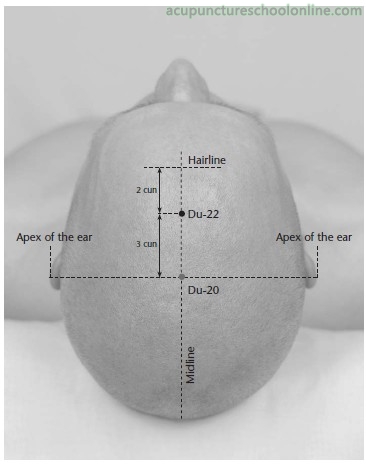
Location Guides: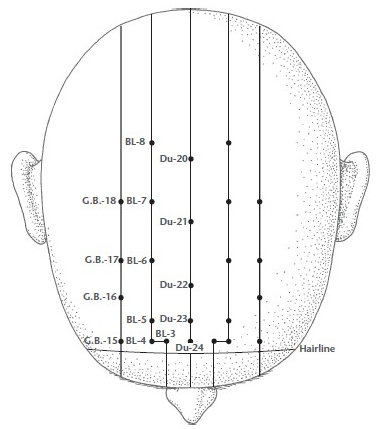 |
One of the "59 piercings" for clearing Heat in Su Wen Ch. 61 and Ling Shu Ch. 23
At the top of the head on th emidline, 2 cun posterior to the anterior hairline.
Transverse insertion 0.5 - 1 cun
This point should not be needled in infants whose fontanelle has not yet closed.
"It is needled to a depth of four fen and moxaed with five cones" (Huangfu Mi 皇甫謐, 3rd Century, Zhenjiu Jiayi Jing 針灸甲乙經).
Benefits the nose
Eliminates Wind and benefits the head
Superficial Innervation: CN V1 ophthalamic branch of trigeminal
Dermatome Segment: CN V1 ophthalamic branch of trigeminal
One of the 36 vital points of Feng Yiyuan 馮一元 listed in the Wu Bei Zhi 武備志 (Treatise on Armament Technology) by Mao Yuanyi 茅元儀 (1621). Also listed in Article 21: Delayed Death Touches with Twelve-Hour (Shichen 時辰) Diagrams. This point along with Qinglengyuan SJ-11, Huiyin Ren-1 and Ququan Liv-8 are associated with Mao 卯 Rabbit (5-7 am) and if struck during this time is said to cause death within 1 day from trauma to the anterior ethmoidal artery and cranial nerve at the frontal fontannel. Along with Xiyangguan GB-33 and Weizhong Bl-40 it is associated with Wu 午 Horse (11 am - 1 pm) and if struck during this time is said to cause indefinite paralysis. In Article 24: Bronze Man Statue, which divides the body into zones associated with the Twelve-Hour branches (Shichen 時辰) going from top downwards, this point is the anterior vital point of Zi 子 Rat (11 pm - 1 am) and considered most vulnerable to a hammer fist strike during this time (McCarthy, 2016, Bubishi: The Classic Manual of Combat).
See Montaigue, Dim Mak Locations, Taijiworld.com for explanation of effects.
The "59 piercings" are named in the Su Wen Ch. 61 and mentioned in Su Wen Ch. 32 for treating Heat diseases. This point along with Shangxing Du-23, Qianding Du-21, Baihui Du-20 and Houding Du-19 clear Heat from counterflow in the Du channel.
Ling Shu Ch. 24, On Counterflow Diseases, seems to employs this set of points in treating headache, dizziness and heaviness of the head. It advises draining from the five points on each of the five channels on the top of the head, including this point, followed by the hand Shaoyin and then foot Shaoyin.
This point along with Baihui Du-20, Qianding Du-21, Shangxing Du-23, Shenting Du-24 and Yintang connect with the frontal brain concerned with differentiation of experiences and is associated with the Liver, Pericardium and Yang channels (Yuen, 1995, The Curious Organs, taken from class notes by Avi Magidoff).
The word for fontanelle (囟 Xin) in this point's name is a homophone for Heart (心 Xin), suggesting the meeting of the sovereign (the highest Yang at Baihui Du-20) with his ministers and reflected in this point's indication for fright palpitations. Hence, among the Du Mai points of the head, this point is associated with the Ministerial Fire element and Pericardium / San Jiao.
In Tibetan medicine:
Moxa point (AMNH, Tibetan Medical Paintings)
Basic information on location, needle depth, TCM actions, indications and combinations is taken from Deadman et al (2001): A Manual of Acupuncture with additional anatomical information researched by reference to Gray's Anatomy (38th Ed., 1995) unless otherwise referenced. Images were found on acupunctureschoolonline.com and can be traced back to Claudia Focks (2008) Atlas of Acupuncture originally. I cannot claim any credit or rights over them. Other sources should be quoted in the text.
For some of the more unusual terms I have created a glossary here
Woodley Bioenergetics
90 Deane Croft Road,
Eascote, Pinner, Greater London. HA5 1SP
Tel/WhatsApp: +44 (0) 7946 174 829
Email: steve@steve-woodley.co.uk