|
Location Guides: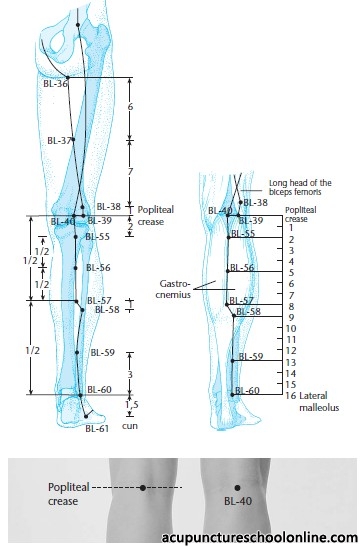 |
Trigger point (Travell & Simons, 1998, Trigger Point Manual)
On the lower leg, 2 cun inferior to Weizhong Bl-40, on the line connecting Weizhong Bl-40 and Chengshan Bl-57, in the depression between the two heads of the gastrocnemius muscle.
Perpendicular insertion 1 - 1.5 cun
"The Taiyang usually has much Blood and little Qi" (Su Wen 素問 ch. 24) implying this channel should normally be bled.
"The foot Taiyang is to be pierced 5 fen deep and remain inserted for seven exhalations" (Ling Shu 靈樞 ch. 12).
"It is needled to a depth of six fen and moxaed with five cones" (Huangfu Mi 皇甫謐, 3rd Century, Zhenjiu Jiayi Jing 針灸甲乙經).
Activates the channel and alleviates pain
Stops uterine bleeding and treats pain of the genitals
Superficial Innervation: Posterior cutaneous nerve of the thigh (S1 - S3)
Dermatome Segment: S2
Deeper Structures: Tibial nerve (L5 - S2)
Muscle:
Gastrocnemius, soleus and popliteus (deep)
Location Notes:
Gastrocnemus trigger points may be found all around this point in the upper part of the gastrocnemus muscle.
For popliteus point it may be useful to locate slightly medial to make sure you are on the muscle.
Pain Referral Pattern:
Gastrocnemus: Around point and across posterior calf to sole of foot
Soleus: To medial calf
Popliteus: To back of knee
Indications:
Calf strain and cramps (gastrocnemus)
; Tenderness in the heel (soleus)
; Diseases of the knee (popliteus)
See Montaigue, Dim Mak Locations, Taijiworld.com for explanation of effects.
In Tibetan medicine:
Moxa point (AMNH, Tibetan Medical Paintings)
Basic information on location, needle depth, TCM actions, indications and combinations is taken from Deadman et al (2001): A Manual of Acupuncture with additional anatomical information researched by reference to Gray's Anatomy (38th Ed., 1995) unless otherwise referenced. Images were found on acupunctureschoolonline.com and can be traced back to Claudia Focks (2008) Atlas of Acupuncture originally. I cannot claim any credit or rights over them. Other sources should be quoted in the text.
For some of the more unusual terms I have created a glossary here
Woodley Bioenergetics
90 Deane Croft Road,
Eascote, Pinner, Greater London. HA5 1SP
Tel/WhatsApp: +44 (0) 7946 174 829
Email: steve@steve-woodley.co.uk