 |
Location Guides: |
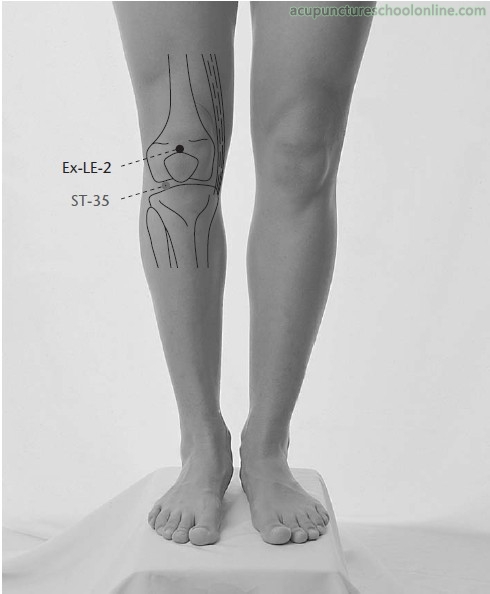
In the depression at the midpoint of the superior border of the patella.
Perpendicular insertion 0.5 - 1 cun
Activates Qi and Blood and benefits the knee joint
Superficial Innervation: Intermediate femoral cutaneous nerve of the thigh (L2 - L3)
Dermatome Segment: L3
This is one of the eight striking points in Northern Praying Mantis Kung Fu. These are the nonfatal areas on an attacker's body that can be struck when just defending or wanting to defeat an attacker. Described as "The points on top of the kneecaps" with the diagram showing it at this point (Olson, 2010, The Complete Guide to Northern Praying Mantis Kung Fu). Wong Honfan (1946) describes as "the soft tissue just below the kneecap" suggesting the Xiyan(Ravenswood Academy, 2020, The Eight Forbidden Strikes of Praying Mantis Fist) although a literal translation is "Crane's Knee Tiger Head" implying the whole knee joint and it's surrounding structures.
See Montaigue, Dim Mak Locations, Taijiworld.com for explanation of effects.
Important secondary point for treatment of the knee joint.
Lad and Durve (2008) in Marma Points of Ayurveda locate a point called the anterior Janu in the centre of the kneecap, between this point and the two Xiyan points. They associate it with the doshas: Vyana Vayu, Prana Vayu, Apana Vayu, Udana Vayu, Shleshaka Kapha, Kledaka Kapha and Avalambaka Kapha.
They give the following functions:
- Benefits the knees
- Promotes circulation
- Relieves pain locally
Another posterior Janu is located at Weizhong Bl-40.
Basic information on location, needle depth, TCM actions, indications and combinations is taken from Deadman et al (2001): A Manual of Acupuncture with additional anatomical information researched by reference to Gray's Anatomy (38th Ed., 1995) unless otherwise referenced. Images were found on acupunctureschoolonline.com and can be traced back to Claudia Focks (2008) Atlas of Acupuncture originally. I cannot claim any credit or rights over them. Other sources should be quoted in the text.
For some of the more unusual terms I have created a glossary here
Woodley Bioenergetics
90 Deane Croft Road,
Eascote, Pinner, Greater London. HA5 1SP
Tel/WhatsApp: +44 (0) 7946 174 829
Email: steve@steve-woodley.co.uk