 |
One of the "59 piercings" for clearing Heat in Su Wen Ch. 61
Meeting of Bladder with San Jiao Divergent
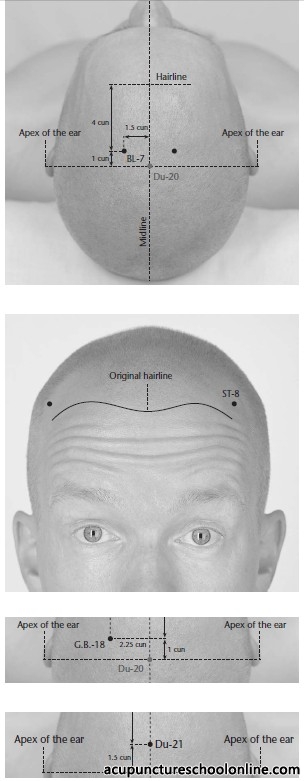
1.5 cun posterior to Chengguang Bl-6 and 4 cun within the anterior hairline, 1.5 cun lateral to the midline. More simply located 1 cun anterior and 1.5 cun lateral to Baihui Du-20.
Transverse insertion 0.5 -1 cun
According to several modern texts this point is contraindicated to moxibustion.
"The Taiyang usually has much Blood and little Qi" (Su Wen 素問 ch. 24) implying this channel should normally be bled.
"The foot Taiyang is to be pierced 5 fen deep and remain inserted for seven exhalations" (Ling Shu 靈樞 ch. 12).
"It is needled to a depth of three fen, (the needle) is retained for a duration of seven exhalations, and it is moxaed with three cones" (Huangfu Mi 皇甫謐, 3rd Century, Zhenjiu Jiayi Jing 針灸甲乙經).
Benefits and regulates the nose
Clears the head
Superficial Innervation: CN V1 ophthalamic branch of trigeminal
Dermatome Segment: CN V1 ophthalamic branch of trigeminal
A strike here can cause confusion and senselessness (Montaigue, Dim Mak Locations, Taijiworld.com).
The "59 piercings" are named in the Su Wen Ch. 61 and mentioned in Su Wen Ch. 32 for treating Heat diseases. This point along with Wuchu Bl-5, Chenguang Bl-6, Luoque Bl-8 and Yuzhen Bl-9 clear Heat from counterflow in the foot Taiyang Bladder channel.
Ling Shu Ch. 24, On Counterflow Diseases, seems to employs this set of points in treating headache, dizziness and heaviness of the head. It advises draining from the five points on each of the five channels on the top of the head, including this point, followed by the hand Shaoyin and then foot Shaoyin.
Yue Hanzhen attributes actions on Liver disorders to the points Bl-5 to Bl-8 (Yue, 17th Century, Explanation of Channels and Points Vol. 1, p.272-276). These points connect with the Liver because the Liver channel runs internally upwards to the vertex and connects to the eyes. In terms of indications, the main Liver symptoms associated with these points are eye and visual disorders, and dizziness from ascendant Yang, although Yue attributes these last symptoms to disorders of the Du Mai, with which the Taiyang is closely associated, both anatomically and functionally.
The points Bl-6 and Bl-7 also have indications for Lung disorders. The connection of the Bladder and Lung is that the Bladder is the most Exterior of the Channels while the Lung is the most Exterior Zangfu with both indicated for Exterior Wind invasions.
Like Chiengling GB-18, this point's indications for Wind-Cold disorders derive from its location on the vertex making it vulnerable to Cold descending from above (Yue, 17th Century, Explanation of Channels and Points Vol. 1, p.275).
In Tung acupuncture the point Zhou Lun (1010.04), Prefecture Elder, is located close to this point, 1.3 cun lateral and 1.5 cun posterior to Baihui Du-20. It is indicated for indicated for brain tumour, hemiplegia, asthma, fatigue and weakness of the limbs (eLotus, 2022).
The Ling Shu ch. 52 describes four Qi "Streets" (街 Jie, "street or market") on the head, chest, abdomen and shins. The Head Qi Street refers to the points located along the Bladder and Gall Bladder channel of the head and are said to have a special connection with the brain.
This point's indications for nasal symptoms and wheezing would make it a suitable candidate for the Bladder Qi Street point relating to the Lung and Large Intestine.
Basic information on location, needle depth, TCM actions, indications and combinations is taken from Deadman et al (2001): A Manual of Acupuncture with additional anatomical information researched by reference to Gray's Anatomy (38th Ed., 1995) unless otherwise referenced. Images were found on acupunctureschoolonline.com and can be traced back to Claudia Focks (2008) Atlas of Acupuncture originally. I cannot claim any credit or rights over them. Other sources should be quoted in the text.
For some of the more unusual terms I have created a glossary here
Woodley Bioenergetics
90 Deane Croft Road,
Eascote, Pinner, Greater London. HA5 1SP
Tel/WhatsApp: +44 (0) 7946 174 829
Email: steve@steve-woodley.co.uk