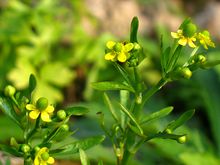
Properties: Cold, acrid, toxic
Meridans Entered:
Primary: Heart, Lung
Traditional Actions/Indications:
- Clears Heat, resolves Toxicity, disperses clumping, reduces swelling and alleviates pain
Swelling toxin of welling abscess
and boil (Crush fresh whole herb, squeeze out the juice and apply it to the affected area)
Chronic lower limb ulcers (Boil it into a paste and apply it to the affected area)
Scrofula (Take an appropriate amount of dried whole herb, boil it into a paste with oil and apply it)
Snake bites (Crush fresh whole herb, squeeze out the juice and apply it to the affected area)
- Stops Malaria (Nue)
Malaria (Take an appropriate amount of fresh whole herb, crush it, and apply it to the Dazhui Du-14 acupoint 6 hours before the onset of the disease)
Suggested Daily Dosage: Crushed and applied externally.
Cautions: Do not ingest. Ingestion may cause burning sensation in the mouth , followed by swelling , difficulty chewing , severe diarrhea , slow pulse, difficulty breathing , dilated pupils , and in severe cases, death.
Notable Constituents:
- Ranunculin
Unstable glycoside that turns into protoanemonin when crushed or chewed, becoming a powerful irritant that can cause cause severe blistering of the mouth and throat, intense abdominal pain, and digestive distress. Drying can reduce this for livestock in hay, but there is no verified or safe method to prepare buttercups for human ingestion. R. sceleratus has ~2.5% Protoanemonin (dry weight basis).
Notes:
Surprisingly the Shen Nong Ben Cao Jing places this in the upper medicinals and says:
"It treats wind, Cold and Damp related Bi obstructions and evil Qi in the Heart and abdomen; it disinhibits the joints; and stops vexation and fullness. Consumed over a long time, it lightens the body, brightens the eyes, and staves off ageing."
This may suggest it was either a different plant, or processed in a way to remove its toxicity with a method now lost to history.
Does not appear in any formulae listed on this site
Research Links & References: (click to display)
Research Links:
Reference Notes:
Individual herb information has sourced mainly from TCM Wiki and American Dragon for basic data and then updated manually with my own notes. Zhou, Xie and Yan (2011): Encyclopedia of Traditional Chinese Medicines, Vol. 5, and A+ Medical Encyclopaedia have been used for entries not available from those sources with additional material searched for and filled in where available. Western herbs not appearing in the Chinese literature have used Ross (2010): Combining Western Herbs and Chinese Medicine: A Clinical Materia Medica, White Rabbit Institute of Healing and therapeutika.ch. Choices of which source to use or combine have been my own.
These pages are intended to assist clinicians and are not intended for self-diagnosis or treatment for which a qualified professional should be consulted. Actions and indications are taken from traditional uses and do not necessarily reflect the evidence base which should be researched independently. Dosages are for guidance only and will vary dependening on the potency of the batch and the tolerance of the individual so should be evaluated by a professional based on individual needs.