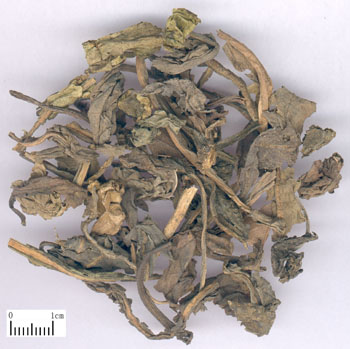
Properties: Bitter, pretty cold
Meridans Entered:
Primary: Lung, Stomach, Heart and Liver
Traditional Actions/Indications:
- Clears Heat and resolves Fire toxicity
Warm febrile disease, pneumonia
Epidemic outbreaks of Fire toxin that affects people regardless of their constitutions (severe contagious diseases)
Fire toxins anywhere in the body (Chuang Yang), especially the Lungs and throat
Often used for mouth ulcers and throat Bi
- Cools the Blood and dissipates maculae
Maculae or other skin eruptions due to Blood Heat
Gallbladder Heat
Often used in cases with intense fever, irritability and changes in consciousness
Hematemesis
Suggested Daily Dosage: 10-15g in decoction.
Notable Constituents: For a complete evaluation of indigo and its constituents, see
Yang et al. (2020) and
Sun et al., (2021).
- Indigotin
Hydroxyindole that gives indigo its characteristic colour. The natural leaves contain indican which is a colourless indolyl glucoside that dissolves in water, whereupon it is acted upon by bacteria that cleave the molecule to become the aglycone form indoxyl. This then reacts with oxygen to become indigotin which has a deep blue colour and is insoluable in water, enabling it to be filtered out.
- Indirubin
Indole alkaloid structural isomer of indigo dye that has been researched for the treatment of proliferative diseases such as cancer and psoriasis (Blažević et al., 2015). It has not yet approved for use but is in clinical trial stage as topical treatment of psoriasis. It has also been studied for use in ulcerative colitis (Sugimoto, Naganuma & Kanai, 2016).
It is often the byproduct of bacterial metabolism, responsible for "purple urine bag syndrome", when bacteria metabolise indoxyl sulfate found naturally in urine.
- Isoindigotin
Indole alkaloid structural isomer of indigo.
- Isatin
Indole derivative obtained by oxidation of Indigo dye with nitric acid and chromic acids. It is an active MAOI with dopaminergic properties (Justo et al., 2016) and is used to synthesise many drugs.
- Tryptanthrine
Organonitrogen heterocyclic compound, an organic heterotetracyclic compound and an alkaloid antibiotic.
- Taraxasterol
Pentacyclic triterpenoid phytosterol with anti-inflammatory properties.
- β-Sitosterol
Phytosterol with a role as a sterol methyltransferase inhibitor, an anticholesteremic drug and an antioxidant.
Appears in 4 formulae listed on this site: (click to display)
Research Links & References: (click to display)
Research Links:
Reference Notes:
Individual herb information has sourced mainly from TCM Wiki and American Dragon for basic data and then updated manually with my own notes. Zhou, Xie and Yan (2011): Encyclopedia of Traditional Chinese Medicines, Vol. 5, and A+ Medical Encyclopaedia have been used for entries not available from those sources with additional material searched for and filled in where available. Western herbs not appearing in the Chinese literature have used Ross (2010): Combining Western Herbs and Chinese Medicine: A Clinical Materia Medica, White Rabbit Institute of Healing and therapeutika.ch. Choices of which source to use or combine have been my own.
These pages are intended to assist clinicians and are not intended for self-diagnosis or treatment for which a qualified professional should be consulted. Actions and indications are taken from traditional uses and do not necessarily reflect the evidence base which should be researched independently. Dosages are for guidance only and will vary dependening on the potency of the batch and the tolerance of the individual so should be evaluated by a professional based on individual needs.