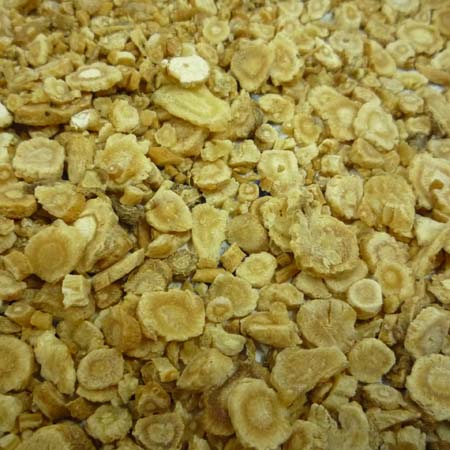
Properties: Sweet, slightly bitter, slightly cold
Meridans Entered:
Primary: Lung and Stomach
Suggested Daily Dosage: 10-30g in decoction.
Cautions: Antagonizing Li Lu.
Notes:
Analysis of the ancient script forms of 參 Shen suggest it is simplified from 曑 (晶 -> 厽) making an ideogrammic compound of 晶 ("stars") + 光 ("light; brightness") + 彡 ("light rays") meaning the Three Stars astrological mansion (referring to the three stars of Orion's belt in western astronomy at the centre of this constellation). 彡 also acts as a phonetic component. Its main meaning is "joining, merging, being a part of" suggesting the three stars making up a single constellation.
光 may also be interpreted as 卩 ("kneeling person"), representing someone looking at the shining stars above him or be the original character for 簪 a hairpin and thus someone with a ceremonial hat of stars.
參 also appears in the title of the famous alchemical text 參同契 Cantong Qi translated as The Seal of the Unity of the Three, or Joining as One with Unity, with 參 playing on the double meaning as "three" and "joined as one" where it refers to the unity of the cosmology of the Yi Jing, Daoism and internal alchemy (Pregradio, 2011, Seal of the Unity of the Three, p. 3).
These all suggest a great reverence for these herbs, which crosses into the cosmological, religious and self-cultivation realms, while also suggesting a completeness of these herbs in themselves. Herbs with 參 in their name may be used individually, without needing a formula to complement them.
Woodley Bioenergetics
90 Deane Croft Road,
Eascote, Pinner, Greater London. HA5 1SP
Tel/WhatsApp: +44 (0) 7946 174 829
Email: steve@steve-woodley.co.uk