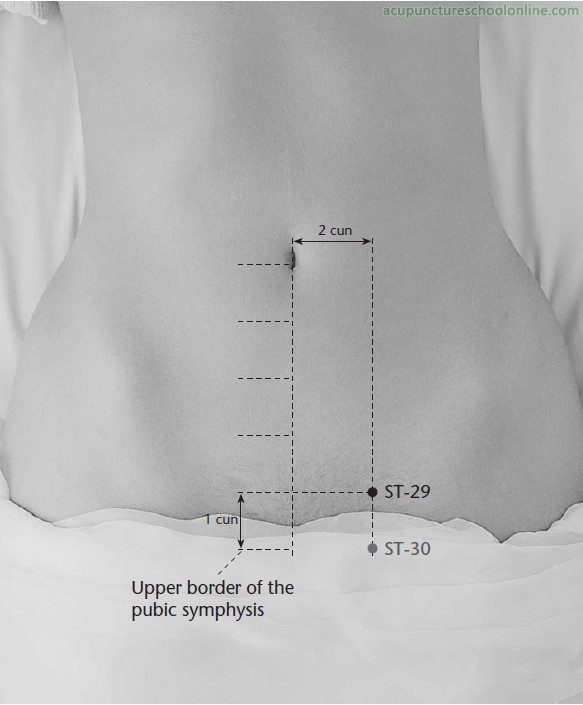
 |
Location Guides: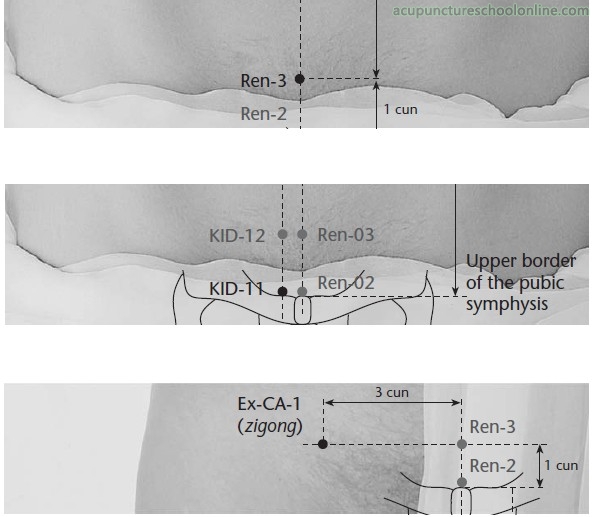 |
On the abdomen, 2 cun lateral to the midline and 4 cun inferior to the umbilicus, level with Zhongji Ren-3.
Perpendicular insertion 1 - 1.5 cun
Deep needling may penetrate the peritoneal cavity in thin subjects or a full bladder. Patients should empty the bladder before needling
"The Yangming usually has much Qi and much Blood" (Su Wen 素問 ch. 24) implying this channel can normally be needled or bled.
"The foot Yangming is to be pierced 6 fen deep and remain inserted for ten exhalations" (Ling Shu 靈樞 ch. 12).
"It is needled to a depth of eight fen and moxaed with five cones" (Huangfu Mi 皇甫謐, 3rd Century, Zhenjiu Jiayi Jing 針灸甲乙經).
Warms the Lower Jiao
Regulates menstruation and benefits the genital region
Superficial Innervation: Femoral branches of gentiofemoral nerves from L1
Dermatome Segment: L1
Striking this point will affect the circulation of Kidney Qi which in turn will affect the power of the whole body leading to a gradual loss of health. The immediate affect is a knock out by the action upon the genitals, hard enough will cause death (Montaigue, Dim Mak Locations, Taijiworld.com).
The Stomach Shu are a proposed set of points that complement the Breast Shu. They are level with the Chest Shu and Front Mu points on the abdomen and receive the Blood and Ying Qi created through the action of the Spleen and Lung, via the Breast Shu, to distribute among the Zangfu. Whereas the Back Shu and Chest Shu deliver Yang and Yin Yuan Qi through the Bladder and Kidney Channels to the Zangfu, these points are focused specifically on postnatal Qi.
This point would be associated with the Bladder, being in line with Zhongji Ren-3. Its indications have little to do with urinary function but instead seem to focus on the Bladder as the Yang of the Kidneys with infertility or impotence due to Cold, prolapse or seminal emission due to sinking Yang, or Shan (疝) Disorder due to Cold in the genital region.
Lad and Durve (2008) in Marma Points of Ayurveda locate a point slightly lateral to this (midway between Bhaga / Qugu Ren-2 and Lohita / Wushu GB-27) called Vankshana and associate it with the doshas: Apana Vayu, Vyana Vayu, Kledaka Kapha and Ranjaka Pitta.
They give the following functions:
- Regulates male and female reproductive organs
- Enhances circulation in pelvic organs
- Relieves local congestion and inflammation
- Regulates bladder sphincter and treats urinary dysfunction
In Tibetan medicine:
Moxa point (AMNH, Tibetan Medical Paintings)
Basic information on location, needle depth, TCM actions, indications and combinations is taken from Deadman et al (2001): A Manual of Acupuncture with additional anatomical information researched by reference to Gray's Anatomy (38th Ed., 1995) unless otherwise referenced. Images were found on acupunctureschoolonline.com and can be traced back to Claudia Focks (2008) Atlas of Acupuncture originally. I cannot claim any credit or rights over them. Other sources should be quoted in the text.
For some of the more unusual terms I have created a glossary here
Woodley Bioenergetics
90 Deane Croft Road,
Eascote, Pinner, Greater London. HA5 1SP
Tel/WhatsApp: +44 (0) 7946 174 829
Email: steve@steve-woodley.co.uk