 |
Location Guides: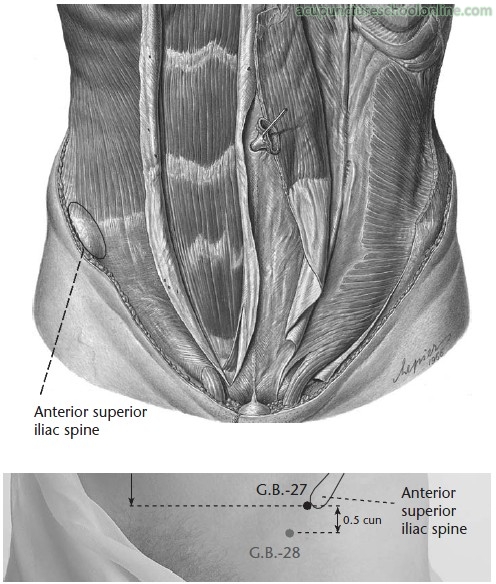 |
Meeting of Gall Bladder with Dai Mai
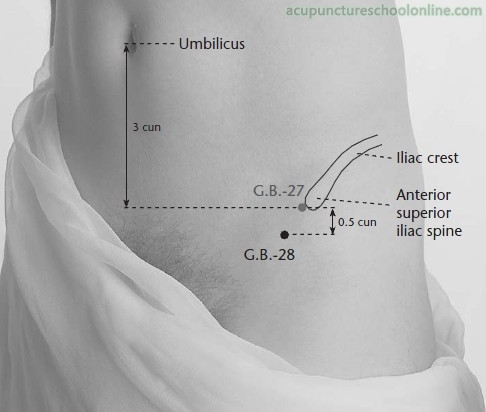
0.5 cun anterior and inferior to Wushu GB-27. The Systematic Classic locates it five cun and three fen below Camphorwood Gate (Liv-13).
Perpendicular insertion 1 - 1.5 cun
"The Shaoyang usually has little Blood and much Qi" (Su Wen 素問 ch. 24) implying this channel should normally be needled.
"The foot Shaoyang is to be pierced 4 fen deep and remain inserted for five exhalations" (Ling Shu 靈樞 ch. 12).
"It is needled to a depth of eight fen and moxaed with three cones" (Huangfu Mi 皇甫謐, 3rd Century, Zhenjiu Jiayi Jing 針灸甲乙經).
Regulates the Dai Mai
Regualtes the Lower Jiao and transforms stagnation
Superficial Innervation: Ilioinguinal nerve (L1)
Dermatome Segment: L1
See Montaigue, Dim Mak Locations, Taijiworld.com for explanation of effects.
Important point on the 胯 Kua (hip-groin functional musculoskeletal region) that facilitates the opening and closing of the hips.
This point is also on the 3rd trajectory of the Chong mai connecting the Chong with the Du (Yuen, 2005, The Eight Extraoridinary Vessels).
This point is chosen in preference over Wushu GB-27 in cases of Dai mai pathology where Yang has been lost presenting with Cold or Damp-Cold signs due to it being Yin's nature to descend and this point being a bit lower (ibid.).
維 more correctly translates as "maintaining, preserving, safeguarding" making 維道 translate as "preserving the Way" suggesting both the spiritual indications of the Dai Mai and Gallbladder as an Extraordinary Organ, and perhaps a connection to the Large Intestine, said by the Nei Jing to be "Transmitter of the Way" 傳道. These can be understood both spiritually and in terms of the function of the Large Intestine and Dai Mai to expel waste from the body, without which we end up holding on to and accumulating harmful things.
In Mayan medicine:
Used to treat painful growths without abscess (Garcia, Sierra, Balam, 1999: Wind in the Blood)
Basic information on location, needle depth, TCM actions, indications and combinations is taken from Deadman et al (2001): A Manual of Acupuncture with additional anatomical information researched by reference to Gray's Anatomy (38th Ed., 1995) unless otherwise referenced. Images were found on acupunctureschoolonline.com and can be traced back to Claudia Focks (2008) Atlas of Acupuncture originally. I cannot claim any credit or rights over them. Other sources should be quoted in the text.
For some of the more unusual terms I have created a glossary here
Woodley Bioenergetics
90 Deane Croft Road,
Eascote, Pinner, Greater London. HA5 1SP
Tel/WhatsApp: +44 (0) 7946 174 829
Email: steve@steve-woodley.co.uk