 |
Location Guides: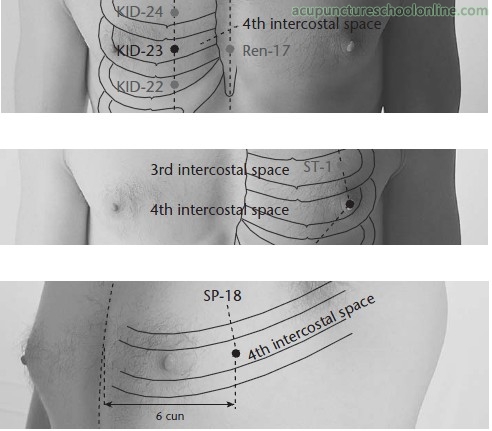 |
Trigger point (Travell & Simons, 1998, Trigger Point Manual)
Meeting of Gall Bladder with Bladder
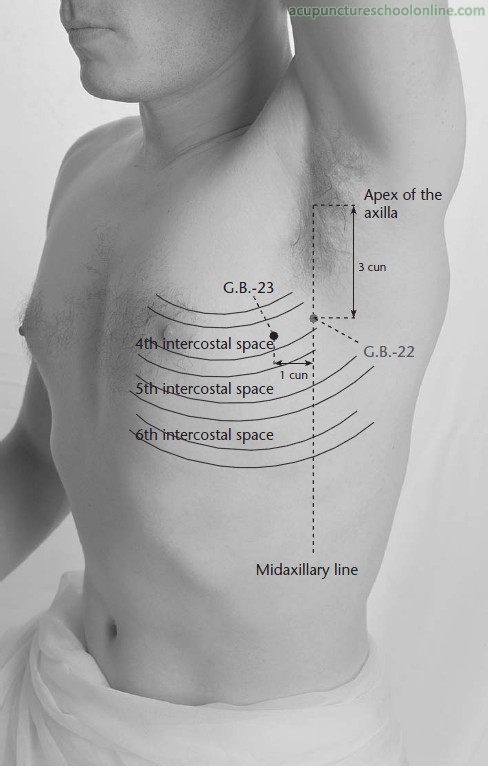
Below the axilla in the fifth intercostal space, 1 cun anterior to Yuanye GB-22, aproximately at the level of the nipple. Some sources locate this point in the fourth intercostal space. The Systematic Classic defines it as 3 cun below and 1 cun anterior to the axilla, on the border of the rib at the side without specifying a particular intercostal space.
Transverse-oblique insertion along the intercostal space 0.5 - 1 cun
Deep or perpendicular needling may induce a pneuomothorax.
"The Shaoyang usually has little Blood and much Qi" (Su Wen 素問 ch. 24) implying this channel should normally be needled.
"The foot Shaoyang is to be pierced 4 fen deep and remain inserted for five exhalations" (Ling Shu 靈樞 ch. 12).
"It is needled to a depth of six fen and is moxaed with three cones" (Huangfu Mi 皇甫謐, 3rd Century, Zhenjiu Jiayi Jing 針灸甲乙經).
Unbinds the chest and lowers rebellion
Regulates Qi in the three Jiao
Superficial Innervation: Lateral cutaneous thoracic nerve from T6
Dermatome Segment: T6
Muscle:
Intercostals
Location Notes:
Intercostals can produce trigger points anywhere in the intercostal space
Pain Referral Pattern:
Locally and towards the sternum. The more posterior the point the stronger its tendency to radiate pain to the front
Indications:
Aching pain exacerbated by deep inhalation and activities such as sneezing and coughing
See Montaigue, Dim Mak Locations, Taijiworld.com for explanation of effects.
Five Corpse Possession is a collection of five different disorders which can all be treated with either 14 cones of moxa at this point (left for men, right for women), 10 cones of moxa at Rugen St-18 or 7 cones of moxa at Shaoshang Lu-11 (Wang Zhizhong, 1220, Supplementing Life with Acupuncture and Moxibustion, Trans. Lu & Wilcox, 2014).
Basic information on location, needle depth, TCM actions, indications and combinations is taken from Deadman et al (2001): A Manual of Acupuncture with additional anatomical information researched by reference to Gray's Anatomy (38th Ed., 1995) unless otherwise referenced. Images were found on acupunctureschoolonline.com and can be traced back to Claudia Focks (2008) Atlas of Acupuncture originally. I cannot claim any credit or rights over them. Other sources should be quoted in the text.
For some of the more unusual terms I have created a glossary here
Woodley Bioenergetics
90 Deane Croft Road,
Eascote, Pinner, Greater London. HA5 1SP
Tel/WhatsApp: +44 (0) 7946 174 829
Email: steve@steve-woodley.co.uk